
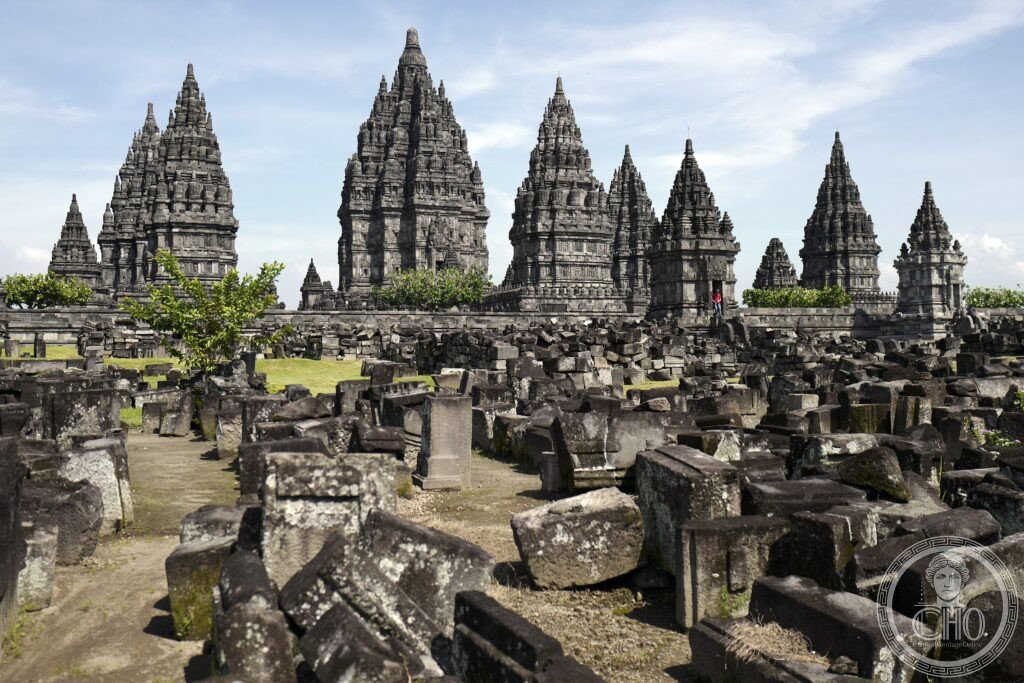
Prambanan Temple Compounds
The largest Hindu temple complex in Southeast Asia and one of the most dramatic achievements of ancient Javanese architecture — Prambanan (Sleman Regency, Yogyakarta, Indonesia; UNESCO WHS 1991) was built by the Sanjaya dynasty in the 9th century CE as the supreme expression of Shivaite Hinduism in the Malay world.
At a glance
Prambanan (the most precisely Prambanan single Sanjaya 856 CE Shivaite Hindu Rakai Pikatan three towers Trimurti Shiva 47m Vishnu Brahma 224 temples earthquake 1006 Java UNESCO heritage: the scale and the context: the complex (the Prambanan Archaeological Park covers approximately 40 hectares; the inner compound contains 3 main temples (Trimurti) + 3 smaller facing temples (Wahana) + 2 row temples + 4 corner towers, all within a large rectangular stone platform; the outer compound (the ruined perwara zone) originally contained 224 additional smaller temples in 4 concentric rows); the three towers (the three main shikhara-form towers (North Indian Nagara style adapted to Javanese stone carving): Shiva temple (47m; the central and tallest; inside: 4 niches contain 4 statues — the main image is the Mahakala Shiva (2.3m; still intact); the north niche contains Durga Mahishasuramardini (the most popular icon at Prambanan; known locally as Roro Jonggrang; associated with the legend of Prambanan’s founding); Brahma temple (37m; south; contains the Brahma statue) and Vishnu temple (37m; north; contains the Vishnu statue)); the Ramayana reliefs (the exterior of the 4 galleries of the Shiva and Brahma temples carry 63-metre-long narrative friezes of the Ramayana epic; 128 individual panels; the most complete and refined Ramayana sequence in Southeast Asian art) — the most precisely Prambanan single Sanjaya 856 CE Shivaite Hindu Rakai Pikatan three towers Trimurti Shiva 47m Vishnu Brahma 224 temples earthquake 1006 Java UNESCO heritage in any UNESCO world heritage site)).
Key facts
- The Ramayana Ballet: the most precisely Prambanan single Ramayana ballet open air performance July October full moon night Trimurti backdrop illuminated UNESCO heritage — the most spectacular open-air classical performance in Asia: the Sendratari Ramayana Ballet (performed at the open-air Trimurti Theatre adjacent to the main temple complex, with the illuminated Prambanan towers as the backdrop); the performances (July-October: full-moon nights (the largest show; approximately 200 dancers); also Saturday evening non-full-moon performances; the narrative (4 nights of performances present the complete Ramayana; an abbreviated 2-hour version on single nights shows the most important episodes: the exile of Rama, the abduction of Sita by Ravana, Hanuman’s burning of Lanka, and the final battle); the style (Yogyakarta classical dance: slow, precise, stylized hand and eye movements; the female dancers in full batik costume and golden headdress; the male performers in animal-mask costumes for the monkey army of Hanuman; the fire dancers are the visual climax (the performers of the fire scene literally dance through and over flames))
- GPS: 7.7520° S, 110.4914° E
History
Sanjaya versus Sailendra (the most precisely Prambanan single Sanjaya dynasty Rakai Pikatan 856 CE Mataram Sailendra rivalry Hindu Buddhist Medang kingdom earthquake 1549 Dutch 1811 Raffles excavation restoration 1937 1991 UNESCO heritage: the history: the Sanjaya-Sailendra rivalry (in the 9th century CE, Central Java was divided between two rival dynasties: the Buddhist Sailendra (builders of Borobudur, approximately 778-850 CE) and the Shivaite Hindu Sanjaya (Mataram kingdom)); the founding inscription (the Shivagrha inscription, dated 856 CE, records the completion of a great Shivaite temple by King Rakai Pikatan (Sanjaya dynasty) to celebrate the defeat of the Sailendra Buddhist faction; the inscription describes the original complex (which was larger than what survives today)); the abandonment (approximately 930-1006 CE; the seat of the Mataram kingdom moved to East Java; the temple was abandoned; a series of earthquakes in the 10th-11th centuries CE caused most of the smaller temples to collapse; a major earthquake (approximately 1006 CE, possibly 1549 CE) devastated the complex)); the Dutch and British period (the Dutch colonized Java from 1600 CE; the temples were known but largely unexcavated; when the British briefly controlled Java (1811-1816 CE), Raffles (again) documented the site but the main excavation and restoration was done by the Dutch archaeologist FDJ van Naerssen (1885 CE onward)); the 2006 earthquake (the Yogyakarta earthquake (May 27, 2006 CE; 6.4 magnitude) damaged several of the perwara temples (already partially restored) and the main temple facades; the ongoing restoration work continues) — the most precisely Prambanan single Sanjaya dynasty Rakai Pikatan 856 CE Mataram Sailendra rivalry Hindu Buddhist Medang kingdom earthquake 1549 Dutch 1811 Raffles excavation restoration 1937 1991 UNESCO heritage in any UNESCO world heritage site)).
What you see
The Shiva tower interior and Roro Jonggrang (the most precisely Prambanan single Shiva temple interior Mahakala Durga Roro Jonggrang legend Agastya Ganesha Vishnu Brahma Ramayana bas-relief gallery UNESCO heritage: the visitor highlights: the Shiva temple interior (ascending the main staircase of the 47m Shiva tower (steep, uncovered stone steps; handrails added for safety); the main cella containing the 2.3m Mahakala Shiva statue (still considered sacred; offerings left by worshippers); the four niches: the north niche containing the Durga/Roro Jonggrang statue (the most photographed piece at Prambanan; the goddess stands with 8 arms, each holding a different weapon; she stands on top of the head of a buffalo-demon; the popular legend holds that this is a princess named Roro Jonggrang who was turned to stone as punishment for refusing to marry Bandung Bondowoso, the man who built the 1,000 temples of Prambanan in a single night; the south niche containing Agastya (the sage Shiva guru); the east niche containing Ganesha)); the Ramayana gallery reliefs (the exterior walkway around the lower gallery of the Shiva temple: 52 large panels of the Ramayana frieze, each approximately 60 × 80 cm; extraordinarily refined low-relief carving; the panels run clockwise from the east entrance staircase)); the Vahana temples (directly opposite each main tower: the Nandi temple (the bull of Shiva), the Garuda temple (the bird-vehicle of Vishnu), the Hamsa temple (the swan of Brahma)) — the most precisely Prambanan single Shiva temple interior Mahakala Durga Roro Jonggrang legend Agastya Ganesha Vishnu Brahma Ramayana bas-relief gallery UNESCO heritage in any UNESCO world heritage site)).
Practical information
- Getting there: 17 km east of Yogyakarta city center (40 min by taxi, IDR 100,000-150,000; or public bus from Malioboro); TransJogja bus route 1A from Malioboro (IDR 3,500; 50 min); Yogyakarta International Airport (YIA) is 40 km west of the city; Adisutjipto Airport (JOG) is 7 km east of the city center and only 10 km from Prambanan); the site is on the direct Yogyakarta-Solo road (an easy combined day trip: visit Prambanan in the morning and continue to Solo for the afternoon); entry fees (approximately USD 18 for foreigners; open 06:00-17:00 daily; the Ramayana Ballet has separate tickets (USD 20-100 depending on seat and performance type; book via the official website in advance for the July-October full-moon shows)
Getting there
Yogyakarta (JOG/YIA). 17 km east. 40 min by taxi. Entry USD 18. Open 06:00-17:00. Ramayana Ballet July-October. GPS: -7.7520, 110.4914.
Nearby
- Borobudur — 45 km west (UNESCO WHS 1991); the largest Buddhist monument in the world (9th century CE; same era as Prambanan; the extraordinary coexistence of Hindu and Buddhist royal patronage in 9th-century Java produced the two greatest religious monuments in Southeast Asia within one generation)
- Plaosan Temple — 1.5 km northeast (a twin Buddhist temple, contemporary with Prambanan; built by the Sailendra queen Pramodhavardhani (wife of Rakai Pikatan) as a statement of Buddhist devotion — the same ruler who built Hindu Prambanan allowed his wife to build Buddhist Plaosan beside it; a rare example of interfaith royal patronage)
Sources
- Wikipedia, Prambanan; Sanjaya dynasty; Roro Jonggrang; Sendratari Ramayana Ballet, accessed June 2026
- UNESCO, Prambanan Temple Compounds, WHS reference 642, inscribed 1991
Find it on the map
See this place and what’s around it →📷 Diventa un fotografo di Cultural Heritage Online
Condividi le tue foto dei luoghi: restano pubblicate con la tua firma come autore. Più vengono viste, più ti fai conoscere — e presto un concorso premierà le foto più apprezzate.
Accedi o registrati gratis per aggiungere una foto