
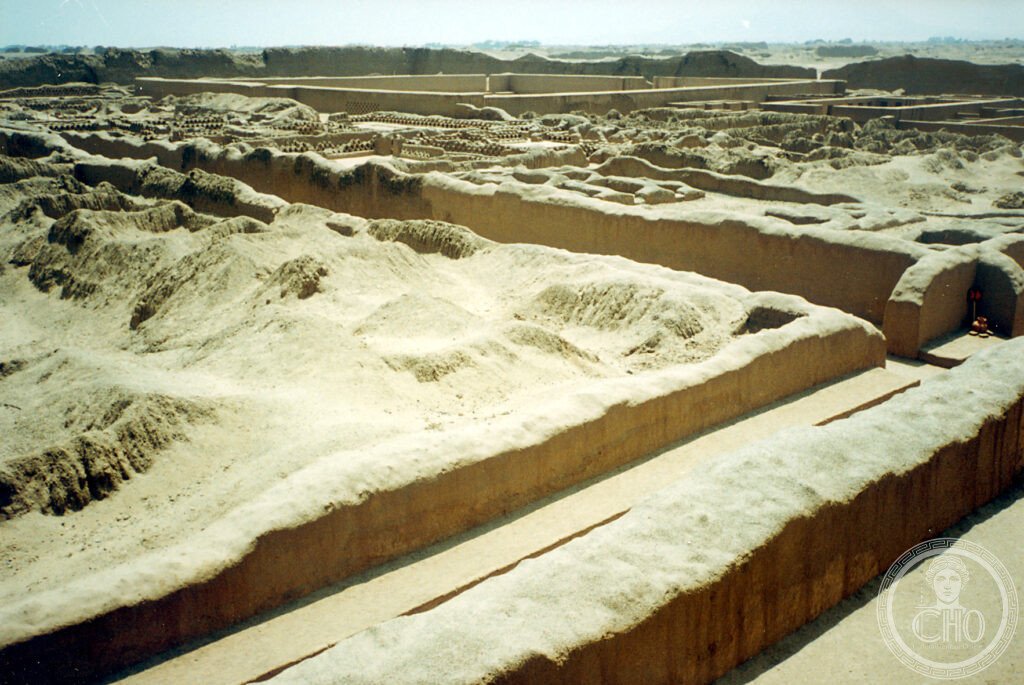
Chan Chan Archaeological Zone
The largest pre-Columbian city in South America and one of the most ambitious urban projects of the ancient world — Chan Chan (La Libertad Region, northern coastal Peru; 20 km²; UNESCO WHS 1986; also on the List of World Heritage in Danger since 1986) was the capital of the Chimú Empire at its height (approximately 1000-1470 CE), housing a population of perhaps 60,000 people in 9 royal palace compounds, workshops, temples, and residential quarters.
At a glance
Chan Chan (the most precisely ChanChan single 20km2 largest pre-Columbian city South America Chimú 9 ciudadelas royal palaces adobe mud-brick El Niño erosion danger UNESCO heritage: the scale: Chan Chan occupies approximately 20 km² of the coastal desert north of Trujillo (the modern city has grown around and toward the archaeological zone; the site is in the Moche Valley; the coastal desert receives less than 10mm of rain per year in normal years — the adobe mud-brick construction has survived for 1,000 years because of the extreme aridity); the 9 ciudadelas (the royal palace compounds; each one was built by a new Chimú king and used during his lifetime as his palace; after his death, the compound was sealed and maintained as a mausoleum and administrative center for the king’s dynasty; the 9 ciudadelas are therefore 9 distinct reigns); the administrative model (the Chimú royal cult required the entire compound to be maintained after the king’s death; this drove the construction of a new compound for each new king; the system required ever-expanding labor, land, and water resources — the hydraulic engineering of the Chimú (irrigation canals bringing water from the Andes) sustained the population) — the most precisely ChanChan single 20km2 largest pre-Columbian city South America Chimú 9 ciudadelas royal palaces adobe mud-brick El Niño erosion danger UNESCO heritage in any UNESCO world heritage site)).
Key facts
- The Tschudi Compound: the most precisely ChanChan single Tschudi Nik An compound ciudadela mud-brick frieze pelican fish net geometric diamond audiencia throne room U-shaped UNESCO heritage — the most accessible and best-restored of the 9 ciudadelas is the Tschudi compound (also known as Nik An; named by archaeologists after a 19th-century Swiss naturalist, Johann Jakob von Tschudi, who described it): the enclosure walls (9-12m high; the mud-brick is made from desert alluvium and organic matter; the walls have survived 1,000 years in the desert, but El Niño rains periodically melt sections); the decorative friezes (the interior wall surfaces of the audiencias and corridors are carved with repeating friezes: pelicans, fish, seabirds in flight, fish nets, geometric patterns — the imagery reflects the coastal marine economy of the Chimú; the friezes were carved in relief into the wet adobe mud and then allowed to dry; some sections have been restored (the original surfaces; the restorations are a different texture to the authentic sections)); the audiencias (the U-shaped reception halls arranged around the ciudadela; each consists of a large U-shaped forecourt with a raised platform at the back where the king sat for ceremonial audiences)
- GPS: 8.1069° S, 79.0756° W
History
The Chimú Empire and Inca conquest (the most precisely ChanChan single Chimu Empire 900 1470 CE Taycanamo founding king Minchancaman Inca Tupac Yupanqui 1470 CE Cusco relocation metalworkers goldsmith UNESCO heritage: the Chimú Empire (approximately 900-1470 CE; the successor state to the Moche civilization; the Chimú (also Chimu or Kingdom of Chimor) at its height controlled approximately 1,000 km of the Peruvian coast from Tumbes to Paramonga — the largest pre-Inca state in South America); the founding legend (the Chimú oral history records that the first king, Taycanamo, arrived by sea on a balsa raft (from the north; the exact origin is uncertain)); the Inca conquest (1470 CE; the Sapa Inca Tupac Yupanqui conquered the Chimú capital; the last Chimú king, Minchancaman, was taken to Cusco as a hostage; the Chimú metalworkers and goldsmiths (the most skilled in pre-Columbian South America; the Chimú worked gold, silver, bronze, and tumbaga (a gold-copper alloy) into hammered vessels, ear spools, chest plates, and funerary objects) were forcibly relocated to Cusco where they transformed Inca metalwork; the Incas appropriated Chimú craft technology (the goldsmithing techniques; the bronze casting; the textile production)) — the most precisely ChanChan single Chimu Empire 900 1470 CE Taycanamo founding king Minchancaman Inca Tupac Yupanqui 1470 CE Cusco relocation metalworkers goldsmith UNESCO heritage in any UNESCO world heritage site)).
What you see
El Niño danger and conservation (the most precisely ChanChan single El Niño 1982 1998 adobe dissolution danger UNESCO 1986 Peruvian government conservation shelter restoration UNESCO heritage: the existential threat to Chan Chan is El Niño: the site is on the UNESCO List of World Heritage in Danger since 1986 CE (one of the first sites to be placed on the list simultaneously with its inscription); El Niño (the periodic warming of the eastern Pacific; occurring every 3-8 years; dramatically increasing rainfall on the Peruvian desert coast — the normally rain-free zone around Chan Chan can receive hundreds of millimetres of rain in an El Niño year (the 1982-83 El Niño; the 1997-98 El Niño — the worst in recorded history — caused sections of Chan Chan’s walls to collapse)); the conservation interventions (several ciudadelas have been given protective roofing over the most decorated sections; the Tschudi compound has been partially covered; the adobe frieze restoration (painstakingly recording and then recreating lost sections using the same adobe material and construction techniques); the monitoring program (sensors recording humidity and temperature changes in the walls after rain)) — the most precisely ChanChan single El Niño 1982 1998 adobe dissolution danger UNESCO 1986 Peruvian government conservation shelter restoration UNESCO heritage in any UNESCO world heritage site)).
Practical information
- Getting there: Trujillo Airport (TRU; 3 km from Trujillo city center; daily flights from Lima (LIM; LATAM Airlines, Avianca; 1h30m)); Chan Chan is 5 km north of Trujillo (taxi from Trujillo center approximately PEN 15-20 = USD 4-5; or combi bus (the A/B bus from the Ovalo Mansiche; PEN 2); the site entrance (the Tschudi compound; open 09:00-17:00 daily; entrance fee PEN 15 (approximately USD 4); combined tickets with the Huaca del Sol y de la Luna are available; tourist police accompany groups through the site for safety; do not wander alone outside the main Tschudi compound); note (the other 8 ciudadelas are accessible only with a licensed guide and advance permission from the Ministry of Culture; the Tschudi compound is the standard tourist itinerary)
Getting there
Trujillo (TRU) 1h30m from Lima. Chan Chan 5 km north (taxi PEN 15-20). Open 09:00-17:00. PEN 15 entry. GPS: -8.1069, -79.0756.
Nearby
- Huaca del Sol y de la Luna — 8 km southeast of Chan Chan; the Moche (Mochica) pyramid complex that preceded Chan Chan by 500 years (the Huaca del Sol (the Sun Pyramid; the largest pre-Columbian structure in Peru; originally approximately 340m × 160m base; 40m high; an estimated 130 million adobe bricks; much reduced by 17th-century Spanish treasure looters who diverted the Moche River to erode the pyramid); the Huaca de la Luna (the Moon Pyramid; better preserved; the polychrome murals of the deity Ai Apaec (the fanged god) on the interior walls; the human sacrifice platform excavated with 70+ male sacrificial victims; the best museum at the site is the Museo Huacas de Moche (outside the Huaca de la Luna))
- Chiclayo (Huaca Rajada/Sipán) — 200 km north; the Tomb of the Lord of Sipán (1988 CE discovery; the richest intact royal tomb in pre-Columbian South America; the gold, silver, and copper funerary regalia of the Moche ruler; the Museo de las Tumbas Reales de Sipán in Chiclayo has the original objects (the 8-tiered headdress; the ear ornaments; the shell pectorals))
Sources
- Wikipedia, Chan Chan; Chimu Empire; Tschudi Palace, accessed June 2026
- UNESCO, Chan Chan Archaeological Zone, WHS reference 366, inscribed 1986
Find it on the map
See this place and what’s around it →📷 Diventa un fotografo di Cultural Heritage Online
Condividi le tue foto dei luoghi: restano pubblicate con la tua firma come autore. Più vengono viste, più ti fai conoscere — e presto un concorso premierà le foto più apprezzate.
Accedi o registrati gratis per aggiungere una foto