
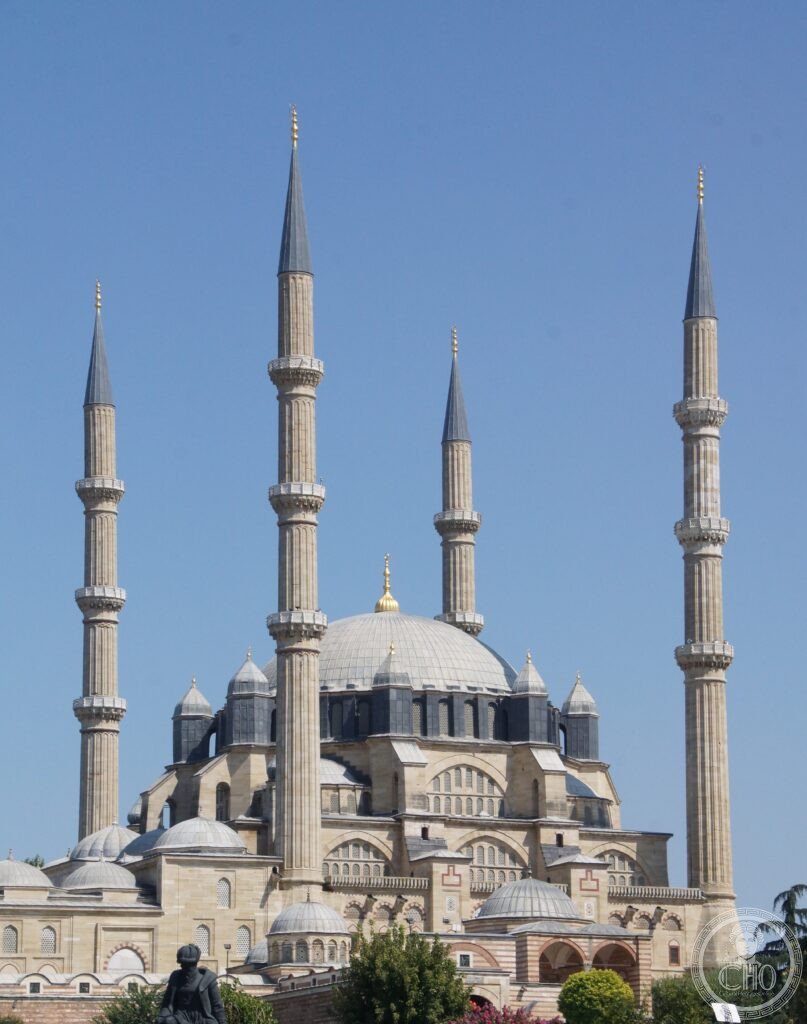
Mimar Sinan, already famous for the Süleymaniye in Istanbul, considered the Selimiye Mosque his true masterpiece. Its dome, wider than that of the Hagia Sophia, rests on eight piers rather than four, leaving the vast prayer hall beneath it entirely free of columns.
At a glance
The Selimiye Mosque dominates the skyline of Edirne, in Turkish Thrace, with four minarets among the tallest ever built and a central dome that Sinan himself claimed as proof that Ottoman architects could surpass the Hagia Sophia. It was raised for Sultan Selim II between 1569 and 1575, when Sinan was already an old man, and it remains the summit of his long career.
Key facts
- Architect: Mimar Sinan, chief Ottoman architect from 1538 until his death in 1588
- Built: 1569–1575, commissioned by Sultan Selim II
- Dome: 31.28 metres in diameter, wider than the Hagia Sophia’s 30.86 metres, and 43.28 metres from floor to apex
- Minarets: four, each 70.89 metres high, among the tallest in Turkey
- Status: inscribed on the UNESCO World Heritage List in 2011
- Interior: around 1,920 square metres of sixteenth-century İznik tilework
History
Edirne, the Roman Adrianople, served as the Ottoman capital from around 1365, when Murad I moved the seat of government there from Bursa, until Mehmed II took Constantinople in 1453. During this period the city acquired a sequence of great imperial mosques: the Eski Camii of the early fifteenth century, followed by the Üç Şerefeli Cami of Murad II, the first Ottoman mosque built with four minarets. The Selimiye represents the culmination of this line of experimentation.
Sultan Selim II ordered the mosque in 1568, and Sinan, by then around eighty years old, oversaw its construction between 1569 and 1575. In his autobiography, the Tezkiretü’l-Bünyan, he wrote that the Selimiye surpassed his earlier Süleymaniye in Istanbul and demonstrated that a Muslim architect could build a dome larger than that of the Hagia Sophia.
What you see
The dome rests on eight massive piers set in an octagon, a departure from the four semi-domes Sinan had used at the Süleymaniye and that support the Hagia Sophia. The result is an unbroken, columnless interior in which every worshipper has a clear view of the mihrab. The mihrab itself is carved from a single block of white Marmara marble beneath a stalactite hood, flanked by windows that let daylight fall on the prayer niche. The area around it, along with a long inscription band running beneath the dome, is covered in İznik tiles worked in blue and turquoise floral patterns.
The mosque stands at the heart of a külliye, the charitable complex that accompanied every major Ottoman mosque. It includes the Darü’l-Kurra medrese, a school for Quranic recitation now housing the Selimiye Foundation Museum, and the arasta, a covered market of shops whose rents once funded the upkeep of the mosque. The arcaded courtyard, with its ablution fountain and domed portico bays, links the minarets to the main structure.
Practical information
- Entry: the mosque is open to visitors outside prayer times; it closes briefly during each of the day’s five prayers
- Dress code: shoulders and knees should be covered, and headscarves are available to borrow at the entrance for women
- Museum: the Selimiye Foundation Museum in the former medrese keeps its own hours, best checked locally before visiting
- Best light: the courtyard and exterior are said to be at their finest in the golden light of late afternoon in summer
Getting there
Edirne lies around 230 kilometres from Istanbul. Regular bus services run from Istanbul’s main terminals, and Turkish State Railways also operates a train from Sirkeci station, though services are limited; it is worth checking current timetables with the relevant operator before travelling.
Nearby
- Eski Camii — about 500 metres south, Edirne’s first Ottoman Friday mosque, begun in 1402 and known for its huge calligraphic panels bearing the names of God and the Prophet
- Kırkpınar Oil Wrestling Festival — held each June at Sarayiçi, a meadow on the Meriç River near the city centre, said to be the oldest continuously held sporting event in the world
Sources
- Wikipedia, Selimiye Mosque, Edirne
- Wikipedia, Mimar Sinan
- Wikipedia, Edirne
- UNESCO, Selimiye Mosque and its Social Complex, WHS reference 1366
Find it on the map
See this place and what’s around it →📷 Become a Cultural Heritage Online photographer
Share your photos of places: they stay published under your name as the author. The more they're seen, the more you get noticed — and soon a contest will reward the most appreciated photos.
Log in or sign up free to add a photoDo you manage this place?
This page is read by travellers and heritage enthusiasts who find it on Google. Keep it accurate — and make it work for you. Free for non-profit heritage institutions.