
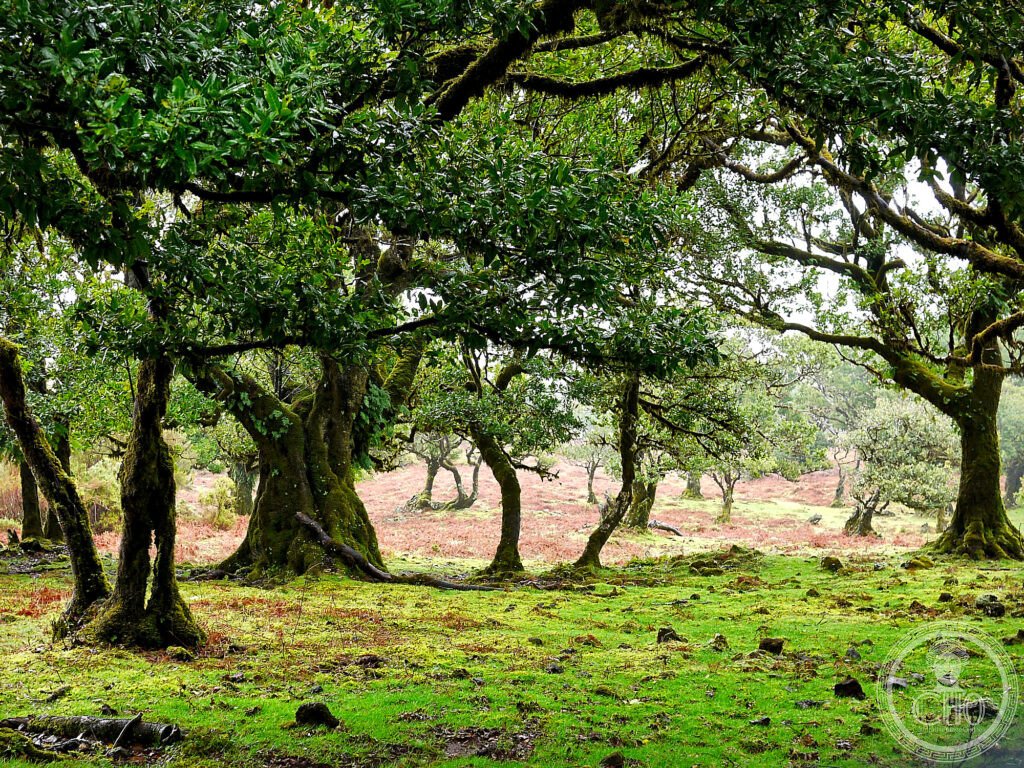
High in Madeira’s northern mountains survives the largest remaining stretch of laurisilva, the laurel forest that once covered much of Europe before the Ice Age. Dark, dripping and moss-hung, it is reached today along the island’s historic levada paths, its canopy still home to the endemic pigeon that keeps it alive.
At a glance
Laurisilva is a subtropical forest dominated by trees of the Lauraceae family, the laurel, cinnamon and avocado group, one of the oldest lineages of flowering plants. It is considered a Tertiary relict: a survivor of the vegetation that covered the humid coastal regions of Europe and North Africa during the Miocene epoch, tens of millions of years ago, when the climate was warmer and wetter than now. As the Pleistocene glaciations cooled and dried the continent, the forest died out everywhere except on a handful of Atlantic islands, including Madeira, the Canaries and the Azores, where the ocean moderated the temperature and trade-wind clouds kept the ground constantly moist.
On Madeira the surviving forest covers around 15,000 hectares, roughly a fifth of the island, concentrated on the northern slopes and the Paúl da Serra plateau.
Key facts
- Extent: around 15,000 hectares, described as the largest remaining stand of primary laurisilva anywhere in the world.
- Origin: a relict of the forest that covered much of Europe before the last Ice Age; it survived on Madeira because the island’s climate and cloud cover never dried out.
- Dominant trees: the Azorean laurel, the Canary laurel, the til or stinkwood, and the Madeiran laurel, all members of the Lauraceae family.
- Keystone species: the Trocaz pigeon, endemic to Madeira, which disperses the laurel trees’ large seeds and allows the forest to regenerate.
- Protection: inscribed as a UNESCO World Heritage Site in 1999.
History
When Portuguese settlers led by João Gonçalves Zarco and Tristão Vaz Teixeira reached Madeira in 1419, laurisilva is said to have covered most of the island. The newcomers cleared much of it by fire to make way for sugar cane, and Madeiran sugar became a major European supply in the fifteenth century before Brazilian production took over. Tradition holds that the fire set to clear the land burned for years. By the twentieth century the forest had shrunk to a small fraction of its original extent.
What remains survived precisely because the northern highlands were too steep, too cloudy and too remote to farm, and stayed inaccessible by road until the twentieth century. That isolation is what preserved the 15,000 hectares now protected under UNESCO status.
What you see
Inside the forest the canopy is dense and dark, and moisture drips constantly from the leaves; the cloud forest is said to draw far more water from cloud drip than from rain falling directly. The trees are the laurels themselves, including the til or stinkwood and the Madeiran laurel, their trunks and branches thick with moss.
The forest’s best-known resident is the Trocaz pigeon, a large grey-blue bird with a silvery neck patch, found only on Madeira. It feeds on laurel fruit, especially the berries of the til, and its droppings disperse the seeds that keep the laurel trees regenerating; without it the forest could not renew itself. Hunted heavily in the twentieth century for its meat, the population fell sharply before recovering under protection. Other endemic birds of the laurisilva include the Madeiran Firecrest, a subspecies found only on the island, and Zino’s Petrel, a critically endangered seabird that breeds solely on Madeira’s highest central cliffs and is among the rarest seabirds in the North Atlantic.
Practical information
- Access: the forest is best explored on foot along the levada paths, the maintenance tracks that run beside Madeira’s historic irrigation channels; the Levada do Norte and the Levada dos Cedros both cross the protected core.
- Suggested routes: the Levada do Caldeirão Verde, roughly 12 km one way from Queimadas park through some of the forest’s most striking sections and several tunnels cut through rock (a head-torch is worth carrying); the shorter and easier Levada das 25 Fontes, about 8 km return, ending at a waterfall.
- Getting around: a hire car is the practical way to reach the trailheads; the Paúl da Serra plateau is reached via the EN204, and the north-coast villages of São Vicente, Seixal and São Jorge serve as gateways to the best walks.
- Before travelling: check current trail conditions, closures and transport schedules with the relevant local tourism or hiking authority rather than relying on fixed timings.
Getting there
Madeira is served by Funchal’s airport, notable for a runway extended out over the sea on stilts, once regarded as one of the more demanding commercial approaches anywhere. Flights connect from Lisbon and from a range of UK and other European airports; exact schedules and journey times are best checked directly with the airlines. From Funchal, the laurisilva is most easily reached by hire car into the northern highlands.
Nearby
- Funchal Old Town — the Rua de Santa Maria, the city’s oldest street, where every door has been painted by a different artist, and the Mercado dos Lavradores, the farmers’ market known for its produce stalls and flower and orchid sellers.
- Monte — reached from Funchal by cable car, with views back over the city and harbour.
- Porto Santo — about 45 km northeast, the archipelago’s other inhabited island, known for its long sandy beach, a rarity in Madeira, and for the house where Christopher Columbus is said to have lived while working as a sugar merchant in the late fifteenth century.
Sources
- Wikipedia
- UNESCO
Find it on the map
See this place and what’s around it →📷 Become a Cultural Heritage Online photographer
Share your photos of places: they stay published under your name as the author. The more they're seen, the more you get noticed — and soon a contest will reward the most appreciated photos.
Log in or sign up free to add a photo