
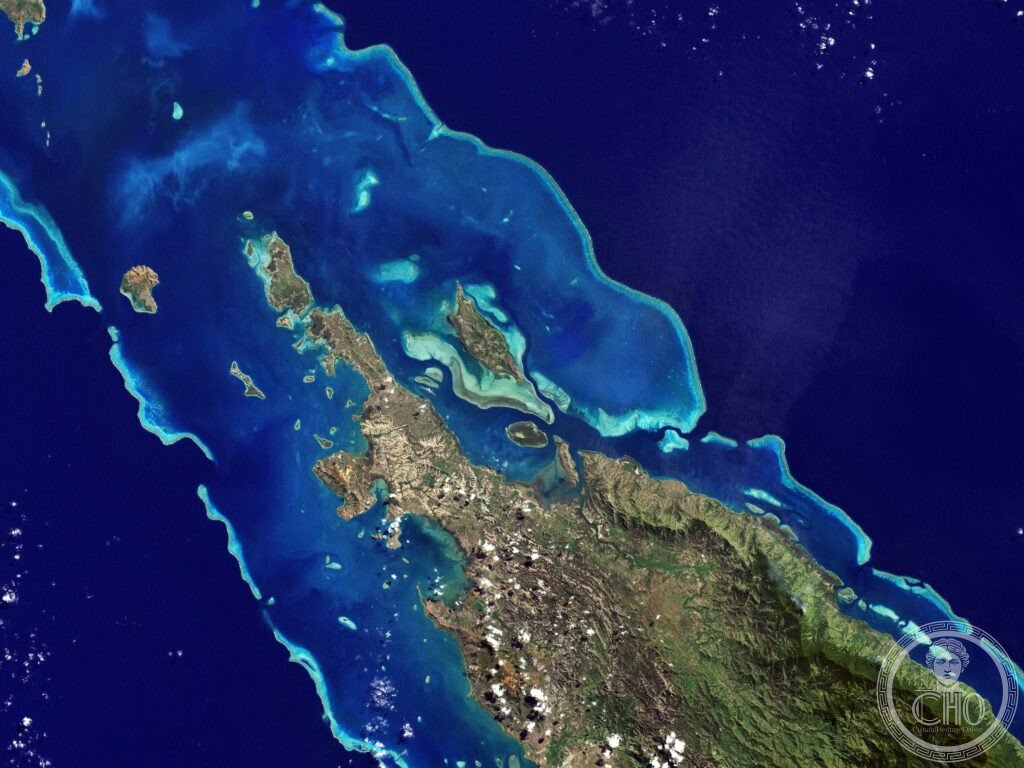
Enclosing the main island of Grande Terre, the Lagoons of New Caledonia form one of the world’s largest coral lagoon systems, held within a barrier reef second in length only to Australia’s Great Barrier Reef. Inscribed by UNESCO in 2008, the reefs shelter dugongs, six species of sea turtle and a coral diversity that surpasses the entire Caribbean Sea.
At a glance
New Caledonia is a French special collectivity in the southwestern Pacific. Its main island, Grande Terre, is ringed by the New Caledonian barrier reef, one of the longest continuous reef systems in the world, enclosing a lagoon of roughly 24,000 square kilometres, an area comparable to Macedonia and the second largest enclosed lagoon on the planet after that of the Great Barrier Reef.
Within this enclosed sea the reef supports more coral genera than the whole of the Caribbean and a fish fauna as rich as that of the Red Sea. The lagoon is one of the last strongholds of the dugong in the Pacific and is visited by six species of sea turtle, numerous sharks and, between July and September, humpback whales that come here to calve.
Key facts
- Lagoon area: around 24,000 km², the second largest enclosed lagoon in the world
- Barrier reef: approximately 1,600 km long, the second longest after Australia’s Great Barrier Reef
- Coral diversity: around 74 coral genera, compared with roughly 20 in the Caribbean
- Marine life: a significant dugong population, six sea turtle species, and seasonal humpback whales
- Status: inscribed as a UNESCO World Heritage Site in 2008 (reference 1115)
History
France annexed New Caledonia in 1853 under Napoleon III, partly to counter British influence in the Pacific. From 1864 the territory served as a penal colony, receiving thousands of French prisoners, including Communards deported after the suppression of the Paris Commune in 1871. The Kanak population, the indigenous Melanesian people who had settled the islands millennia earlier, was reduced by disease and displaced onto reserved lands as European settlers took over the rest, a policy known as cantonnement. A major uprising led by Chief Atai in 1878 was put down by French forces.
The modern independence movement produced the Matignon Accords of 1988 and the Nouméa Accord of 1998, and three referenda on independence were held in 2018, 2020 and 2021, each returning a vote against separation from France, though pro-independence parties boycotted the final one. Kanak clan authorities had long designated certain reef areas as sacred and off-limits to fishing, an early form of marine protection whose traditional knowledge was folded into the management plan submitted for UNESCO recognition.
What you see
Nouméa, the capital, is the usual base for exploring the lagoon, with a French colonial feel in its architecture and café culture. From here, boats reach the Amédée islet, where a 57-metre cast-iron lighthouse, built in Paris and shipped out in 1865, stands on a sandy motu surrounded by fringing reef good for swimming, snorkelling and diving.
The Île des Pins, reached by air from Nouméa, offers a natural swimming pool at Oro Bay, the beaches of Kuto and Kanumera, and a landscape marked by endemic Araucaria pines; it is considered the best base for snorkelling in the southern lagoon. Further south, the seagrass meadows of Prony Bay are a reliable place to see dugongs, often watched quietly from a kayak.
Practical information
- Main gateway: La Tontouta International Airport, near Nouméa
- Accommodation: ranges from budget hostels to beachfront hotels in Nouméa, including the Méridien and the Hilton Anse Vata
- Currency: the CFP Franc, pegged to the Euro, with Euro widely accepted
- Best time to visit: July to September for diving and whale-watching; dugongs can be seen year-round, with calmer waters from September to November
Getting there
La Tontouta International Airport near Nouméa is the main gateway, served by Air France from Paris, Qantas from Sydney and Air New Zealand from Auckland. Air Caledonie operates domestic connections onward to the Île des Pins and the outer islands, and Air Vanuatu links Nouméa to Vanuatu.
Nearby
- Vanuatu — reached by air from Nouméa; an archipelago of more than 80 islands known for its linguistic diversity, the active volcano of Mount Yasur on Tanna, and the underwater post office at Hideaway Island
- Loyalty Islands — reached by air from Nouméa; the coral atolls of Maré, Lifou and Ouvéa, the most traditional of New Caledonia’s islands, with raised limestone landscapes and notable snorkelling at Ouvéa
Sources
- Wikipedia, Lagoons of New Caledonia
- Wikipedia, New Caledonia
- Wikipedia, Kanak people
- UNESCO, Lagoons of New Caledonia: Reef Diversity and Associated Ecosystems, WHS reference 1115
Find it on the map
See this place and what’s around it →📷 Become a Cultural Heritage Online photographer
Share your photos of places: they stay published under your name as the author. The more they're seen, the more you get noticed — and soon a contest will reward the most appreciated photos.
Log in or sign up free to add a photo