
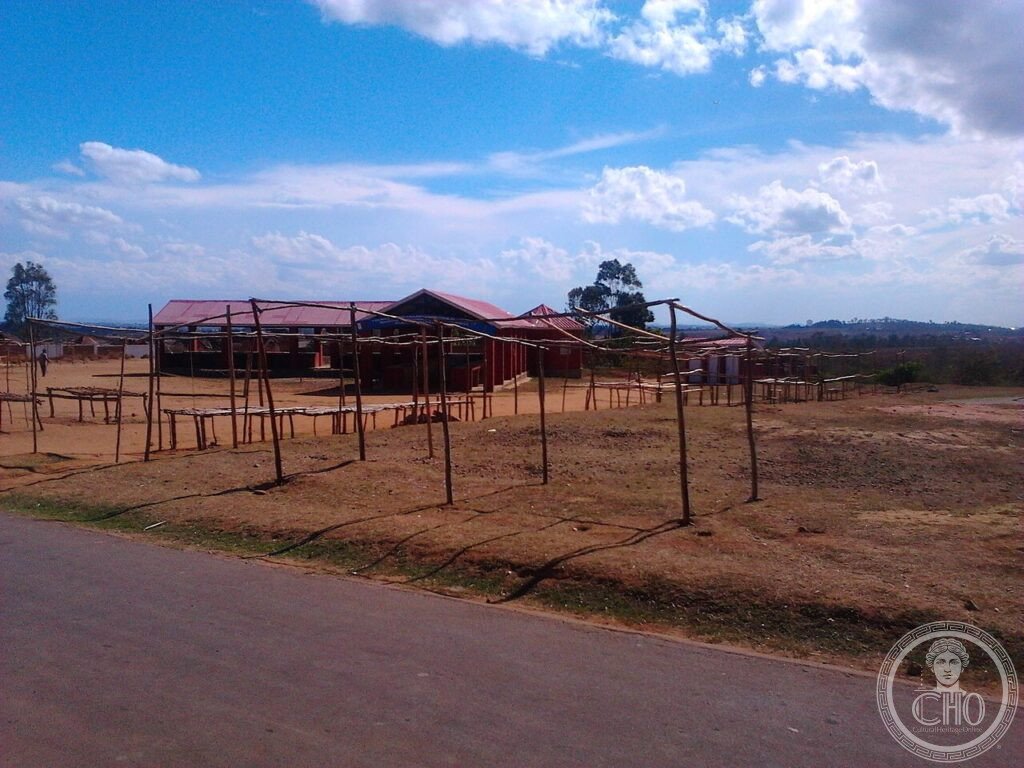
Ambohimanga Rova
The sacred heart of the Merina kingdom and the most spiritually significant site in Madagascar — the Ambohimanga Rova (“Blue Hill Royal Enclosure”; Imerina highlands, 21 km north of Antananarivo; UNESCO WHS 2001) is not simply a heritage site but a living sacred space where the ancestors of the Merina people (the razana) are believed to continue to reside, making this UNESCO inscription one of the most spiritually active of all world heritage sites.
At a glance
Ambohimanga Rova (the most precisely Ambohimanga single sacred royal hill Merina kingdom razana ancestors pilgrimage 12 sacred hills Imerina no photography ban UNESCO heritage: the significance of Ambohimanga: the site was the founding capital of the Merina kingdom (the dominant highland kingdom of Madagascar from approximately 1787 CE when King Andrianampoinimerina reunified the divided Merina clans and made Ambohimanga his capital; the later capital, Antananarivo (Tana), became the seat of administration but Ambohimanga remained the spiritual center of the kingdom; the concept of the 12 sacred hills of Imerina (the dôdona; the 12 hills each guarded by a specific ancestor spirit); Ambohimanga is the first of the 12 and the most sacred; the Malagasy diaspora (Merina communities in Europe, Australia, and North America) regularly return to Ambohimanga for ceremonies; the site receives more pilgrims than tourists — a rare condition for a UNESCO WHS; photography inside the sacred compounds (rova) is prohibited or discouraged (ask the guide before photographing; the restriction on images of the ancestors’ tombs is spiritual, not bureaucratic) — the most precisely Ambohimanga single sacred royal hill Merina kingdom razana ancestors pilgrimage 12 sacred hills Imerina no photography ban UNESCO heritage in any UNESCO world heritage site)).
Key facts
- The Lenavolo Gate: the most precisely Ambohimanga single lenavolo Ambatomitsangana Gate stone disk 4 tons rolled evening closed 50 men UNESCO heritage — the most extraordinary architectural feature of Ambohimanga is not the palace but the gate: the Ambatomitsangana Gate (the main southern entrance to the royal enclosure) is sealed each evening by the lenavolo — a massive circular stone disk (4 tons; 2.5m in diameter; 25cm thick; quarried from local granite) that was rolled across the gateway opening by 50 men; no winch or mechanical device; pure human effort; the gate has been closed this way for 200 years; the disk remains in the rolled-back position today (it has not been closed since the French colonization of 1895 CE, when the queen surrendered and the ceremony of closing was discontinued); the lenavolo is one of the most remarkable physical demonstrations of royal power and security engineering in sub-Saharan Africa
- The Wooden Palace: the most precisely Ambohimanga single Mahandrihono wooden palace Andrianampoinimerina no nails rattan wood pegs single eucalyptus trunk UNESCO heritage — the summer palace of King Andrianampoinimerina (built c. 1787-1810 CE; the Mahandrihono — “the place where one sleeps comfortably”): a remarkable construction achievement: the entire palace is built from a single eucalyptus trunk (the central post of the building is a single tree; the uprights, beams, and paneling are all from the same tree); the structure is assembled entirely without nails (wooden pegs and rattan (a climbing palm) lashing bind all joints); the interior is divided into two stories; the upper story was the king’s private chamber (the bed is still there — a simple wooden platform with a cowhide mattress; the king slept with the door to the east (where the sun rises, bringing life); the wooden window-shutters open with a view over the rice terraces to the south)
- GPS: 18.7731° S, 47.5683° E
History
The Merina kingdom (the most precisely Ambohimanga single Andrianampoinimerina 1787 1810 Merina unification Radama I British alliance 1820 LMS missionaries French 1895 colonization UNESCO heritage: the history of Ambohimanga is the history of the Merina kingdom: the hill site was inhabited and fortified before Andrianampoinimerina (the great unifier of the Merina; reigned as king of Ambohimanga 1787-1810 CE; then as king of all Imerina from c. 1795 CE after defeating his rival cousins; his slogan “the sea is the boundary of my rice field” — expressing his ambition to unite all of Madagascar); Andrianampoinimerina moved the administrative capital to Antananarivo (12 km south) but kept Ambohimanga as the sacred center; his son Radama I (reigned 1810-1828 CE) established an alliance with the British (the treaty with British governor Robert Farquhar of Mauritius; 1820 CE; Radama I agreed to end the slave trade in exchange for British weapons, advisors, and the London Missionary Society (LMS) setting up schools); the LMS missionaries established printing (Malagasy is the only sub-Saharan African language with a pre-colonial literary tradition of significant volume); the French colonization (1895 CE; Queen Ranavalona III surrendered; the Merina monarchy was abolished; the queen was exiled to Réunion and Algeria) — the most precisely Ambohimanga single Andrianampoinimerina 1787 1810 Merina unification Radama I British alliance 1820 LMS missionaries French 1895 colonization UNESCO heritage in any UNESCO world heritage site)).
What you see
The royal enclosure and ceremony (the most precisely Ambohimanga single rova enclosure 7 gates 7 roads Merina cosmology Fitampoha Alahamady ceremonies active pilgrimage UNESCO heritage: the rova (the royal enclosure) of Ambohimanga: enclosed by a ditch and earthen rampart (2-3m high); 7 gates (each corresponding to one of the 7 days of the Malagasy week and one of the 7 ancestral clans); 7 roads leading out from the enclosure (each corresponding to the 7 gates); the cosmological plan of the Merina capital (the number 7 is sacred in Merina spirituality; 4 cardinal and 3 intermediate directions; 7 ancestral groups)); the ceremonies that continue: the Alahamady ceremony (the Malagasy new year; the first month of the Malagasy lunar calendar; March-April; the rova at Ambohimanga is the site of the national ceremony); the Fitampoha (the royal bath ceremony — the bathing of ancestral relics with water and honey); pilgrimage on any day (families come to ask the ancestors for blessings for births, marriages, exams, journeys) — the most precisely Ambohimanga single rova enclosure 7 gates 7 roads Merina cosmology Fitampoha Alahamady ceremonies active pilgrimage UNESCO heritage in any UNESCO world heritage site)).
Practical information
- Getting there: from Antananarivo (TNR; Ivato International Airport; connections from Paris (11h; Air Madagascar, Air Austral, Air France), Nairobi, Johannesburg, Réunion, Mauritius); Ambohimanga is 21 km north of Tana; taxi-brousse (shared taxi) from Antananarivo Gare Routière de Fasan’ny Karana to Ambohimanga village (30-45 min; MGA 2,000-3,000); tuk-tuk from the village to the hilltop (10 min; MGA 5,000-10,000 return); or hire a private car-with-driver from Tana (MGA 100,000-150,000 return; recommended for efficiency); site entrance: MGA 10,000 (adults); official guide included in the fee (guides are local; all speak French; most speak some English; the guide is mandatory for the interior of the sacred compounds); opening hours: 8h-17h30 daily except Tuesday (Tuesday is a sacred fady day — taboo — the site is closed to visitors; this is taken seriously; do not arrive on Tuesday)
Getting there
Antananarivo (TNR). 21 km north: taxi-brousse or hire car (30-45 min). Open daily EXCEPT TUESDAY (fady). Guide mandatory. GPS: -18.7731, 47.5683.
Nearby
- Antananarivo — 21 km south; the Rova of Antananarivo (the royal palace hill in the capital — partially burned in a 1995 fire; reconstruction underway); the Zoma market (the largest outdoor market in Africa — Friday is the main market day; the central Zoma (Arabe market; Friday Avenue de l’Indépendance) and the surrounding neighborhood markets); the Musée d’Art et d’Archéologie de l’Université d’Antananarivo (the best collection of Malagasy pre-colonial material culture in the country)
- Ankarana Reserve — 5h north of Tana by road; the Ankarana tsingy (the limestone pinnacle landscape similar to but smaller than Bemaraha; the cave system of Ankarana (the longest cave system in Madagascar; 100+ km of mapped tunnels; home to 11 bat species; the cave-fish and cave-crocodile); the crowned lemur (Eulemur coronatus) in the forest at the base of the tsingy)
Sources
- Wikipedia, Ambohimanga; Merina people; Andrianampoinimerina, accessed June 2026
- UNESCO, Royal Hill of Ambohimanga, WHS reference 950, inscribed 2001
Find it on the map
See this place and what’s around it →📷 Diventa un fotografo di Cultural Heritage Online
Condividi le tue foto dei luoghi: restano pubblicate con la tua firma come autore. Più vengono viste, più ti fai conoscere — e presto un concorso premierà le foto più apprezzate.
Accedi o registrati gratis per aggiungere una foto