
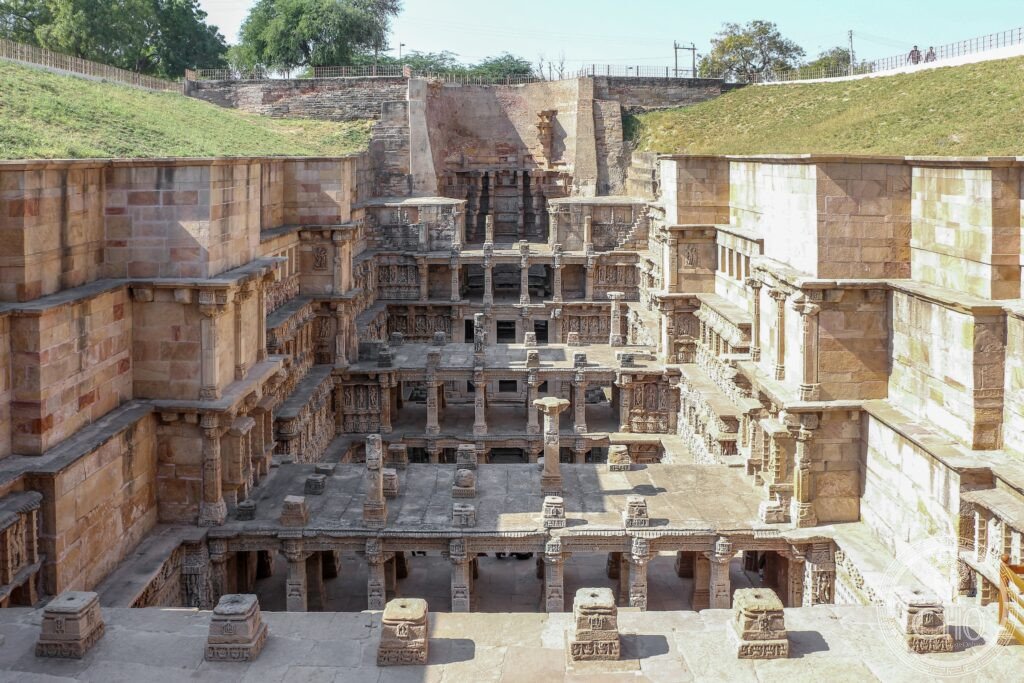
Beneath a quiet garden in northern Gujarat lies the most elaborately carved stepwell in India, seven storeys of sandstone sunk to the water table and covered with over 1,500 sculptures. Built by a queen in memory of her husband, it vanished under river silt for centuries before archaeologists brought it back into the light.
At a glance
Rani ki Vav, the Queen’s Stepwell, stands at Patan in Gujarat and was built in the eleventh century by Queen Udaymati in memory of her husband, King Bhimdev I of the Solanki, or Chaulukya, dynasty. It belongs to a distinctive Gujarati and Rajasthani building type, the vav, in which a well is combined with a monumental staircase and carved galleries, serving at once as a water source, a cool retreat in the hot months, and an underground temple.
Key facts
- Location: Patan, Gujarat, India.
- Built by: Queen Udaymati, in memory of King Bhimdev I of the Solanki dynasty.
- Dimensions: approximately 64 metres long, 20 metres wide and 27 metres deep, descending through seven levels.
- Sculptural programme: more than 1,500 carvings, including the ten avatars of Vishnu at full scale and numerous apsara figures.
- Status: inscribed as a UNESCO World Heritage Site in 2014.
- Cultural recognition: the stepwell appears on an Indian banknote in circulation.
History
Rani ki Vav was raised in the second half of the eleventh century, begun after the death of King Bhimdev I, who had also commissioned the Sun Temple at nearby Modhera. His queen, Udaymati, oversaw its construction as both a memorial and a functioning piece of water architecture, carved throughout with the imagery of the Solanki court’s devotion to Vishnu.
By the thirteenth century the stepwell had been buried under thick silt deposited when the Saraswati river, on whose banks Patan stands, flooded. The burial proved a form of protection: sealed in wet sediment, the carvings escaped both weathering and the destruction visited on much Hindu sculpture elsewhere in North India during the medieval period. The Archaeological Survey of India discovered the buried structure in 1940 and excavation continued in stages over several decades, reaching completion around the 1980s.
What you see
The stepwell sits within a low enclosure, and its scale is invisible from the garden above; the whole experience is one of descent. A long staircase runs along the main east-west axis down through the seven levels to the water, and the carved walls close in on either side as the visitor goes lower. The noise of the surface falls away and the air cools noticeably level by level.
The carving itself is arranged in horizontal registers running the full height of the walls. The principal cycle depicts the Dashavatara, the ten avatars of Vishnu, carved at close to life size and with exceptional finish. Alongside these are the apsara panels, sinuous figures shown dressing, gazing into mirrors or adorning themselves, which have become the best-known image of the site. Light plays a large part in how the carving reads: early morning brings out the relief with slanting light, while the flat overhead sun of midday tends to flatten the detail.
Practical information
- Opening and tickets: the stepwell is managed by the Archaeological Survey of India; check current opening times and entry arrangements through its official channels before visiting.
- Best season: the cooler months from October to March are the most comfortable; the hot season from May to September is best tackled early in the day, when the lower levels offer welcome relief from the heat above.
- Combine with: Patan’s Patola silk weaving workshops and the Patan Museum, which holds a strong collection of medieval Gujarati sculpture.
Getting there
Patan lies to the north of Ahmedabad, whose Sardar Vallabhbhai Patel International Airport is the nearest major hub, with domestic connections across India and international links to the Gulf, Southeast Asia and the UK. From Ahmedabad, Patan is reached by state bus or by hired car; the stepwell itself is in the northern part of the town, a short ride from the bus stand.
Nearby
- Sun Temple, Modhera — about 50 km southeast; built by King Bhimdev I in 1027, with a stepped tank, a pillared assembly hall and an alignment that lets sunrise strike the shrine image at the equinoxes.
- Siddhpur — about 35 km northwest; a townscape of elaborate Bohra mansions built by the Dawoodi Bohra merchant community in the nineteenth and early twentieth centuries, now largely empty but still maintained by families who return for weddings and festivals.
Sources
- Wikipedia, Rani ki Vav
- Wikipedia, Solanki dynasty
- Wikipedia, Patan, Gujarat
- UNESCO, Rani-ki-Vav (the Queen’s Stepwell) at Patan, Gujarat
Find it on the map
See this place and what’s around it →📷 Become a Cultural Heritage Online photographer
Share your photos of places: they stay published under your name as the author. The more they're seen, the more you get noticed — and soon a contest will reward the most appreciated photos.
Log in or sign up free to add a photoIs this page about you?
This page is read by travellers and heritage enthusiasts who find it on Google. Tell us how you are connected to this place and we will take it from there.