
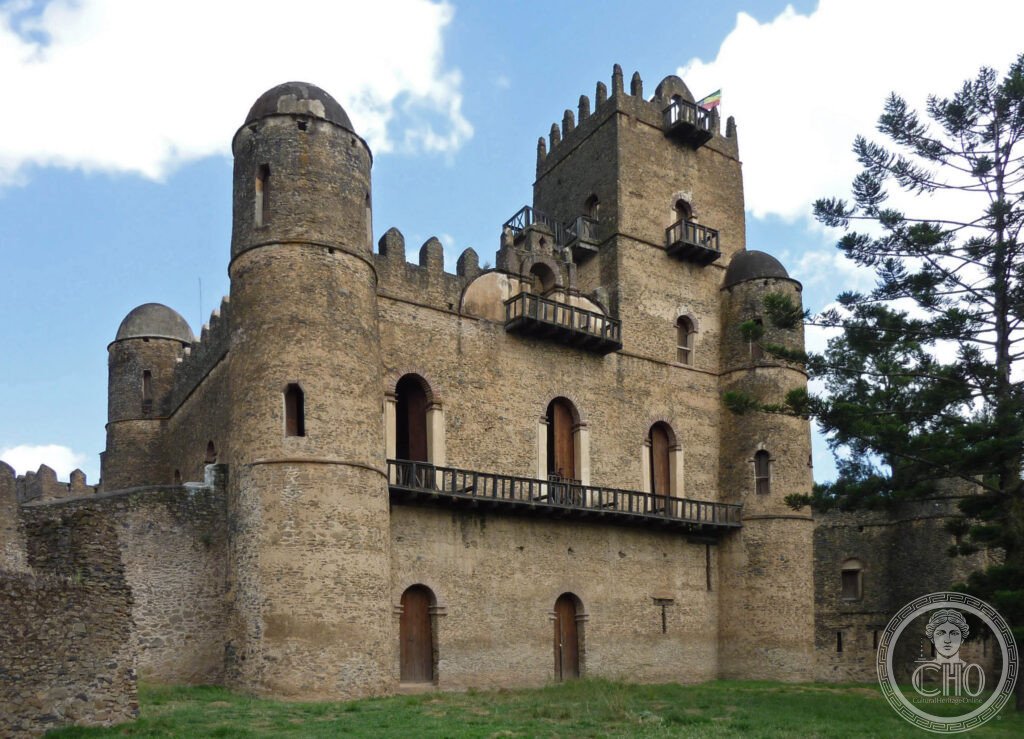
Behind a basalt wall on the highlands above Lake Tana stands a walled city of castles unlike anything else in Africa: the seat of the Ethiopian emperors who built in a hybrid style drawing on Portuguese, Indian and Moorish craftsmanship layered onto Ethiopian tradition, still standing at the heart of modern Gondar.
At a glance
Fasil Ghebbi, meaning the Compound of Fasil, is the walled royal enclosure of Gondar. A perimeter wall of basalt, originally pierced by twelve gates of which five survive, encloses six royal castles and three churches. The largest and earliest structure is the Castle of Fasilides, followed later by the Iyasu I Palace, the palace of Dawit III, the palace of Bakaffa, the library of Yohannes I and the treasury of Fasilides.
The buildings combine rectangular tower-keeps with cylindrical corner towers and flat crenellated rooftops, built in local basalt and lime mortar, with horseshoe arches and carved window ornament introduced through the Ethiopian-Portuguese alliance, carved woodwork attributed to Indian craftsmen employed by the emperors, and church murals showing Byzantine influence. This layering of traditions has no real parallel elsewhere in Africa.
Key facts
- Founder: Emperor Fasilides, who reigned 1632–1667 and made Gondar the Ethiopian Empire’s first permanent capital in 1636, ending the era of the mobile royal court.
- Religious context: Fasilides expelled the Jesuit missionaries who had converted his predecessor Susenyos to Roman Catholicism and restored Ethiopian Orthodox Christianity as the state religion; his first castle asserted both political and architectural independence.
- Castle of Fasilides: the oldest and most prominent building in the enclosure, a rectangular keep roughly 32 metres high with four cylindrical corner towers, flat battlemented roof, decorated corbelled windows, and interior banqueting hall and treasury rooms.
- Fasilides Bath: a large rectangular pool outside the enclosure, ringed by a two-storey arcaded palace, used each year for the Timkat festival marking the Ethiopian Epiphany, when the pool is flooded and the tabot is carried to the water for blessing.
- Coordinates: 12.6066° N, 37.4680° E.
History
The Portuguese architectural traces visible at Gondar descend from the 1541 Ethiopian-Portuguese alliance. Cristóvão da Gama, son of Vasco da Gama, led four hundred Portuguese musketeers to Ethiopia to support Emperor Gelawdewos against the forces of Ahmad ibn Ibrahim al-Ghazi of the Adal Sultanate, known as Ahmad Gran, who had conquered much of Ethiopia. Cristóvão was captured and executed before the allied force secured victory in 1543. The Portuguese presence left artistic and architectural traces that, a century later, shaped the builders of Gondar.
Fasilides founded Gondar in 1636 as the empire’s first fixed capital, following his expulsion of the Jesuits and his restoration of Orthodox Christianity. His castle, the first in the enclosure, was followed over the next decades by further palaces and churches built by his successors, giving the complex its final form by the early eighteenth century.
What you see
The visit to the enclosure typically begins at the Castle of Fasilides, where a guide unlocks the interior, allowing access to the main hall and to the roof, from which the whole complex and the city of Gondar can be seen. The route continues to the ruins of the Iyasu I Palace, noted for its richer carved stonework and for fragments of blue tilework still visible on the exterior. A short walk beyond the enclosure leads to the Fasilides Bath, with its pool and surrounding arcaded structure.
Practical information
- Guides: strongly recommended, since castle interiors are kept locked and a guide is needed to explain the iconography of the murals; arrangements can be made locally.
- Timkat festival: held on 19–20 January, drawing large numbers of white-robed pilgrims to the Fasilides Bath; accommodation should be booked well ahead if visiting for the festival.
- Accommodation: the Quara Hotel and the Goha Hotel are among the options in Gondar.
- Tickets and hours: check the site’s official channels for current entry arrangements and opening times.
Getting there
Gondar lies in the Amhara Region of northern Ethiopia, some 750 kilometres north of Addis Ababa, reachable by domestic flight to Gondar Airport or by overnight road transport. From Lalibela the distance is around 200 kilometres, covered by road or by a short domestic flight.
Nearby
- Debre Berhan Selassie Church — about 1 kilometre from the enclosure, Gondar’s most important church, built in the 17th century, with an interior ceiling covered in painted angel faces known locally as the angels of Gondar, and murals depicting the life of Mary; commonly added as a half-day extension to the enclosure visit.
- Simien Mountains National Park — around 100 kilometres northeast, a UNESCO World Heritage Site since 1978, with a high plateau above 3,000 metres cut by dramatic escarpments, Ras Dashen at 4,550 metres the highest peak in Ethiopia, and populations of the endemic Walia ibex and Gelada baboon.
Sources
- Wikipedia, Fasil Ghebbi
- Wikipedia, Fasilides
- Wikipedia, Gondarine period
- Wikipedia, Cristóvão da Gama
- UNESCO, Fasil Ghebbi, Gondar Region
Find it on the map
See this place and what’s around it →📷 Become a Cultural Heritage Online photographer
Share your photos of places: they stay published under your name as the author. The more they're seen, the more you get noticed — and soon a contest will reward the most appreciated photos.
Log in or sign up free to add a photo