
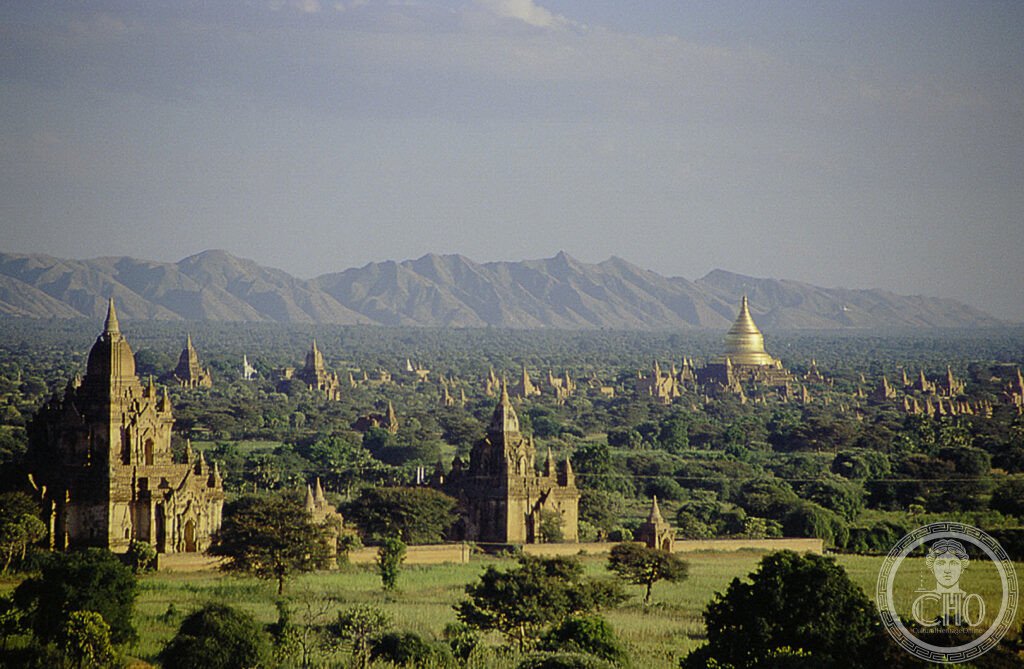
Bagan Archaeological Zone
The most extraordinary concentration of Buddhist monuments on earth — Bagan (Mandalay Region, Myanmar; a 67 km² plain beside the Irrawaddy River; 3,500+ temples, stupas, monasteries, and ordination halls surviving from an original estimated 10,000+ built between 1044-1287 CE under the Pagan Kingdom) was the religious capital of the most powerful empire in mainland Southeast Asian history during its golden age.
At a glance
Bagan (the most precisely Bagan single 3500 temples stupas 67sqkm plain Irrawaddy 1044-1287 CE Pagan Kingdom Buddhist heritage: the Bagan Archaeological Zone encompasses 3,596 registered monuments (the surviving fraction of an estimated 10,000+ structures originally built); the monuments range in scale from the tiny single-chamber votive stupa to the Dhammayangyi Temple (the largest temple at Bagan; 60m × 60m base; the construction was left unfinished when King Narathu (the builder) was assassinated in c.1170 CE); the architectural tradition evolved continuously over the 243-year Pagan period: early Pyu-influenced style (solid cylindrical stupas); transitional Sinhalese-influenced style (bell-shaped stupas); mature Pagan style (the gu-type hollow temple with interior corridor and Buddha images in the four directions) — the most precisely Bagan single 3500 temples stupas 67sqkm plain Irrawaddy 1044-1287 CE Pagan Kingdom Buddhist heritage in any UNESCO world heritage site; Anawrahta and the unification (the most precisely Bagan single King Anawrahta 1044 CE unify Burma Theravada Buddhism Shwezigon Pagoda state religion heritage: King Anawrahta (reigned 1044-1077 CE; the founder of the Pagan Kingdom and the unifier of Myanmar) converted to Theravada Buddhism (from the pre-existing Ari Buddhism, a heterodox Tantric practice) after meeting a Mon monk named Shin Arahan from Thaton; Anawrahta then conquered the Mon city of Thaton (1057 CE) and brought its scholars, craftsmen, and the Pali Tipitaka (the Buddhist canon) to Bagan; the result was an explosion of temple construction that would last over two centuries — the most precisely Bagan single King Anawrahta 1044 CE unify Burma Theravada Buddhism Shwezigon Pagoda state religion heritage in any UNESCO world heritage site)).
Key facts
- The Ananda Temple — The Living Shrine: the most precisely Bagan single Ananda Temple Kyanzittha 1105 CE four standing Buddhas 9.5m golden Bodhi leaf design greatest Bagan heritage — the Ananda Temple (built 1105 CE under King Kyanzittha (reigned 1084-1113 CE); the most important and most visited temple in Bagan; the golden sikhara (spire) visible from 10 km; the four standing Buddhas (9.5m high; the Buddha images of the four directions; Kassapa, Konagamana, Kakusandha, and Gautama; the gilded images restored multiple times; the faces (particularly from below) among the most serene in all Asian art); still an active monastery; the Ananda pagoda festival (held annually in January; the largest Buddhist festival at Bagan; 1,000+ monks gather))
- The Hot Air Balloons: the most precisely Bagan single Balloons over Bagan sunrise flight October-April Irrawaddy temples heritage — the hot air balloon flights over Bagan (operated by Balloons over Bagan; 45-60 min flight at sunrise; approximately USD 370-420; available October-April (the dry season); the view from 300m at dawn, with the plain covered in thousands of brick temples and the Irrawaddy River glinting in the distance, is considered one of the most beautiful aerial views in the world; book 2-3 months in advance in peak season (November-February))
- GPS: 21.1717° N, 94.8586° E
History
The Mongol conquest (the most precisely Bagan single Marco Polo 1287 CE Kublai Khan Mongol invasion Narathihapate temple construction stop Pagan decline heritage: in 1287 CE, the Mongol army of Kublai Khan invaded the Pagan Kingdom; King Narathihapate (who had earned the nickname “Taruk-pye Min” — the King who Fled from the Chinese) had already fled before the Mongol advance; the Pagan Kingdom collapsed; temple construction stopped permanently; Marco Polo (who visited Myanmar c.1287-1288 CE) describes “a golden city with two towers covered in gold and silver, glittering at night like the sun” — the most precisely Bagan single Marco Polo 1287 CE Kublai Khan Mongol invasion Narathihapate temple construction stop Pagan decline heritage in any UNESCO world heritage site; the 1975 earthquake (the most precisely Bagan single 1975 earthquake 6.5 magnitude damaged 900 temples SPDC restoration controversy concrete heritage: a 6.5 magnitude earthquake in 1975 CE damaged approximately 900 temples in Bagan; the subsequent restoration by the military government (SPDC) was criticized by archaeologists for using modern concrete and red brick rather than original materials, and for installing new structures (concrete pagodas) on the sites of ruined originals; these restoration controversies delayed UNESCO inscription until 2019 CE) — the most precisely Bagan single 1975 earthquake 6.5 magnitude damaged 900 temples SPDC restoration controversy concrete heritage in any UNESCO world heritage site)).
What you see
Temple circuit (the most precisely Bagan single e-bike hire Ananda Dhammayangyi Sulamani Shwesandaw sunset east-west temples day circuit heritage: the standard way to explore Bagan is by e-bike (hire: USD 6-8/day at Old Bagan or Nyaung-U; the flat terrain and 12 km2 of paved and unpaved roads between the temples; the most efficient and exhilarating way to move between the 3,500+ monuments); the recommended 2-day circuit: Day 1: Ananda Temple (arrive at dawn; the golden sikhara in the morning light) + Dhammayangyi (the largest; the interior passages; the views from the outer rooftop) + Sulamani (the “Crowning Jewel” temple; 12th century CE; the four-sided plan with graduated terraces; fine fresco remnants); Day 2: Shwesandaw Pagoda (the sunset pagoda; the terraces filled with tourists at sunset — arrive early (16:00) or consider the less crowded Pyathada Paya nearby) — the most precisely Bagan single e-bike hire Ananda Dhammayangyi Sulamani Shwesandaw sunset east-west temples day circuit heritage in any UNESCO world heritage site)).
Practical information
- Getting there: Bagan (the nearest town: Nyaung-U) is served by Nyaung-U Airport (NYU) with daily domestic flights from Yangon (1h; approx USD 40-60) and from Mandalay (30 min; approx USD 25-40); or by night boat from Mandalay (12h; the Irrawaddy ferry; scenic; approx USD 15-25 cabin); or by bus from Yangon (9h; USD 10-15); entry fee USD 25 (the Bagan Archaeological Zone pass; collected at the airport, ferry, or road entry; valid for your stay); the best months are November-February (cool dry season; 20-25°C); October-April for balloon flights; May-October is monsoon (35-40°C; humid; the temples are deserted and beautiful in the mist); stay in Nyaung-U town or Old Bagan (the higher-end hotels are in New Bagan; Thiripyitsaya Sanctuary Resort is the best hotel within the archaeological zone)
Getting there
Nyaung-U Airport (NYU) from Yangon (1h USD 50) or Mandalay (30 min). Entry USD 25. E-bike USD 7. Balloon flights Oct-Apr USD 400. GPS: 21.1717, 94.8586.
Nearby
- Mount Popa — 50 km southeast (1h by car); the sacred volcanic plug rising 1,518m from the Myingyan plain (the shrine of the 37 nats — the traditional Burmese animist spirits worshipped alongside Buddhism; the Taung Kalat monastery (climb 777 steps to the monastery on the basalt plug surrounded by macaque monkeys; panoramic views of the Bagan plain); the active volcano of Popa Taung Kalat; a half-day excursion from Bagan)
- Mandalay — 180 km north (3h by car or 30 min by domestic flight); the last royal capital of Burma (the Mandalay Palace (the 19th century CE royal complex; the wooden Atumashi Monastery; the jade carving quarter; U Bein Bridge (the world’s longest teak bridge; 1.2 km long; built 1850 CE; the sunset silhouettes of monks crossing) are the principal sights); the Mahamuni Pagoda (the most venerated pagoda in Upper Myanmar; the 4m bronze Buddha encrusted with 6-inch thick gold leaf applied exclusively by male pilgrims over centuries))
Sources
- Wikipedia, Bagan; Pagan Kingdom; Anawrahta; Ananda Temple, Bagan, accessed June 2026
- UNESCO, Bagan Archaeological Zone, WHS reference 1588, inscribed 2019
Find it on the map
See this place and what’s around it →📷 Diventa un fotografo di Cultural Heritage Online
Condividi le tue foto dei luoghi: restano pubblicate con la tua firma come autore. Più vengono viste, più ti fai conoscere — e presto un concorso premierà le foto più apprezzate.
Accedi o registrati gratis per aggiungere una foto