
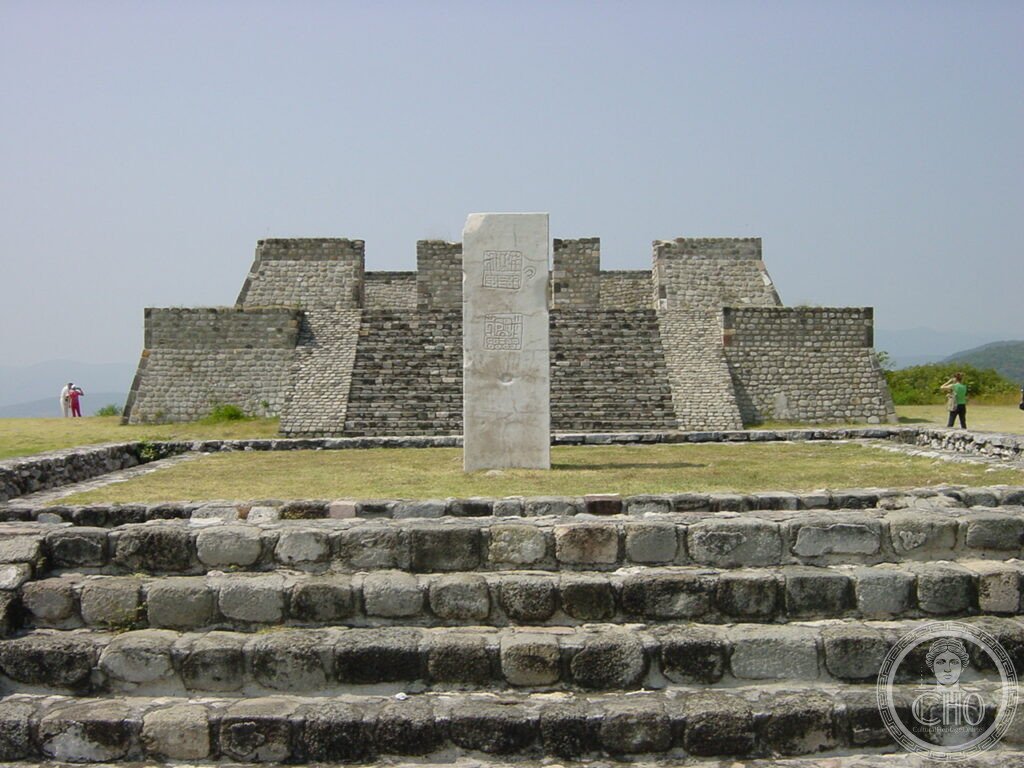
Xochicalco is a fortified hilltop city that rose in Morelos after the collapse of Teotihuacan. Its Temple of the Plumed Serpent carries a continuous carved frieze combining Maya, Zapotec, Gulf Coast and Teotihuacan imagery, thought to record a gathering of astronomer-priests who met here to reconcile the calendars of Mesoamerica. Beneath the hill, a natural cave served as a solar observatory.
At a glance
Xochicalco flourished between roughly 650 and 900 CE, in the period immediately after the fall of Teotihuacan around 550 CE. It developed as a neutral hilltop settlement where representatives of several Mesoamerican civilisations are thought to have met. Tradition links the site to a calendar reform congress held around 650 CE, called to reconcile calendrical systems that had drifted apart across the region; this event is depicted on the Temple of the Plumed Serpent.
Beneath the hilltop lies a natural cave, artificially extended and fitted with a hexagonal shaft open to the sky. On the days each year when the sun passes directly overhead in central Mexico, a column of light falls onto a carved altar in the cave floor, a feature that appears to have been used to calibrate the calendar.
Key facts
- Temple of the Plumed Serpent: the lower storey is entirely covered in carved andesite slabs showing feathered serpents undulating over seated astronomer-priests, understood as a visual record of the calendar reform meeting.
- Iconography: the carving deliberately blends Zapotec, Maya, Gulf Coast and Teotihuacan stylistic elements within a single monument.
- Ball court: an I-shaped court with a stone ring set in the sloping wall, one of the best-preserved examples of the Late Classic period.
- Obsidian workshops: the city’s prosperity relied partly on controlling obsidian trade, with material from the Pachuca and Otumba sources worked here and traded across Mesoamerica.
- Coordinates: 18.8003° N, 99.2996° W.
History
Nahua traditions recorded after the Spanish conquest associate Xochicalco with the birth of Ce Acatl Topiltzin, the legendary ruler later identified with the god Quetzalcoatl. This association gave the site continuing religious significance for the later Toltec and Aztec world.
Xochicalco was burned and abandoned around 900 CE, part of a wider collapse of Classic-period urban centres across Mesoamerica that also affected Monte Albán and the Maya cities within roughly the same century. The causes, whether drought, political upheaval or pressure from new powers to the north, remain debated.
What you see
Xochicalco is among the most heavily fortified sites of the Classic period, with the whole hilltop enclosed by defensive terracing, dry moats and ramparts, a reflection of the unsettled times that followed the fall of Teotihuacan.
The site museum, at the entrance, holds the original bas-relief slabs removed from the Temple of the Plumed Serpent for conservation; high-quality casts stand in their place on the temple itself. The museum also has a room devoted to the cave observatory and a strong collection of Xochicalco ceramics.
Practical information
- Visiting the cave observatory: access is timed around specific viewing periods; current show times are posted at the site entrance and it is worth checking the official channel before travelling.
- Entry and hours: for current admission arrangements, consult the site’s official information rather than third-party listings.
- Time needed: allow a reasonable stretch of the day to see the temple, fortifications, ball court and museum together.
- What to bring: water, given the exposed hilltop setting.
Getting there
Xochicalco lies north of Cuernavaca and south of Mexico City, reachable by road via the Mexico City–Cuernavaca toll road, or by bus from Cuernavaca’s main terminal to Alpuyeca followed by a local combi to the site. Cuernavaca, the nearest city with hotels, makes a practical base.
Nearby
- Cuernavaca — a short drive north; known as the city of eternal spring for its mild year-round climate, with the Cortés Palace of 1522, its Diego Rivera murals of 1929–30, and the Cathedral of the Assumption of 1529 with its martyrdom frescoes and painted trade-route ceiling map.
- Tepoztlán — a Nahua village in a dramatic mountain valley, home to the hilltop Tepozteco Pyramid dated 1100–1400 CE and one of Mexico’s best-preserved colonial Dominican convents, founded in 1559, with syncretic Indian-Christian cloister paintings.
Sources
- Wikipedia
- UNESCO
Find it on the map
See this place and what’s around it →📷 Become a Cultural Heritage Online photographer
Share your photos of places: they stay published under your name as the author. The more they're seen, the more you get noticed — and soon a contest will reward the most appreciated photos.
Log in or sign up free to add a photo