
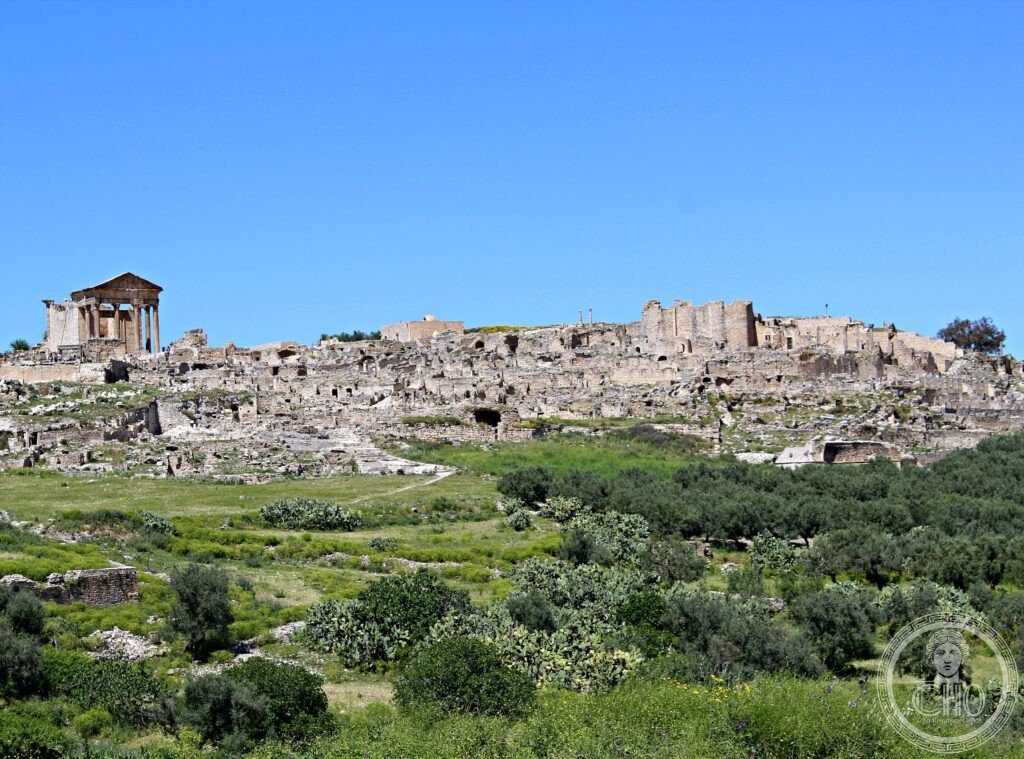
Dougga is the best-preserved Roman city in North Africa, a hillside site that was never built over by a later town. Its Capitol still stands almost intact, its theatre is still used for performances, and a pre-Roman tower tomb recalls the Numidian town that stood here before Rome arrived.
At a glance
Dougga occupies 63 hectares of Tunisian countryside and preserves an almost complete Roman urban landscape from the 2nd and 3rd centuries CE, when the city held a population estimated between 3,000 and 5,000. Unlike Carthage or Utica, it was never overlaid by a medieval or modern town; instead it was slowly stripped of building stone by nearby villages from the 7th century onward, which left its stonework standing rather than buried under later construction. Systematic study of the site began in the nineteenth century.
Before Rome, Dougga was Thugga, a Numidian settlement, and the Libyco-Punic Mausoleum on the site is the only substantial monument surviving from that earlier town.
Key facts
- Capitol: built 166–169 CE, dedicated to Jupiter, Juno and Minerva by Marcius Quadratus and his son; four Corinthian columns of the pronaos still stand, regarded as the finest surviving Roman capitolium outside Rome.
- Theatre: built 168–169 CE, seating around 3,500 across nineteen rows in three sections; still used for performances in summer.
- Libyco-Punic Mausoleum: 2nd century BCE, a three-storey tower tomb around 21 metres tall, built for the Numidian chief Atban; its bilingual Libyan-Punic inscription was central to deciphering the Libyan alphabet.
- Baths of Caracalla: early 3rd century CE, with four pools, among the largest bath complexes outside Rome.
- Coordinates: 36.4232° N, 9.2196° E.
History
Thugga was a Numidian town before it came under Roman control, and the Libyco-Punic Mausoleum is what remains of that earlier settlement. Under Rome the city grew into a substantial provincial centre, supplied with water from a spring at Ain Mizeb some 12 kilometres away via a Roman aqueduct, and served by at least twelve ornate public fountains and several large bath complexes, including the Baths of Caracalla.
The French archaeologist Charles Ernest Beulé, later director of the French School in Athens, carried out the first systematic excavation of the site and identified the Capitol. Further excavation during the French colonial period, running from 1882 to 1956, uncovered most of what is visible today.
What you see
The approach from the car park passes beneath the Arch of Septimius Severus, dedicated in 205 CE to the emperor and his sons Caracalla and Geta, which frames the view towards the Capitol. The Capitol itself, raised in honour of the deified Marcus Aurelius, retains its four standing Corinthian columns and an inner sanctuary with the apse where the cult statue of Jupiter once stood.
The theatre, built in the same period as the Capitol, is well enough preserved to host performances during the summer festival held on site. Among the private houses, the House of the Cyclops once held a mosaic of Odysseus blinding Polyphemus, now removed to the Bardo National Museum in Tunis, where it is counted among the finest Roman mosaics found in Tunisia.
Practical information
- Terrain: the site is hilly with paths of uneven quality; sturdy, comfortable shoes are advisable.
- Shade: there is little or none across the site, so an early visit in warmer months is worth planning for; check the official channel for current visiting arrangements.
- Combine with Tunis: a visit to the Bardo National Museum, which holds mosaics removed from Dougga, adds useful context either before or after seeing the site.
Getting there
Dougga lies inland from Tunis-Carthage airport. A hire car or a guided day tour from Tunis is the most straightforward way to reach the site. Travellers relying on public transport can take a bus from Tunis to the nearby town of Teboursouk and continue to Dougga by taxi.
Nearby
- Bulla Regia — around 45 km west; a Roman city known for houses built partly underground to escape summer heat, with mosaic floors still in place, including the Hunting House and the House of Amphitrite.
- Bardo National Museum, Tunis — around 110 km northeast; holds an extensive collection of Roman mosaics from Tunisian sites, including material from Dougga such as the mosaic of Ulysses and the Sirens.
Sources
- Wikipedia, Dougga
- Wikipedia, Capitol of Dougga
- Wikipedia, Libyco-Punic Mausoleum of Dougga
- UNESCO, Dougga / Thugga, World Heritage Site reference 794
Find it on the map
See this place and what’s around it →📷 Become a Cultural Heritage Online photographer
Share your photos of places: they stay published under your name as the author. The more they're seen, the more you get noticed — and soon a contest will reward the most appreciated photos.
Log in or sign up free to add a photo