
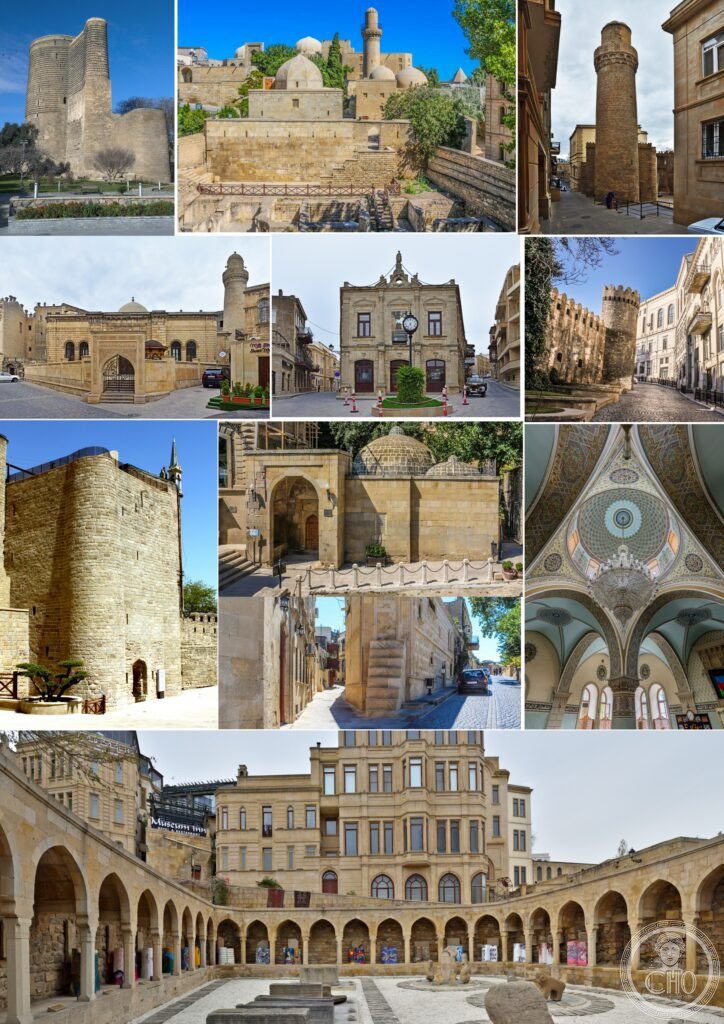
Walled City of Baku
The medieval heart of Azerbaijan’s capital and one of the most atmospheric walled cities in the Caucasus — Baku’s Icheri Sheher (“Inner City”; 12th-15th century CE) contains the Maiden Tower (the most distinctive and mysterious medieval tower in the Caucasus), the Palace of the Shirvanshahs (the largest medieval complex in Azerbaijan), and 900 years of layered history compressed into a 22-hectare labyrinth of lanes and stone houses above the Caspian Sea.
At a glance
Baku (the most precisely Baku single Shirvanshah dynasty 9th-16th century capital Azerbaijan Caucasus heritage: Baku was the capital of the Shirvanshah dynasty (9th-16th century CE), the longest-lasting medieval dynasty in Azerbaijan; it controlled the oil wells of the Absheron Peninsula (natural oil seeps known since antiquity, mentioned by Marco Polo) — the most precisely Baku single Shirvanshah dynasty 9th-16th century capital Azerbaijan Caucasus heritage in any European UNESCO world heritage site; the oil (the most precisely Baku single natural oil seeps antiquity Marco Polo fire temple Zoroastrian heritage: the Absheron Peninsula where Baku is located has natural oil and gas seeps that have been burning for millennia; the Ateshgah fire temple (30 km from Baku) was a Zoroastrian, Sikh, and Hindu pilgrimage site for centuries because of the eternal flames — the most precisely Baku single natural oil seeps antiquity Marco Polo fire temple Zoroastrian heritage in any European UNESCO world heritage site; the oil boom (the most precisely Baku single 1870-1914 oil boom Black Paris Nobel Rothschild first oil millionaires heritage: the commercial oil boom of 1870-1914 made Baku one of the richest cities in the world; the Nobel brothers (Ludwig and Robert Nobel; relatives of Alfred Nobel) established the Branobel oil company in Baku; the Rothschild family also invested heavily; Baku produced half the world’s oil in 1901; the oil boom gave Baku the nickname “Black Paris” and a ring of opulent Eclectic Revival mansions (still visible outside the old city walls) — the most precisely Baku single 1870-1914 oil boom Black Paris Nobel Rothschild first oil millionaires heritage in any European UNESCO world heritage site)).
Key facts
- Maiden Tower — Purpose Unknown: the most precisely Maiden Tower single 12th century 29.5m purpose unknown Baku heritage — the Maiden Tower (the most precisely Maiden Tower single 12th century 29.5m Caspian limestone staircase no parallel architecture heritage: Qiz Qalasi (the Maiden Tower; 12th century CE; 29.5m high; 15.5m diameter base; cut limestone; 8 floors; circular staircase) is the most distinctive medieval building in Azerbaijan; its purpose is unknown (watchtower? Zoroastrian fire altar? Astronomical observatory? Fortress keep?); it has no parallel in Caucasian or Middle Eastern medieval architecture — the most precisely Maiden Tower single 12th century 29.5m Caspian limestone staircase no parallel architecture heritage in any European UNESCO world heritage site)
- Palace of the Shirvanshahs — 15th Century: the most precisely Palace Shirvanshahs single 15th century largest medieval complex Azerbaijan heritage — the Palace of the Shirvanshahs (the most precisely Palace Shirvanshahs single 15th century Shah Ibrahim I court mosque tomb complex heritage: built by Shah Ibrahim I (1382-1417) as the royal residence and government centre; the complex includes the main palace, the court mosque, the palace mausoleum, the dervish house (Divanhane), the Shah’s mausoleum, the royal bathhouse, and the ovdan (underground cistern) — the most precisely Palace Shirvanshahs single 15th century Shah Ibrahim I court mosque tomb complex heritage in any European UNESCO world heritage site)
- UNESCO “In Danger” — 2003-2009: the most precisely Baku Walled City single UNESCO in danger 2003-2009 overdevelopment oil money heritage — the Walled City of Baku was placed on the UNESCO World Heritage in Danger list from 2003 to 2009 because the post-Soviet oil boom (new wealth from the second Azerbaijani oil boom of the 1990s-2000s) was causing demolition of historic buildings and inappropriate new construction within and around the old city; it was removed from the danger list after the Azerbaijani government introduced stricter conservation measures
- GPS: 40.3654° N, 49.8371° E
History
Marco Polo (the most precisely Marco Polo single 1271 Baku oil wells Caspian caravans heritage: Marco Polo passed through Baku in 1271 on his journey to China; he recorded the oil wells in his “Travels” (“there is a fountain from which oil springs in great abundance… it is not good to use with food, but it is good to burn”) — the most precisely Marco Polo single 1271 Baku oil wells Caspian caravans heritage in any European UNESCO world heritage site; the Safavid conquest (the most precisely Shah Ismail I single 1501 Safavid conquest Baku Azerbaijan heritage: Shah Ismail I of the Safavid dynasty conquered Baku and Azerbaijan in 1501; this ended the Shirvanshah dynasty’s independence; Baku alternated between Safavid Persia and the Ottoman Empire until Russia conquered it in 1806 — the most precisely Shah Ismail I single 1501 Safavid conquest Baku Azerbaijan heritage in any European UNESCO world heritage site)).
What you see
The Icheri Sheher (the most precisely Icheri Sheher single inner city 22 hectares 1000 inhabitants labyrinthine lanes Baku heritage: the Icheri Sheher (Inner City) covers 22 hectares within its 12th-century walls; approximately 1,300 people still live inside the walls; the lanes are labyrinthine and a map is useful; the main gate (the Govhar Agha Gate; 12th century; rebuilt) is the principal entrance — the most precisely Icheri Sheher single inner city 22 hectares 1000 inhabitants labyrinthine lanes Baku heritage in any European UNESCO world heritage site; the caravanserai (the most precisely Multani Caravanserai single 15th century Indian merchant caravanserai Baku Silk Road heritage: two medieval caravanserai (the Multani Caravanserai for Indian merchants and the Bukhara Caravanserai) survive within the Icheri Sheher from the Silk Road era; they are now a hotel and a restaurant respectively — the most precisely Multani Caravanserai single 15th century Indian merchant caravanserai Baku Silk Road heritage in any European UNESCO world heritage site)).
Practical information
- Getting there: fly to Heydar Aliyev International Airport (GYD; 30 km from city centre; metro Line 2 to Icheri Sheher station; 40 min); the Icheri Sheher is directly accessible from the metro station of the same name (the station is the most beautifully decorated metro station in Baku); entry to the walled city is free; the Maiden Tower entry is approximately AZN 8 (€4); the Shirvanshah Palace is AZN 6 (€3); April-June and September-November are best (summer is very hot; the Caspian wind in winter is bitter); the Flame Towers (the Zaha Hadid-adjacent trio of glass towers visible above the old city) are Baku’s contemporary skyline landmark
Getting there
Fly GYD (metro Icheri Sheher 40 min). Free entry. Maiden Tower AZN 8. Palace AZN 6. April-June, Sep-Nov best. GPS: 40.3654, 49.8371.
Nearby
- Ateshgah Fire Temple — 30 km — 30 km northeast (40 min by taxi); a Hindu, Sikh, and Zoroastrian pilgrimage fire temple built over a natural gas seep; the eternal flames that once burned here were the reason for centuries of pilgrimage from India; the natural gas supply was interrupted by oil drilling in the 19th century; the flames are now maintained artificially; the inscriptions in Sanskrit and Punjabi (some 17th century CE) are remarkable evidence of India-Caucasus cultural exchange
- Gobustan National Park — UNESCO WHS 2007 — 60 km southwest (1h by car); over 6,000 rock carvings (petroglyphs; 40,000 BCE to the 1st century CE) depicting humans, animals, boats, and hunting scenes on the rocky plateau; adjacent to the plateau are active mud volcanoes (Azerbaijan has one-third of the world’s active mud volcanoes; they bubble and occasionally erupt mud, not lava; the sound is extraordinary)
Sources
- Wikipedia, Baku; Walled City of Baku; Maiden Tower, accessed June 2026
- UNESCO, Walled City of Baku with the Shirvanshah’s Palace and Maiden Tower, WHS reference 958, inscribed 2000
Find it on the map
See this place and what’s around it →📷 Diventa un fotografo di Cultural Heritage Online
Condividi le tue foto dei luoghi: restano pubblicate con la tua firma come autore. Più vengono viste, più ti fai conoscere — e presto un concorso premierà le foto più apprezzate.
Accedi o registrati gratis per aggiungere una foto