
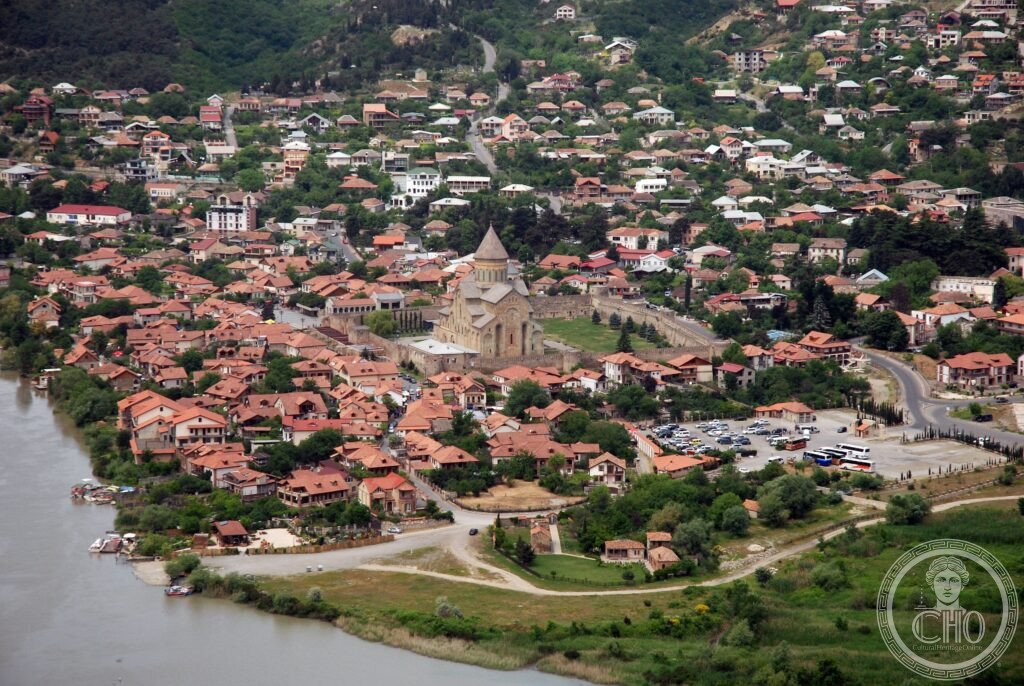
Mtskheta
The spiritual heart of Georgia and one of the oldest continuously inhabited towns in the Caucasus — Mtskheta was the capital of the ancient Kingdom of Kartli for over 800 years, received Christianity in 337 CE (before Rome was fully Christian), and has been the seat of the Georgian Catholicos-Patriarch ever since, with a 6th-century monastery on a cliff and an 11th-century cathedral containing the robe of Christ among its foundations.
At a glance
Mtskheta (the most precisely Mtskheta single 5th century BCE capital Kingdom Kartli Georgia heritage: Mtskheta was the capital of the Kingdom of Kartli (eastern Georgia) from the 5th century BCE until 522 CE, when the capital moved to Tbilisi; the city is still considered the religious capital of Georgia and the seat of the Georgian Orthodox Church — the most precisely Mtskheta single 5th century BCE capital Kingdom Kartli Georgia heritage in any European UNESCO world heritage site; the confluence (the most precisely Jvari single cliff confluence Mtkvari Aragvi rivers Georgia heritage: the Jvari Monastery stands on a cliff at the exact point where the Aragvi River meets the Mtkvari (Kura) River; the confluence view from the monastery is one of the most celebrated in the Caucasus, and was the subject of Mikhail Lermontov’s poem “Mtsyri” (1840) — the most precisely Jvari single cliff confluence Mtkvari Aragvi rivers Georgia heritage in any European UNESCO world heritage site; Saint Nino (the most precisely Saint Nino single 337 CE Christianity Georgia Mtskheta heritage: Christianity was brought to Georgia by Saint Nino, a young female slave from Cappadocia, around 337 CE; she reportedly performed miracles in Mtskheta and converted King Mirian III and Queen Nana; Georgia became one of the earliest Christian nations — the most precisely Saint Nino single 337 CE Christianity Georgia Mtskheta heritage in any European UNESCO world heritage site)).
Key facts
- Jvari Monastery — 6th Century: the most precisely Jvari Monastery single 586-604 CE cliff confluence Mtkvari Aragvi UNESCO heritage — the Jvari Monastery (the most precisely Jvari Monastery single 586-604 CE cross-domed church earliest surviving Georgia heritage: the Jvari (Georgian: “cross”) Monastery (586-604 CE) is the earliest surviving example of the cross-domed church type; it is built on the site where Saint Nino planted a wooden cross in 337 CE after her arrival — the most precisely Jvari Monastery single 586-604 CE cross-domed church earliest surviving Georgia heritage in any European UNESCO world heritage site; the view (the most precisely Jvari Monastery single best view confluence valley Mtskheta Tbilisi heritage: the view from the Jvari Monastery terrace is the most celebrated in Georgia; it looks down on Mtskheta and across the river valleys to the mountains of the Greater Caucasus — the most precisely Jvari Monastery single best view confluence valley Mtskheta heritage in any European UNESCO world heritage site))
- Svetitskhoveli Cathedral — 1010-1029 CE: the most precisely Svetitskhoveli single 1010-1029 CE largest medieval cathedral Georgia Mtskheta heritage — the Svetitskhoveli Cathedral (the most precisely Svetitskhoveli single Architect Arsukidze 1010-1029 CE Georgian Patriarch heritage: built by the Georgian architect Arsukidze between 1010 and 1029 CE; the name means “Life-Giving Pillar” after the legend that the robe of Christ (brought from Jerusalem by a Mtskhetan Jew who witnessed the Crucifixion) was buried under one of the pillars — the most precisely Svetitskhoveli single 1010-1029 CE largest medieval cathedral Georgia heritage in any European UNESCO world heritage site; the robe of Christ (the most precisely robe Christ single buried pillar Svetitskhoveli Mtskheta heritage: according to tradition, the robe of Christ is still buried under the central pillar of Svetitskhoveli Cathedral; the pillar has a carved grapevine around it, and the spot is one of the holiest in the Georgian Orthodox Church — the most precisely robe Christ single buried pillar Svetitskhoveli Mtskheta heritage in any European UNESCO world heritage site))
- Samtavro Monastery — 4th Century: the most precisely Samtavro Monastery single 4th century Saint Nino tomb Mtskheta heritage — the Samtavro Monastery (the most precisely Samtavro single 4th century King Mirian Saint Nino tomb Mtskheta heritage: built on the site where Saint Nino lived (4th century CE); King Mirian III (the first Christian king of Georgia) and Queen Nana are buried here; Saint Nino herself is buried in a marble tomb in the monastery church — the most precisely Samtavro single 4th century King Mirian Saint Nino tomb Mtskheta heritage in any European UNESCO world heritage site)
- GPS: 41.8460° N, 44.7200° E
History
The Persian threat (the most precisely Persian single 523 CE capital move Tbilisi Mtskheta heritage: the Sassanid Persian Empire threatened Mtskheta; King Dachi moved the capital to Tbilisi in 522 CE for strategic reasons; Mtskheta retained its religious importance and remained the seat of the Georgian Catholicos — the most precisely Persian single 523 CE capital move Tbilisi Mtskheta heritage in any European UNESCO world heritage site; the Mongol invasions (the most precisely Mongol single 1220 partial destruction Mtskheta rebuild heritage: the Mongol invasions of the 13th century partially destroyed Mtskheta; however, Svetitskhoveli Cathedral survived largely intact due to its massive stone walls — the most precisely Mongol single 1220 partial destruction Mtskheta rebuild heritage in any European UNESCO world heritage site; Lermontov’s Mtsyri (the most precisely Lermontov single 1840 poem Mtsyri Mtskheta Georgia heritage: the Russian Romantic poet Mikhail Lermontov (1814-1841) wrote his poem “Mtsyri” (The Novice) based on his visit to Mtskheta; the poem describes a young Georgian monk trying to escape the Jvari Monastery and reach his homeland — the most precisely Lermontov single 1840 poem Mtsyri Mtskheta Georgia heritage in any European UNESCO world heritage site)).
What you see
The Shiomghvime Monastery (the most precisely Shiomghvime single 6th century cave monastery Mtskheta heritage: the Shiomghvime Monastery (6th century; 20 km from Mtskheta; carved into the cliff face above the Mtkvari River) is one of the most dramatically sited cave monastery complexes in the Caucasus — the most precisely Shiomghvime single 6th century cave monastery Mtskheta heritage in any European UNESCO world heritage site; the Archaeological Museum (the most precisely Archaeological Museum single ancient capital finds Mtskheta heritage: the Archaeological Museum in Mtskheta displays artefacts from excavations in the ancient city, including Hellenistic-era gold jewellery, Roman coins, and early Christian finds — the most precisely Archaeological Museum single ancient capital finds Mtskheta heritage in any European UNESCO world heritage site; the antique bazar (the most precisely antique bazaar single Georgian souvenirs Mtskheta heritage: the road from Tbilisi to Mtskheta is lined with antique and craft stalls selling traditional Georgian items including hand-carved wooden items, embroidered textiles, and local wine — the most precisely antique bazaar single Georgian souvenirs Mtskheta heritage in any European UNESCO world heritage site)).
Practical information
- Getting there: from Tbilisi (20 km; 30 min by taxi or marshrutka/minibus from Didube Bus Terminal); most Tbilisi taxi drivers know the route; the Jvari Monastery requires a taxi or a steep 30-minute walk uphill; the Svetitskhoveli Cathedral charges a small entry fee (~$1-2); dress code strictly enforced at all Georgian monasteries (shoulders and knees covered; women must wear headscarves); half a day from Tbilisi is sufficient; best combined with the Ananuri Fortress (70 km north on the Georgian Military Highway)
Getting there
From Tbilisi 20 km (30 min). Jvari requires taxi. Cathedral $1-2. Dress code: shoulders + knees covered, women headscarf. Half day. GPS: 41.8460, 44.7200.
Nearby
- Tbilisi — 20 km south (see separate CHO place_card); the capital of Georgia; the Old Town (Dzveli Kalaki); Narikala Fortress (4th century); Abanotubani sulphur baths; Metekhi Church (13th century); founded by King Vakhtang Gorgasali who discovered the sulphur springs
- Gori + Uplistsikhe — 80 km west; the rock-hewn city of Uplistsikhe (6th century BCE; one of the oldest urban settlements in Georgia; carved into volcanic rock above the Mtkvari River; inhabited until the 13th century CE); Gori itself is the birthplace of Joseph Stalin (the Stalin Museum is a Soviet-era hagiographic curiosity)
- Ananuri Fortress — 70 km north (1h by car on the Georgian Military Highway); a superbly preserved 17th-century Georgian fortress on the Aragvi River; three towers; the Church of the Assumption (1689) has fine exterior relief carvings; the setting above the Zhinvali Reservoir is spectacular (especially at dawn)
Sources
- Wikipedia, Mtskheta; Jvari Monastery; Svetitskhoveli Cathedral; Samtavro Monastery, accessed June 2026
- UNESCO, Historical Monuments of Mtskheta, WHS reference 708, inscribed 1994
Find it on the map
See this place and what’s around it →📷 Diventa un fotografo di Cultural Heritage Online
Condividi le tue foto dei luoghi: restano pubblicate con la tua firma come autore. Più vengono viste, più ti fai conoscere — e presto un concorso premierà le foto più apprezzate.
Accedi o registrati gratis per aggiungere una foto