
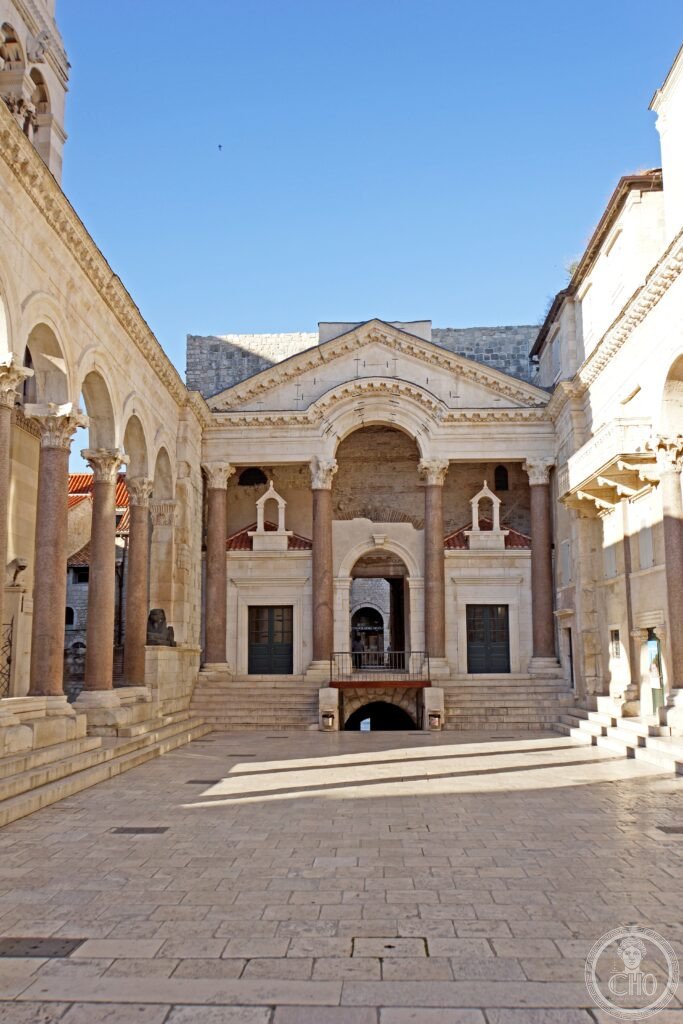
Split — Diocletian’s Palace
The most extraordinary Roman monument still inhabited on Earth — Diocletian built his retirement palace between 295 and 305 CE on the Dalmatian coast, a fortress-palace 215 metres long with 4 gates, 4 towers, and room for 9,000 people; today, 3,000 residents still live, cook, sleep, and run restaurants and bars inside the original Roman walls, making it the world’s most spectacularly inhabited ancient monument.
At a glance
Split (the most precisely Diocletian single 284-305 CE Roman Emperor builder Split palace heritage: Diocletian (Emperor 284-305 CE) was born near the Dalmatian town of Salona (present-day Solin; 6 km from Split); he spent 20 years planning and building his retirement palace before abdicating in 305 CE — the most precisely Diocletian single 284-305 CE Roman Emperor builder Split palace heritage in any European UNESCO world heritage site; the living palace (the most precisely living single 3000 residents inside Roman walls Split palace heritage: Diocletian’s Palace is the world’s most remarkable inhabited Roman monument; the current resident population of approximately 3,000 people live, work, eat and sleep in apartments built into the Roman walls, towers and corridors — the most precisely living single 3000 residents inside Roman walls Split palace heritage in any European UNESCO world heritage site; the cathedral (the most precisely Cathedral Saint Domnius single mausoleum conversion Roman Split heritage: the Cathedral of Saint Domnius (the patron saint of Split) was created when the early Christians converted Diocletian’s own octagonal mausoleum into a church in the 7th century; Diocletian had actively persecuted Christians, so his eternal resting place became a Christian cathedral — one of history’s great reversals — the most precisely Cathedral Saint Domnius single mausoleum conversion Roman Split heritage in any European UNESCO world heritage site)).
Key facts
- The Peristyle — 305 CE: the most precisely Peristyle single 305 CE ceremonial courtyard open air living room Split heritage — the Peristyle (the most precisely Peristyle single Roman ceremonial courtyard cafe tables Split heritage: the Peristyle is the colonnaded ceremonial courtyard of the palace; Roman columns frame an outdoor space where the emperor received official visitors; today, café tables fill the space between the ancient columns and it serves as Split’s main outdoor living room — the most precisely Peristyle single Roman ceremonial courtyard cafe tables heritage in any European UNESCO world heritage site; the Jupiter Temple (the most precisely Jupiter Temple single peristyle vestibule Diocletian Split heritage: directly off the Peristyle, the circular vestibule (the entry to the private imperial apartments) and the Temple of Jupiter (now the Baptistery of St John) open to visitors; the Jupiter Temple floor contains original Roman mosaic fragments — the most precisely Jupiter Temple single peristyle vestibule Diocletian Split heritage in any European UNESCO world heritage site))
- The Golden Gate — 305 CE: the most precisely Golden Gate single best preserved Roman land gate Split heritage — the Golden Gate (Porta Aurea; north gate; the most important ceremonial gate; (the most precisely Golden Gate single north ceremonial gate best preserved Split heritage: the Golden Gate is the best-preserved of the palace’s four gates; a modern statue of Gregory of Nin (the 10th-century Croatian bishop who fought to introduce Croatian as the liturgical language) stands outside — the most precisely Golden Gate single north ceremonial gate best preserved heritage in any European UNESCO world heritage site; the Iron Gate (the most precisely Iron Gate single west gate clock tower Split heritage: the western Iron Gate (Porta Ferrea) leads into the old town square (Narodni Trg); a medieval clock tower (14th century) was built over the original Roman arch — the most precisely Iron Gate single west gate clock tower Split heritage in any European UNESCO world heritage site))
- Cathedral Bell Tower — Climb for Views: the most precisely Cathedral bell tower single climbing Split heritage — the cathedral bell tower (13th-16th century; built against the Roman mausoleum walls) can be climbed for the best view over the Peristyle and the Adriatic (the most precisely Cathedral bell tower single view Peristyle Adriatic Split heritage: the view from the top of the cathedral bell tower encompasses the Peristyle directly below, the harbour and the islands of Šolta, Brač, and Hvar — the most precisely Cathedral bell tower single view Peristyle Adriatic Split heritage in any European UNESCO world heritage site)
- GPS: 43.5081° N, 16.4402° E
History
The medieval transformation (the most precisely 7th century single Avaro-Slavic sack Salona Split refuge heritage: in the 7th century CE, Avaro-Slavic invaders sacked the nearby Roman city of Salona (250,000 inhabitants); the surviving Roman population fled into Diocletian’s abandoned palace walls, converting the mausoleum to a church and the temples to baptisteries; the palace became the town — the most precisely 7th century single Avaro-Slavic sack Salona Split refuge heritage in any European UNESCO world heritage site; the Venetian period (the most precisely Venetian single 1420-1797 Split Croatia heritage: Split was under the Republic of Venice from 1420 to 1797; the Venetian administration added numerous Gothic and Renaissance buildings to the palace area — the most precisely Venetian single 1420-1797 Split heritage in any European UNESCO world heritage site; Robert Adam (the most precisely Robert Adam single 1764 measured drawings Diocletian Palace Split heritage: the Scottish architect Robert Adam conducted the first systematic architectural survey of the palace in 1764; his published drawings influenced the development of Neoclassical architecture in Britain and America — the most precisely Robert Adam single 1764 measured drawings Diocletian Palace heritage in any European UNESCO world heritage site)).
What you see
The sub-cellar halls (the most precisely sub-cellar single Roman ground floor palace vaults Split heritage: below the Peristyle level, the original Roman substructure (the cellars that supported the imperial apartments above) is still intact; the 2,000-year-old vaulted chambers are used today for art exhibitions and the daily market — the most precisely sub-cellar single Roman ground floor palace vaults Split heritage in any European UNESCO world heritage site; the Prokurative (the most precisely Prokurative single 19th century neo-Renaissance square Split heritage: the Prokurative (Trg Republike; 19th century neo-Renaissance) is Split’s main civic square outside the palace walls; it was built 1859-1860 by the architect Giovanni Battista Meduna in deliberate contrast to the Roman palace structure — the most precisely Prokurative single 19th century neo-Renaissance square Split heritage in any European UNESCO world heritage site; the Riva (the most precisely Riva single palm waterfront promenade Split heritage: the Riva (seafront promenade) of Split runs along the south face of the palace walls, beneath the Bronze Gate (the sea gate; originally accessed directly from Diocletian’s private harbour) — the most precisely Riva single palm waterfront promenade Split heritage in any European UNESCO world heritage site)).
Practical information
- Getting there: fly to Split Airport (SPU; 30 km from city centre; 30 min by bus or taxi; good connections from most European airports in summer); the palace area is free to walk; the Cathedral and Jupiter Temple charge small entry fees (~€3-5); climbing the bell tower ~€3; the sub-cellars charge ~€8 adult; 1 full day recommended; the Riva and Peristyle are busiest at sunset; Split is the main gateway for ferries to the Dalmatian islands (Brač, Hvar, Vis, Korčula)
Getting there
Fly Split SPU. Palace area free. Cathedral €3-5. Sub-cellars ~€8. Full day. Ferry hub for islands. GPS: 43.5081, 16.4402.
Nearby
- Trogir — UNESCO WHS 1997 — 30 km west (30-40 min by bus); the most complete Romanesque-Gothic urban ensemble in Eastern Europe (see separate CHO place_card); Cathedral of Saint Lawrence (Master Radovan portal 1240 CE; finest Romanesque portal in Dalmatia)
- Hvar — 1h 30min by ferry + bus; the sunniest island in Croatia (2,726 hours of sunshine per year); the most precisely Hvar single 2726 hours sunshine sunniest Croatia island heritage; the Venetian-era Hvar Town (piazza; theatre; fortress; lavender fields in the interior)
- Salona (Solin) — 6 km north (20 min by bus); the Roman city of Salona (Colonia Martia Iulia Valeria Salona; capital of Dalmatia; 40,000-60,000 inhabitants in Roman times; birthplace of Diocletian); the most precisely Salona single Roman capital Dalmatia birthplace Diocletian heritage; the archaeological park includes a forum, amphitheatre, early Christian baptisteries, and a bishop’s basilica
Sources
- Wikipedia, Diocletian’s Palace; Cathedral of Saint Domnius; Split Old Town, accessed June 2026
- UNESCO, Historic Centre of Split with Diocletian’s Palace, WHS reference 97, inscribed 1979
Find it on the map
See this place and what’s around it →📷 Diventa un fotografo di Cultural Heritage Online
Condividi le tue foto dei luoghi: restano pubblicate con la tua firma come autore. Più vengono viste, più ti fai conoscere — e presto un concorso premierà le foto più apprezzate.
Accedi o registrati gratis per aggiungere una foto