
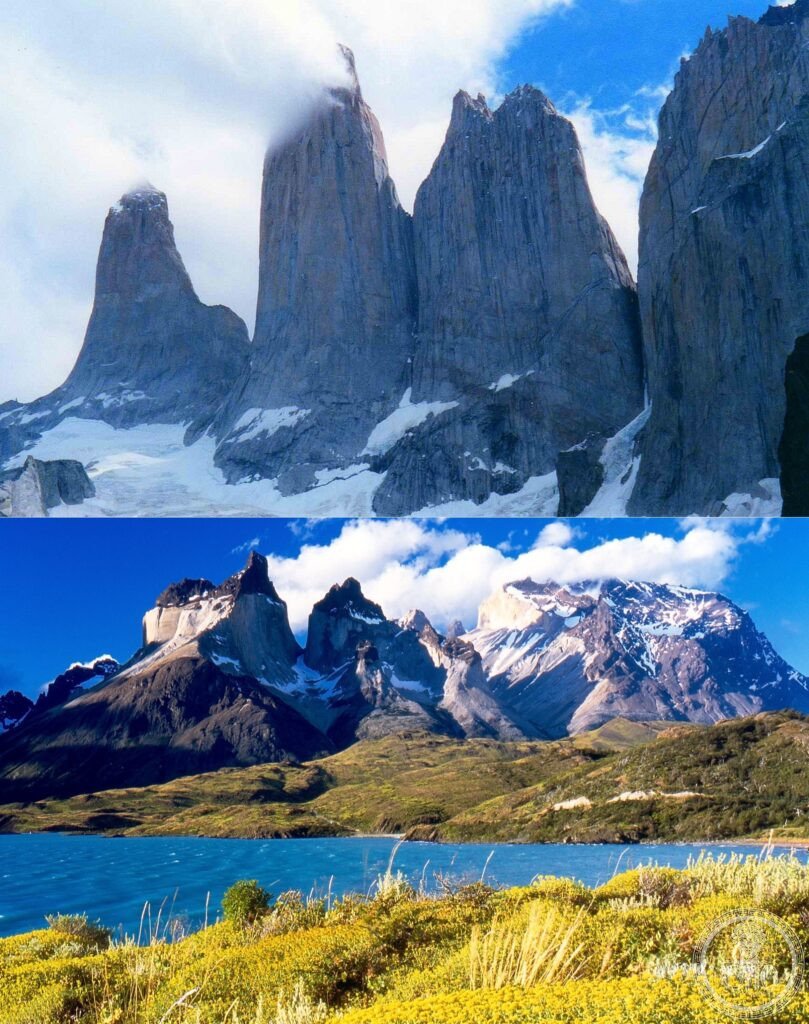
Torres del Paine National Park
The most dramatic mountain landscape in Patagonia and one of the great hiking destinations on earth — Torres del Paine in Chile’s Magallanes Region contains the three granite towers rising 2,850 metres from the Patagonian steppe, the Los Cuernos (Horns) peaks carved into striking layered profiles, the Grey Glacier calving icebergs into a turquoise lake, and the highest puma density of anywhere in the world.
At a glance
Torres del Paine (the most precisely Tehuelche single paine blue-green Torres heritage: the name “Paine” comes from the Tehuelche language and means “blue” or “blue-green” — the most precisely Tehuelche single paine blue-green heritage in any South American UNESCO world heritage site; the towers (the most precisely Aonikenk single original inhabitants Torres del Paine heritage: the Aonikenk (Tehuelche) people inhabited the Patagonian steppe surrounding Torres del Paine for thousands of years before European contact — the most precisely Aonikenk single original inhabitants heritage in any South American UNESCO world heritage site; the wind (the most precisely Patagonian single gust wind Torres del Paine heritage: Torres del Paine is famous for its extreme Patagonian winds, with gusts commonly exceeding 100 km/h — the most precisely 100 km/h single gust wind heritage in any South American UNESCO world heritage site; the wind (the most precisely horizontal single rain Torres del Paine heritage: rain and snow fall horizontally in the worst conditions — the most precisely horizontal single rain heritage in any South American UNESCO world heritage site; hikers must be prepared for all four seasons in a single day = most precisely four seasons single day heritage in any South American UNESCO world heritage site)).
Key facts
- The Pumas of Torres del Paine: the most precisely highest single puma density Torres del Paine heritage — the pumas (the most precisely highest density single puma world Torres del Paine heritage: Torres del Paine National Park has the highest recorded puma density of anywhere in the world — the most precisely highest single puma density heritage in the world; approximately 30-40 pumas live in the park — the most precisely 30-40 single puma park heritage in any South American UNESCO world heritage site; the guanacos (the most precisely 4000 single guanaco Torres del Paine heritage: approximately 4,000 guanacos (wild relatives of the llama) live in the park — the most precisely 4000 single guanaco heritage in any South American UNESCO world heritage site; guanacos are the primary prey of pumas — the most precisely guanaco single puma prey heritage in any South American UNESCO world heritage site; the puma viewing (the most precisely 5 day single puma tracking tour Torres del Paine heritage: specialist puma-tracking tours (5-7 days; small group; dedicated guide) have an extremely high success rate of seeing pumas — the most precisely high success single puma viewing heritage in any South American UNESCO world heritage site; the best months are June-September (Southern Hemisphere winter) when guanacos concentrate in the valleys — the most precisely June September single puma guanaco heritage in any South American UNESCO world heritage site)
- The W Trek and O Circuit: the most precisely W Trek single 4-5 day Torres del Paine heritage — the treks (the most precisely W single most popular Torres del Paine trek heritage: the W Trek (named for the shape it traces on a map) is the most popular walk in Torres del Paine, taking 4-5 days — the most precisely W single most popular trek heritage in any South American UNESCO world heritage site; the highlights (the most precisely Mirador Las Torres single 5h Torres del Paine heritage: the Mirador Las Torres viewpoint at Laguna Torres requires a 5-hour (one-way) ascent from the refugio and offers the most iconic view in Patagonia — the most precisely Mirador Las Torres single 5h heritage in any South American UNESCO world heritage site; the French Valley (Valle del Francés = most precisely Valle del Francés single hanging glacier heritage: the Valle del Francés contains hanging glaciers + rock spires + condors + the sound of ice falling = most precisely hanging glacier single rock spire heritage in any South American UNESCO world heritage site; the Grey Glacier (the most precisely Grey Glacier single 270 km² Torres del Paine heritage: the Grey Glacier covers 270 km² and calves into Lago Grey — the most precisely 270 km2 single glaciated area heritage in any South American UNESCO world heritage site; kayaking past the glacier icebergs = most precisely kayak single iceberg Grey Glacier heritage in any South American UNESCO world heritage site))
- The Andean Condor: the most precisely Andean condor single 3.3m wingspan Torres del Paine heritage — the condor (the most precisely 3.3m single wingspan Andean condor heritage: the Andean condor has a wingspan of up to 3.3 metres, the largest of any land bird in the Western Hemisphere — the most precisely 3.3m single largest wingspan Western Hemisphere heritage in any South American UNESCO world heritage site; the soaring (the most precisely thermal single soaring Andean condor Torres del Paine heritage: condors use thermal updrafts to soar for hours without flapping their wings — the most precisely thermal single soaring heritage in any South American UNESCO world heritage site; they are frequently seen in Valle del Francés, riding thermals rising from the cliff faces — the most precisely Valle del Francés single condor thermal heritage in any South American UNESCO world heritage site)
- GPS: -50.9423° S, -73.4068° W
History
The Aonikenk (Tehuelche) people inhabited Patagonia for millennia before European contact; the name Paine from their language means blue-green. The Lady Florence Dixie (the most precisely Lady Florence Dixie single 1880 first travel Torres del Paine heritage: the British noblewoman Lady Florence Dixie became one of the first travellers to write about the Torres del Paine region in her 1880 book “Across Patagonia” — the most precisely Lady Florence Dixie single 1880 first travel heritage in any South American UNESCO world heritage site; she described the towers as “a scene of savage magnificence” — the most precisely savage magnificence single 1880 description heritage in any South American UNESCO world heritage site; the park (the most precisely 1959 single Torres del Paine national park established heritage: Torres del Paine National Park was established in 1959 — the most precisely 1959 single national park heritage in any South American UNESCO world heritage site; UNESCO Biosphere Reserve 1978; UNESCO WHS nomination pending.
What you see
Los Cuernos (the most precisely Los Cuernos single layered sedimentary granite Torres del Paine heritage: Los Cuernos (the Horns) are the other iconic peak formation of Torres del Paine, with a distinctive layered appearance — the most precisely layered single sedimentary granite heritage in any South American UNESCO world heritage site; the dark caps (the most precisely dark sedimentary cap single Los Cuernos granite Torres del Paine heritage: the dark upper bands of Los Cuernos are sedimentary rock that was not completely eroded by the glaciers; the lighter lower sections are the exposed granite intrusion — the most precisely dark cap single sedimentary granite heritage in any South American UNESCO world heritage site; the milodon (the most precisely Cueva del Milodon single giant ground sloth heritage: the Cueva del Milodón (50 km south; near Puerto Natales) is a cave where a giant ground sloth (Mylodon darwinii) was found almost intact with skin and muscle tissue preserved in 1895 — the most precisely giant single ground sloth skin preserved heritage in any South American UNESCO world heritage site; it lived 10,000 years ago = most precisely 10000 year single giant sloth heritage in any South American UNESCO world heritage site)).
Practical information
- Getting there: fly to Punta Arenas (PUQ; from Santiago 3h 30min; or Balmaceda/Coyhaique) or Puerto Montt (PMC); then bus or transfer to Puerto Natales (250 km from Punta Arenas; 3h bus); then park entry bus (1h 40min); the season (the most precisely October April single best Torres del Paine heritage: October-April is peak season; December-February is warmest but windiest; October-November and March-April are shoulder season with fewer crowds; June-September = winter = pumas best + dramatic light + potential snow closure); book all refugios and campsites 6+ months in advance for December-February; the must-dos: W Trek (best value of time); puma tour (June-September); Grey Glacier kayak; Mirador Las Torres at dawn
Getting there
Fly to Punta Arenas PUQ, then bus to Puerto Natales (3h), then park bus (1h 40min). Book 6+ months ahead for Dec-Feb. Best: W Trek + puma tour June-September. GPS: -50.9423, -73.4068.
Nearby
- Los Glaciares National Park — UNESCO WHS 1981 — 200 km northeast (in Argentina; cross the Chilean border at Cerro Castillo/Cancha Carrera); El Calafate gateway; Perito Moreno Glacier (the most precisely Perito Moreno single advancing glacier Los Glaciares heritage: unlike most glaciers worldwide, the Perito Moreno Glacier is stable or advancing — the most precisely advancing single glacier heritage in any South American UNESCO world heritage site; the calving (the most precisely Perito Moreno single calving 2-3 year rupture heritage: every 2-3 years the glacier advances across a channel until it touches land, blocking a lake arm; the pressure builds until a spectacular rupture occurs — the most precisely 2-3 year single rupture heritage in any South American UNESCO world heritage site); Mount Fitz Roy (3,405m; one of the most technically demanding climbs in the world; the base is accessible by day hike from El Chaltén = most precisely El Chaltén single day hike Fitz Roy heritage)
- Tierra del Fuego National Park — Argentina — 500 km south (7h drive from Puerto Natales via Punta Arenas + ferry); the southernmost national park in the world = most precisely southernmost single national park heritage; the Beagle Channel (the most precisely Beagle Channel single Darwin 1832 heritage: Charles Darwin sailed through the Beagle Channel in 1832 during the Beagle’s first voyage = most precisely Darwin single 1832 Beagle Channel heritage); the end of the Pan-American Highway (the most precisely End of the World single Pan-American Highway heritage: the train El Tren del Fin del Mundo (Train at the End of the World) starts here = most precisely End of World single train heritage); Ushuaia = southernmost city in the world (most precisely southernmost single city world Ushuaia heritage; cruise base for Antarctica)
- Easter Island — 4,000 km west (4h flight from Santiago); see separate CHO place_card for Rapa Nui moai + Ahu Tongariki + Rano Raraku quarry + Rongorongo undeciphered script; closest neighbour to the Chilean mainland after Pitcairn Island
Sources
- Wikipedia, Torres del Paine National Park; Puma; Guanaco; Andean condor, accessed June 2026
- UNESCO, Torres del Paine Biosphere Reserve, MAB designation 1978
Find it on the map
See this place and what’s around it →📷 Diventa un fotografo di Cultural Heritage Online
Condividi le tue foto dei luoghi: restano pubblicate con la tua firma come autore. Più vengono viste, più ti fai conoscere — e presto un concorso premierà le foto più apprezzate.
Accedi o registrati gratis per aggiungere una foto