
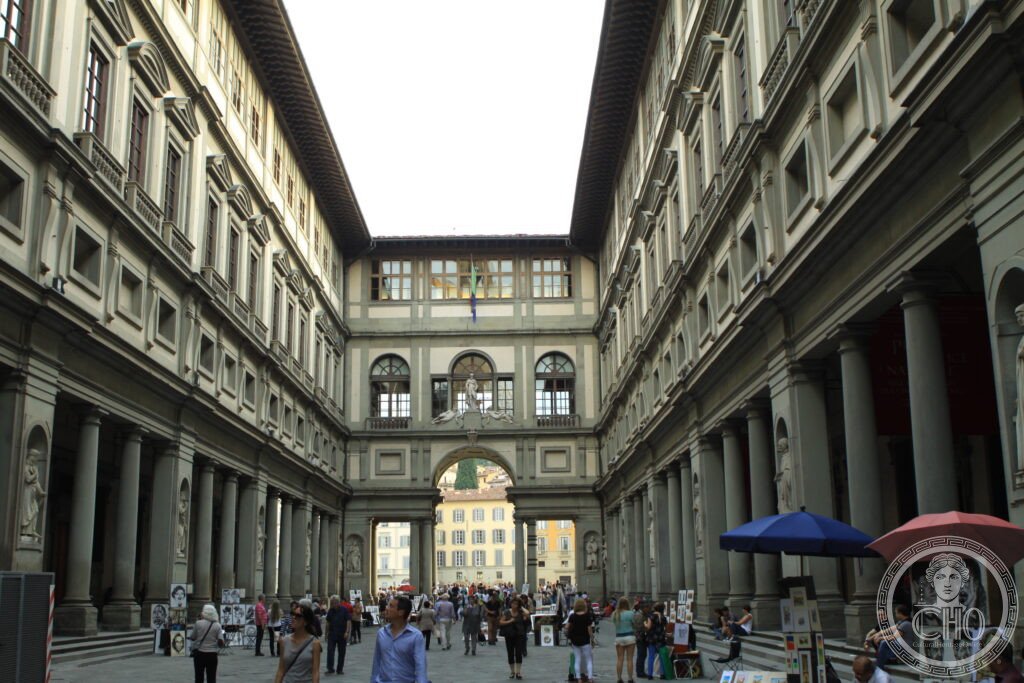
The Medici built it as an office block — uffizi means offices — and filled the top floor with the family’s paintings. Two centuries later the last of the line left the whole collection to Florence on one condition: that it must never leave the city. It never has, which is why the greatest gathering of Italian Renaissance painting is in the building where it was assembled.
At a glance
Giorgio Vasari designed the Uffizi for Cosimo I de’ Medici from 1560 as a single administrative building for the Tuscan state, two long wings enclosing a narrow courtyard that opens at one end onto the Arno. The upper floor was given over to the display of the family’s collection almost from the start, and the Tribuna, the octagonal room built by Bernardo Buontalenti in the 1580s to hold the most precious objects, is the ancestor of every museum gallery since. The collection became public property through the bequest of Anna Maria Luisa de’ Medici in 1737, opened to visitors on request in 1769, and now occupies both the first and the second floors of the building.
Key facts
- The Family Pact of 1737: Anna Maria Luisa, the last of the Medici, left the entire collection to the Tuscan state on condition that nothing ever be removed from Florence. It is the reason the city still holds what it holds, and one of the earliest acts of heritage protection anywhere in Europe.
- Botticelli: the Birth of Venus and the Primavera are the pictures most people come for. They now face each other in a redisplayed suite of rooms, in sealed cases and under new lighting, with the heavy outer glass removed so the paintings can be seen directly.
- The Vasari Corridor: built in 1565, it runs about a kilometre from the Uffizi across the Ponte Vecchio, over the goldsmiths’ shops, to Palazzo Pitti, so that the Grand Duke could move between his home and his offices without going through the streets. It has reopened to visitors after eight years of closure, on restricted access.
- Not only Botticelli: Leonardo’s Annunciation and unfinished Adoration of the Magi, Michelangelo’s Doni Tondo, Raphael, Titian’s Venus of Urbino, Caravaggio’s Medusa and Bacchus, and Gentile da Fabriano and Piero della Francesca among the earlier rooms.
- Heritage: within the Historic Centre of Florence, UNESCO World Heritage Site since 1982.
- GPS: 43.7677° N, 11.2555° E
History
The Medici had been collecting for a century before the building existed. Cosimo the Elder and then Lorenzo the Magnificent gathered antiquities, manuscripts, gems and paintings, and the habit continued through the grand-ducal line. Cosimo I commissioned Vasari in 1560 to gather the scattered magistracies of the state into one structure between Palazzo Vecchio and the river; the architect died in 1574 with the work unfinished, and Buontalenti completed it, adding the Tribuna in the 1580s as a jewel-box for the best of the collection.
The dynasty ended in 1737. Anna Maria Luisa, sister of the last Grand Duke, signed the agreement that transferred everything to the incoming Lorraine rulers and, through them, to Florence, binding it to the city in perpetuity. The gallery opened to visitors by request in 1769 and to the public properly in the following century. Two later dates matter: in 1966 the flood of the Arno reached the lower floors and damaged the deposits; in 1993 a car bomb detonated behind the west wing, killing five people and destroying part of the building and several works. Both scars are visible in the museum’s own account of itself. The long project known as the New Uffizi has since roughly doubled the number of rooms in use.
What you see
The visit runs along the second-floor corridors first — long galleries under grotesque frescoes, lined with ancient sculpture, with the windows giving views over the courtyard, the Arno and the Palazzo Vecchio — and the rooms opening off them in roughly chronological order, from the great thirteenth-century altarpieces of Cimabue, Duccio and Giotto through the fifteenth century to Botticelli and Leonardo. The first floor holds the later collections: Caravaggio and the seventeenth century, the foreign schools, and the temporary exhibitions.
Outside, the courtyard is lined with nineteenth-century statues of illustrious Tuscans — Dante, Giotto, Machiavelli, Galileo, Leonardo, Michelangelo — and ends at the loggia above the river. The view back from the far end, with the Palazzo Vecchio tower framed between the wings, is the composition Vasari intended.
Practical information
- Booking: strongly advisable and effectively necessary in season — timed entry is booked on the museum’s own site, with a reservation fee on top of admission. Without it, queues of a couple of hours are ordinary in summer.
- When to go: at opening or in the last two hours of the afternoon; the Botticelli rooms are the pinch point in the middle of the day. The museum closes on Mondays.
- Vasari Corridor: visited separately, with its own ticket and limited numbers; check availability well ahead.
- Combined visits: the Uffizi Galleries also include Palazzo Pitti and the Boboli Gardens across the river; a combined ticket exists and makes sense over several days rather than one.
Getting there
The entrance is on Piazzale degli Uffizi, beside Piazza della Signoria, about fifteen minutes on foot from Santa Maria Novella station. The historic centre is closed to traffic; there is no useful parking nearby. GPS: 43.7677, 11.2555.
Nearby
- Palazzo Vecchio — adjoining; the seat of government the Uffizi was built to serve, with the Salone dei Cinquecento and Vasari’s ceiling.
- Ponte Vecchio — two minutes; the corridor runs above the shops on its eastern side.
- Palazzo Pitti and the Boboli Gardens — across the river at the far end of the corridor; the grand-ducal residence and its garden.
Sources
- Gallerie degli Uffizi — official site: the building, the visit route, the Botticelli redisplay and the Vasari Corridor
- Ministero della Cultura (Italy) — Gallerie degli Uffizi, institutional profile
- UNESCO World Heritage Centre, Historic Centre of Florence, inscribed 1982
- Encyclopaedia Britannica, Uffizi Gallery
Find it on the map
See this place and what’s around it →📷 Become a Cultural Heritage Online photographer
Share your photos of places: they stay published under your name as the author. The more they're seen, the more you get noticed — and soon a contest will reward the most appreciated photos.
Log in or sign up free to add a photoIs this page about you?
This page is read by travellers and heritage enthusiasts who find it on Google. Tell us how you are connected to this place and we will take it from there.