
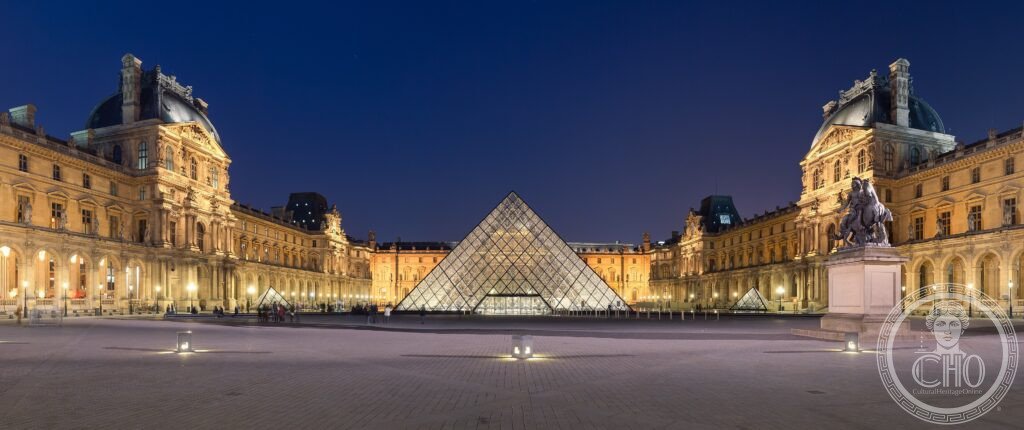
A medieval fortress rebuilt as a royal palace and opened to the public in 1793, the Louvre now holds one of the largest and most varied art collections in the world, from the Mona Lisa to the Venus de Milo, beneath I. M. Pei’s glass pyramid.
At a glance
The Louvre began life in 1190 as a fortress built by Philippe II Auguste to defend Paris against English invasion. Francis I had most of the medieval structure demolished in 1541 to make way for a Renaissance royal palace. During the French Revolution, on 10 August 1793, the building reopened as a public museum, on the grounds that art confiscated from the Church and the aristocracy now belonged to the people. The opening fell on the first anniversary of the French Republic.
Key facts
- Location: 1st arrondissement, Paris, on the right bank of the Seine.
- Collection: around 380,000 objects, with roughly 35,000 on display across three wings — Richelieu, Sully and Denon.
- Gallery space: approximately 72,735 m².
- Highlights: Leonardo da Vinci’s Mona Lisa (c.1503–1519), the Venus de Milo (c.100 BCE), and the Winged Victory of Samothrace (c.190 BCE).
- The pyramid: designed by I. M. Pei, 21 metres high with a 35-metre square base and 603 glass panes, inaugurated on 30 March 1989.
- GPS: 48.8606° N, 2.3376° E.
History
Louis XIV moved the royal court to Versailles in 1682, and the Louvre was largely abandoned as a residence, falling into disrepair and becoming home to artists and squatters. Its rebirth as a public museum in 1793 was followed, under Napoleon I, by a rapid expansion of the collection through works confiscated from conquered territories; the Grande Galerie filled with paintings from Italy, Spain, Germany and the Netherlands, though much of this was returned after Waterloo.
Napoleon III completed the Richelieu Wing in 1857, giving the palace much of its present form. Over a century later, I. M. Pei’s glass pyramid was added to the Cour Napoléon and inaugurated in 1989; Parisians initially dismissed it as a folly, though it is now widely admired. The Louvre lies within the Banks of the Seine, inscribed as a UNESCO World Heritage Site in 1991.
What you see
The Galerie d’Apollon, designed by Charles Le Brun in 1661, houses the French Crown Jewels and served as the model for the Hall of Mirrors at Versailles. The Cour Carrée, the oldest surviving part of the present palace, is the largest preserved Renaissance courtyard in Europe. In the basement of the Sully Wing, visitors can see the excavated and lit foundations of Philippe-Auguste’s 1190 fortress, including its moat and a reconstructed wooden bridge.
In the Denon Wing, the Mona Lisa hangs in the Salle des États behind glass, viewed from a short distance; Leonardo’s Virgin of the Rocks hangs nearby and draws far smaller crowds. The Venus de Milo and the Winged Victory of Samothrace, the latter positioned at the top of the Daru staircase, are among the other set-piece works in the collection.
Practical information
- Tickets: booking a timed entry slot online is strongly advised, since queues at the pyramid entrance can be considerable without one — check the museum’s official website for current details.
- Best times: the Louvre stays open later on certain evenings, which tend to be quieter than daytime hours; consult the official site for the current schedule.
- Seeing the Mona Lisa: arriving as the museum opens gives the best chance of viewing it without a large crowd.
- Planning a visit: the collection is too large to see in a single day, so choosing three or four priorities in advance is more rewarding than attempting everything; the Louvre’s own app offers navigation and audio guides, and three to four hours is a reasonable allowance for a focused visit.
Getting there
The nearest metro stop is Palais Royal–Musée du Louvre, served by Lines 1 and 7. The RER A stops at Châtelet–Les Halles, a short walk away.
Nearby
- Tuileries Garden — directly east of the museum, a large formal garden leading to the Place de la Concorde.
- Musée d’Orsay — a walk west along the Seine, home to a major collection of Impressionist and Post-Impressionist painting.
- Sainte-Chapelle and Notre-Dame de Paris — on the Île de la Cité; Sainte-Chapelle is a UNESCO-listed royal chapel from 1248 known for its stained glass, while Notre-Dame, badly damaged by fire in 2019, reopened in December 2024 after restoration.
- Centre Pompidou — to the east, the Musée National d’Art Moderne occupies a building by Renzo Piano and Richard Rogers with its structural services exposed on the exterior.
Sources
- Wikipedia — Louvre
- Wikipedia — Mona Lisa
- Wikipedia — Venus de Milo
- Wikipedia — Winged Victory of Samothrace
- James Gardner, The Louvre: The Many Lives of the World’s Most Famous Museum, Atlantic Monthly Press, 2020
- Dan Brown, The Da Vinci Code, Doubleday, 2003
Gallery
Find it on the map
See this place and what’s around it →📷 Become a Cultural Heritage Online photographer
Share your photos of places: they stay published under your name as the author. The more they're seen, the more you get noticed — and soon a contest will reward the most appreciated photos.
Log in or sign up free to add a photoRequest to use these images
Each photograph is by the person named on it. Cultural Heritage Online is the seller: it runs the payment, handles tax and delivers the file, and the photographer receives 70% of the price net of tax. Buying gives you the right to use the image in your own project — a website, an article, a presentation — with the file and a written licence. Read the Terms of Sale.
What you receive. The file as it is held in our archive: the photographer's own original, without the Cultural Heritage Online watermark, unretouched and not enlarged. This is a working archive built over many years by many people, so the files differ — some were taken recently, others years ago with the equipment of their time. Older pictures are usually smaller: a camera from fifteen or twenty years ago simply recorded fewer pixels than a phone does today, so the resolution is lower and the print comes out smaller. We say so rather than hide it. The size, weight, format and year of each one are printed below it, and the print size is given at 300 dpi. Nothing is upscaled to make a number look better. Where the picture on this page has been cropped for the layout, the file you receive is the full frame, which may be wider or taller than what you see here.
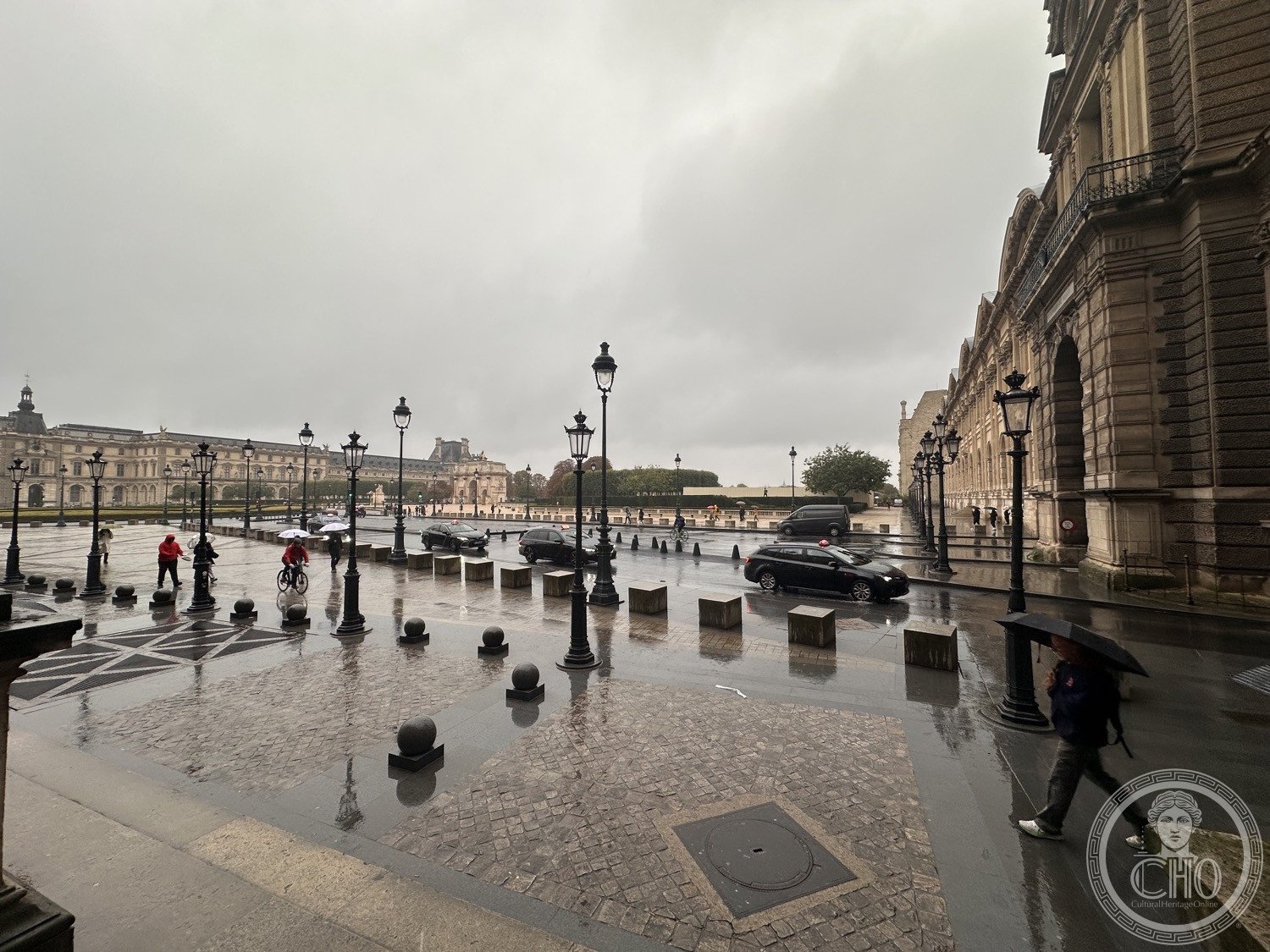
Louvre Museum — Paris, October 2024
Photo: Luigi De Marchi
€3.00
1500 × 1125 px · JPG · 427.3 KB
prints 13 × 10 cm at 300 dpi · taken 2024
Is this page about you?
This page is read by travellers and heritage enthusiasts who find it on Google. Tell us how you are connected to this place and we will take it from there.