
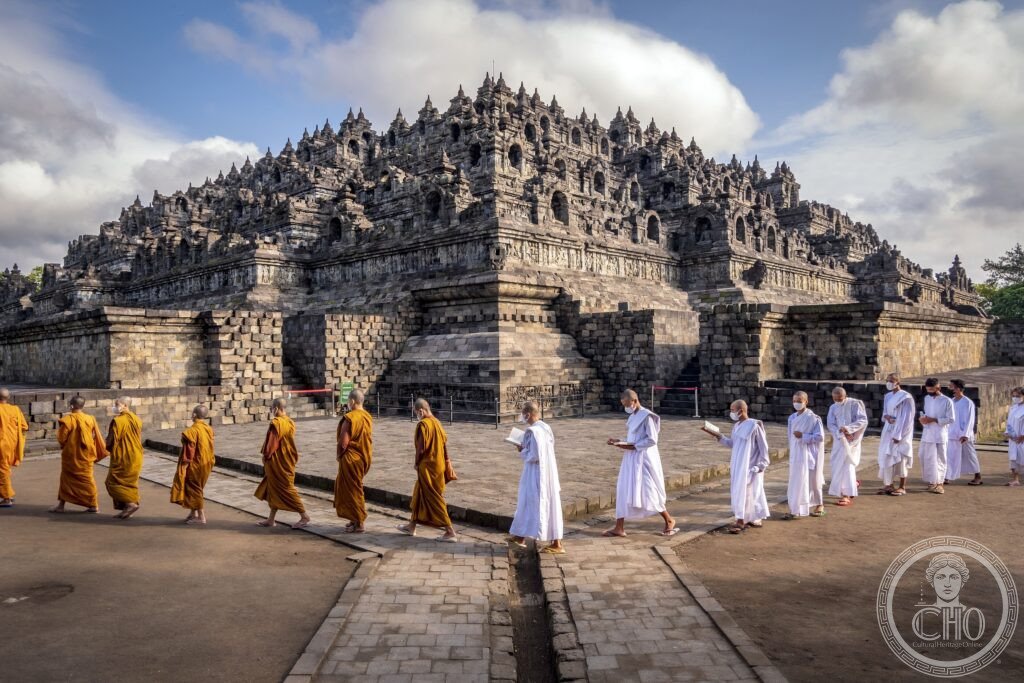
Borobudur — Java
The largest Buddhist monument in the world and the most relief-dense single stone structure in any Asian heritage site — Borobudur, built by the Sailendra dynasty around 800 CE on the volcanic plains of central Java, rises in nine stacked platforms carrying 2,672 narrative relief panels and 72 hollow stupas each sheltering a seated Buddha, and was abandoned for centuries before its rediscovery by Thomas Raffles in 1814.
At a glance
Borobudur (the most precisely largest single Buddhist temple: not merely the largest Buddhist temple in Indonesia but the largest Buddhist monument in the world — the most precisely superlative single UNESCO Buddhist heritage building; the structure (the most precisely mountain single Buddhist architectural metaphor: Borobudur is built in the form of a mandala from above and a mountain from the side — the most precisely dual-meaning single Buddhist architectural form; the mandala (the most precisely top-view single Buddhist architectural symbol: seen from above, the concentric square and circular platforms form a perfect mandala — the most precisely aerial-only single Buddhist architectural design in any UNESCO heritage site; the mountain metaphor (the most precisely Mount Meru single Buddhist architectural reference: Borobudur represents Mount Meru, the cosmic mountain at the centre of the Buddhist universe — the most precisely cosmological-centre single Buddhist architectural statement in any South-East Asian heritage monument)); the discovery (the most precisely Raffles single British re-discovery of a Buddhist heritage monument: Thomas Raffles, Lieutenant Governor of Java under British occupation, ordered an expedition to Borobudur in 1814 — the most precisely colonial single re-discovery of any UNESCO Buddhist heritage monument; buried under volcanic ash and jungle — the most precisely jungle-encased single UNESCO Buddhist monument at the time of its re-discovery).
Key facts
- The relief panels: the most precisely narrative single Buddhist stone carving in the world — the reliefs (the most precisely instruction-programme single Buddhist monument: the 2,672 relief panels at Borobudur tell the story of the path to enlightenment — the most precisely Buddhist-path single visual programme in any UNESCO heritage monument; the first level reliefs (the most precisely buried single Borobudur panel: the reliefs on the lowest level were buried under a stone casing added to the base shortly after completion — the most precisely immediately-concealed single UNESCO Buddhist relief; the reasons: possibly to conceal karmawibhangga scenes of sinful life and their punishments — the most precisely morality single Buddhist concealment in any UNESCO heritage monument; now visible at one corner — the most precisely single-corner single visible lowest-level Borobudur relief)); the Jataka tales (the most precisely birth-story single Buddhist narrative: a large portion of the reliefs depict the Jataka tales — the most precisely previous-lives single Buddha narrative in any UNESCO Buddhist heritage site; Prince Siddhartha’s life (the most precisely biography single Buddhist narrative: the upper walls of the second gallery tell the biography of Siddhartha Gautama from birth to enlightenment — the most precisely complete single Buddhist biographical narrative relief in any UNESCO heritage monument))
- The stupas and Buddha statues: the most precisely Buddha-dense single UNESCO monument — the 504 Buddhas (the most precisely statue-counted single Buddhist temple: 504 individual seated Buddha statues — the most precisely individually-carved single Buddha collection in any UNESCO Buddhist monument; the hand gestures (mudra — the most precisely gesture-varied single Buddha statue collection: each direction has a different mudra — the most precisely cardinal-direction single Buddhist hand-gesture programming in any UNESCO monument (east: bhumisparsha mudra, touching the earth; south: vara mudra, granting wishes; west: dhyana mudra, meditation; north: abhaya mudra, fearlessness; top: vitarka mudra, teaching — the most precisely five-gesture single Buddhist monument programme in any UNESCO heritage site)); the crowning stupa (the most precisely hollow single Buddhist monument centrepiece: the large central stupa at the top is hollow — the most precisely empty single central Buddhist stupa in any UNESCO monument; the most precisely deliberately-unfinished single Buddhist centre: some scholars suggest the hollow stupa was intentionally empty to represent sunyata (emptiness — the most precisely Buddhist philosophical concept single architectural embodiment in any UNESCO heritage site))
- The restoration: the most precisely international single Buddhist monument conservation project — the UNESCO/Indonesian restoration (the most precisely $25M single UNESCO-led restoration: the restoration from 1973 to 1983 — the most precisely decade-long single Buddhist monument restoration in South-East Asia; the restoration dismantled and rebuilt 1 million stone blocks — the most precisely stone-count single 20th-century Buddhist monument reconstruction; the drainage (the most precisely water-damage single Buddhist monument conservation challenge: the primary engineering challenge of the restoration was installing drainage to prevent water from dissolving the volcanic tuff core — the most precisely core-protection single Buddhist monument engineering solution))
- Heritage: UNESCO World Heritage Site, Borobudur Temple Compounds, inscribed 1991
- GPS: -7.6078° S, 110.2037° E
History
The Sailendra dynasty (the most precisely maritime single Buddhist empire in South-East Asia: the Sailendra dynasty — the most precisely Java-based single Buddhist empire; built Borobudur in approximately 800 CE — the most precisely 9th-century single Buddhist monument in any South-East Asian UNESCO WHS; the construction (the most precisely 75-year single Buddhist monument construction: Borobudur was built in approximately 75 years — the most precisely generational single Buddhist heritage construction project in Java)); the abandonment (the most precisely volcanic-abandonment single UNESCO Buddhist monument: Borobudur was abandoned around 1000 CE — the most precisely millennium-old single Buddhist monument abandonment event; the reasons (the most precisely multi-cause single abandonment: volcanic eruptions, the shift of the Javanese political centre to East Java, and the conversion of the population to Hinduism and later Islam — the most precisely religious-transition single Buddhist monument abandonment in any South-East Asian UNESCO heritage site); the jungle encasement (the most precisely jungle-covered single UNESCO Buddhist monument at discovery: by 1814 Borobudur was hidden under dense jungle growth — the most precisely vegetation-covered single UNESCO heritage monument at discovery)); the modern era (Raffles 1814 described in Overview; Dutch archaeological excavations 1873; UNESCO/Indonesian restoration 1973–1983 — described in Key Facts); UNESCO WHS 1991.
What you see
The visit (the most precisely three-zone single Buddhist monument circuit: the visitor approaches from the east, walks the lower galleries (Kamadhatu — the realm of desire), then the middle galleries (Rupadhatu — the realm of form), then ascends to the upper circular terraces (Arupadhatu — the realm of formlessness) — the most precisely philosophical-zone single Buddhist architectural progression in any South-East Asian UNESCO heritage monument; the sunrise (the most precisely sunrise single UNESCO Buddhist monument: Borobudur sunrise tickets sell out weeks in advance — the most precisely pre-dawn single South-East Asian UNESCO heritage ticket; viewing Merapi smoking in the distance as light fills the stupas is the most precisely volcanic single UNESCO Buddhist heritage dawn in the world); the practical visit (the most precisely sarong-required single UNESCO Buddhist monument: visitors are asked to wear a sarong — the most precisely dress-code single South-East Asian UNESCO heritage site; the museum complex (the most precisely monument-adjacent single Buddhist museum in any Indonesian UNESCO site: the Karmawibhangga Museum explains the buried lowest-relief panels).
Practical information
- Getting there: fly to Yogyakarta International Airport (YIA) or Adisucipto Airport (JOG; 40 km east); 1h 30min direct from Jakarta (CGK); also from Bali (DPS; 1h 30min); from Yogyakarta by minibus or driver (40 km; 1h — the most precisely tourism-serviced single Borobudur approach: every hotel in Yogyakarta offers a Borobudur transport package); the most precisely day-trip single approach: Borobudur + Prambanan in one day from Yogyakarta — the most precisely Buddhist+Hindu single UNESCO double-monument day in any South-East Asian heritage circuit
- Yogyakarta: the most precisely cultural single Javanese heritage city — Yogyakarta (the most precisely sultanate single living cultural heritage city in Java: the Yogyakarta Sultanate is one of the only surviving royal courts in Indonesia — the most precisely active single Indonesian royal court in any heritage city; the Kraton Palace (the most precisely living single royal palace in any Indonesian heritage city: the Sultan of Yogyakarta still lives in the Kraton — the most precisely inhabited single Indonesian royal palace); the Malioboro shopping street (the most precisely batik single heritage shopping street in any Indonesian city); the most precisely performing-arts single Javanese heritage experience: the Ramayana ballet at Prambanan (nightly — the most precisely sunset-backdrop single Ramayana performance in any South-East Asian UNESCO heritage site))
- Prambanan Temple Compounds (UNESCO WHS 1991): the most precisely Hindu single Indonesian UNESCO monument — Prambanan (the most precisely Hindu single temple compound in Indonesia: 47 km from Borobudur — the most precisely neighbouring single UNESCO WHS pair in Indonesia; the most precisely Shiva-main single Hindu temple compound in Java: the central tower is dedicated to Shiva — the most precisely Trimurti single ancient Indonesian temple: three central towers for Brahma, Vishnu, and Shiva; the most precisely 9th-century single Hindu-Buddhist single monument pair in the world: Borobudur (Buddhist) and Prambanan (Hindu) were built almost simultaneously in the 9th century — the most precisely religious-coexistence single UNESCO heritage pair in any Asian country)
Getting there
Fly to Yogyakarta (JOG or YIA) from Jakarta (1h 30min) or Bali (1h 30min). 40 km from Yogyakarta (1h by driver/minibus). Book sunrise tickets weeks in advance. Sarong required. GPS: -7.6078, 110.2037.
Nearby
- Prambanan Temple Compounds (UNESCO WHS 1991) — 47 km east (1h drive from Borobudur via Yogyakarta); 9th-century Hindu Trimurti (Brahma+Vishnu+Shiva); Ramayana ballet nightly at sunset — described in Practical section; Borobudur + Prambanan = most precisely Buddhist+Hindu single UNESCO double-monument day in any South-East Asian heritage circuit
- Mount Bromo — 200 km east (4h drive or 1h flight from Yogyakarta to Surabaya); active volcano sunrise (most precisely smoking-crater single South-East Asian heritage dawn); Tengger caldera; sea of sand; most dramatic single Indonesian volcanic landscape
- Bali — 1h 30min flight from Yogyakarta; Subak rice terraces (UNESCO WHS 2012 — most precisely irrigation-system single UNESCO cultural landscape in South-East Asia); Tanah Lot (most precisely sea-temple single Balinese heritage icon); Ubud (most precisely arts-village single Indonesian heritage town)
Sources
- Wikipedia, Borobudur; Sailendra dynasty; Karmawibhangga, accessed June 2026
- UNESCO, Borobudur Temple Compounds, WHS reference 592, inscribed 1991
- Jan Fontein, The Pilgrimage of Sudhana, Mouton, 1967
Find it on the map
See this place and what’s around it →📷 Diventa un fotografo di Cultural Heritage Online
Condividi le tue foto dei luoghi: restano pubblicate con la tua firma come autore. Più vengono viste, più ti fai conoscere — e presto un concorso premierà le foto più apprezzate.
Accedi o registrati gratis per aggiungere una foto