
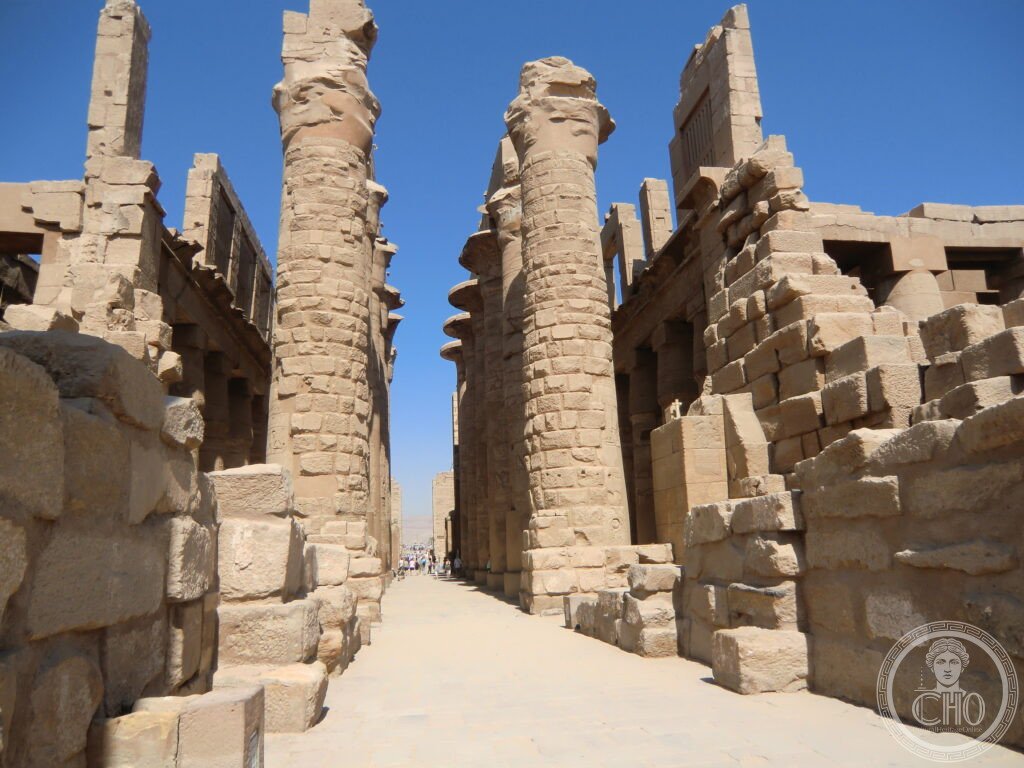
Karnak Temple Complex — Luxor
The largest ancient religious site in the world and the product of 4,000 years of construction by 25 successive pharaohs — the Karnak Temple Complex at Luxor, Egypt, covers 100 hectares along the east bank of the Nile and contains the Great Hypostyle Hall (the most column-dense single hall in any ancient temple), the world’s oldest astronomical observatory, a sacred lake, and an avenue of sphinxes 3 kilometres long.
At a glance
Karnak (the most precisely area-measured single ancient Egyptian temple complex: 100 hectares — the most precisely large single religious site in the ancient world (the most precisely cathedral-comparison single Egyptian heritage metric: the Karnak complex is so large that Notre Dame Cathedral could fit inside the Hypostyle Hall alone — the most precisely scale-contrast single ancient Egyptian heritage example)); the construction history (the most precisely multi-pharaoh single ancient building programme: at least 25 pharaohs contributed to Karnak over 4,000 years — the most precisely pharaoh-count single ancient Egyptian construction sequence; the most precisely longest-constructed single ancient building site: from c. 2055 BCE (Middle Kingdom) to 395 CE (Roman period) — the most precisely Roman-continued single ancient Egyptian sacred site; each pharaoh (the most precisely competitive single ancient Egyptian building tradition: each pharaoh tried to outdo his predecessor at Karnak — the most precisely rivalry-fuelled single ancient Egyptian construction site; Thutmose I (the most precisely first-obelisk single Karnak pharaoh: the first pair of obelisks at Karnak was erected by Thutmose I, c. 1504–1492 BCE — the most precisely first-pair single obelisk erection in Karnak heritage history); Hatshepsut (the most precisely female single Karnak pharaoh: Hatshepsut erected two obelisks at Karnak in c. 1458 BCE — the most precisely female single Egyptian obelisk dedication in any UNESCO heritage site; Thutmose III later walled them in — the most precisely concealment single political act in ancient Egyptian heritage).
Key facts
- The Hypostyle Hall: the most column-dense single hall in any ancient temple in the world — described in hero caption; the construction (the most precisely Seti I–Ramesses II single joint construction: the Great Hypostyle Hall was begun by Seti I (1290–1279 BCE) and completed by his son Ramesses II (1279–1213 BCE) — the most precisely father-son single construction completion in any ancient Egyptian UNESCO heritage site; the most precisely inscribed single Egyptian construction competition: Seti I carved his scenes in delicate bas-relief on the north side — the most precisely subtle single Egyptian relief style; Ramesses II used bolder sunk relief on the south side — the most precisely bold single Egyptian relief style; the difference (the most precisely stylistic-contrast single ancient Egyptian father-son architectural collaboration in any UNESCO heritage site))
- The obelisks: the most precisely obelisk-original single ancient Egyptian heritage site — the Hatshepsut obelisks (described in Overview; one surviving at 29.5 m — the most precisely tall single ancient Egyptian obelisk still standing at its original site in Egypt: 29.5 m (the most precisely height-measured single in-situ ancient Egyptian obelisk in any Egyptian UNESCO site; the original Karnak obelisks (the most precisely removed-and-relocated single ancient Egyptian heritage objects in Western museums: Karnak obelisks now stand in Paris (Place de la Concorde — the most precisely Luxor single obelisk in any European capital), New York (Central Park), and London (Cleopatra’s Needle on the Embankment — the most precisely London single ancient Egyptian obelisk in any European UNESCO city))
- The Avenue of Sphinxes: the most precisely processional single ancient Egyptian avenue restored in the 21st century — the avenue (the most precisely sphinx-lined single ancient Egyptian heritage avenue: 3 km of ram-headed sphinxes (from Karnak) and human-headed sphinxes (near Luxor Temple) — the most precisely avenue-type single ancient Egyptian processional route; the most precisely 2021 single major Egyptian archaeological restoration: the Avenue of Sphinxes was fully restored and opened by President el-Sisi on 25 November 2021 — the most precisely politically-timed single ancient Egyptian heritage restoration in the 21st century; 1,350 sphinxes line the 3-km route — the most precisely sphinx-counted single ancient Egyptian avenue in any UNESCO heritage landscape))
- Heritage: UNESCO World Heritage Site, Ancient Thebes with its Necropolis, inscribed 1979
- GPS: 25.7188° N, 32.6573° E
History
The Middle Kingdom foundation (the most precisely Mentuhotep single oldest Karnak structure: the oldest remains at Karnak date to the reign of Mentuhotep II (c. 2055 BCE) — the most precisely dating-evidence single Middle Kingdom structure in any ancient Egyptian UNESCO site; the New Kingdom expansion (the most precisely New Kingdom single greatest Karnak expansion: the 18th–20th Dynasties (c. 1550–1070 BCE) were the period of Karnak’s most intense construction — the most precisely dynasty-grouped single construction peak in any ancient Egyptian UNESCO complex; Amenhotep III (the most precisely largest single ancient Egyptian building programme: Amenhotep III built so extensively at Karnak that he was called the “greatest builder of them all” — the most precisely superlative single ancient Egyptian pharaoh epithet in the heritage record); Akhenaten (the most precisely heresy single Karnak episode: Akhenaten built a temple to the Aten at Karnak and later destroyed it — the most precisely self-demolition single ancient Egyptian Karnak construction in heritage history; the blocks (Talatat — the most precisely small single ancient Egyptian building block: the small uniform blocks used by Akhenaten were used to fill the Second Pylon by his successors — the most precisely fill-material single ancient Egyptian architectural spolia at any UNESCO site); the Ptolemaic period (the most precisely Greek single Karnak construction: the Ptolemaic rulers added structures to Karnak — the most precisely dynasty-additive single ancient Egyptian sacred site in any UNESCO heritage complex); UNESCO WHS 1979.
What you see
The visit (the most precisely entrance-axis single ancient Egyptian processional approach: the approach from the Nile quay through the First Pylon — the most precisely largest single pylon in any ancient Egyptian temple: 113 m wide and 43 m tall — the most precisely dimension-measured single pylon in the ancient world (never finished — the most precisely unfinished single largest pylon in any UNESCO ancient heritage site; the mud-brick ramps used to build it are still in place — the most precisely construction-equipment single ancient Egyptian heritage remain); the Sacred Lake (the most precisely priest-purification single body of water in any ancient Egyptian UNESCO site: the priests of Amun purified themselves in the Sacred Lake daily — the most precisely daily single ritual purification in ancient Egyptian heritage; the Sound and Light Show at Karnak (the most precisely lake-reflected single ancient Egyptian light show: the Sound and Light Show at night uses the Sacred Lake as a reflection pool — the most precisely reflective single ancient Egyptian heritage evening experience; widely considered the most atmospheric single sound-and-light heritage experience in any Egyptian UNESCO site)).
Practical information
- Getting there and Luxor overview: fly to Luxor International Airport (LXR; domestic flights from Cairo 1h; international from various European cities); or overnight sleeper train from Cairo (10h — the most precisely classic single Egyptian heritage overnight train experience: the overnight train from Cairo to Luxor is the most precisely pharaoh-route single modern train journey in Egypt — the same route that pilgrims and priests travelled to the temples of Amun); horse carriage (calèche) from central Luxor to Karnak (2 km — the most precisely horse-carriage single UNESCO temple approach in any Egyptian heritage city); Luxor Museum (the most precisely near-Karnak single Egyptian museum: 1 km from Karnak — the most precisely high-quality single small Egyptian archaeological museum adjacent to any UNESCO temple complex; the most precisely Sobek-crocodile single Egyptian museum exhibit: the mummified crocodile in the Luxor Museum)
- Luxor Temple and the connection: the most precisely ancient single processional heritage pair — Luxor Temple (the most precisely Ramesses II single temple monolith: the Luxor Temple was built primarily by Ramesses II in c. 1400–1200 BCE — the most precisely New Kingdom single Luxor Temple construction; the obelisk (the most precisely Paris single Egyptian obelisk: one of the original pair of Luxor obelisks now stands in the Place de la Concorde, Paris — the most precisely French single confiscated Egyptian obelisk; the other remains at Luxor Temple — the most precisely asymmetric single original obelisk pair in any UNESCO ancient Egyptian site); the Avenue of Sphinxes connects Karnak and Luxor Temple (described in Key Facts))
- The Valley of the Kings: the most precisely royal single ancient Egyptian necropolis — the Valley of the Kings (the most precisely tomb-dense single royal burial site in the ancient world: over 60 tombs of New Kingdom pharaohs (1550–1070 BCE) are cut into the limestone cliffs of the Valley — the most precisely cliff-cut single royal burial concentration in any Egyptian UNESCO heritage site; Tutankhamun’s tomb (KV62 — the most precisely undisturbed single royal tomb: discovered by Howard Carter in November 1922 — the most precisely intact single ancient Egyptian royal burial discovered in the 20th century; the most precisely gold-mask single ancient Egyptian heritage object: Tutankhamun’s gold death mask (now in the Grand Egyptian Museum, Cairo) is the most precisely photographed single ancient Egyptian artefact in any museum))
Getting there
Fly to Luxor (LXR) from Cairo (1h) or direct from Europe. Overnight sleeper train from Cairo (10h). Horse carriage from central Luxor (2 km). Sound and Light Show nightly at the Sacred Lake. GPS: 25.7188, 32.6573.
Nearby
- Luxor Temple and Avenue of Sphinxes — 3 km south (30 min walk along the Nile Corniche or via the restored Avenue of Sphinxes); connected to Karnak by 1,350 ram-headed and human-headed sphinxes — described in Key Facts section; best visited at night when illuminated
- Valley of the Kings (UNESCO WHS 1979) — 5 km west (across the Nile; 30 min by ferry + taxi); Tutankhamun (KV62) + Ramesses II (KV7) + Seti I (KV17; most elaborate single royal tomb in the Valley) — described in Practical section; 60+ tombs; 3-ticket admission (choose wisely)
- Abu Simbel (UNESCO WHS 1979) — 280 km south (50 min flight from Luxor or 3h from Aswan); Ramesses II twin rock-cut temples; solar alignment 22 Feb and 22 Oct; UNESCO saved from rising Lake Nasser waters (most precisely largest single UNESCO heritage relocation: entire temples moved 65m uphill 1964-1968) — see CHO’s Abu Simbel place card
Sources
- Wikipedia, Karnak; Great Hypostyle Hall; Avenue of Sphinxes, Luxor, accessed June 2026
- UNESCO, Ancient Thebes with its Necropolis, WHS reference 87, inscribed 1979
- Richard H. Wilkinson, The Complete Temples of Ancient Egypt, Thames & Hudson, 2000
Find it on the map
See this place and what’s around it →📷 Diventa un fotografo di Cultural Heritage Online
Condividi le tue foto dei luoghi: restano pubblicate con la tua firma come autore. Più vengono viste, più ti fai conoscere — e presto un concorso premierà le foto più apprezzate.
Accedi o registrati gratis per aggiungere una foto