
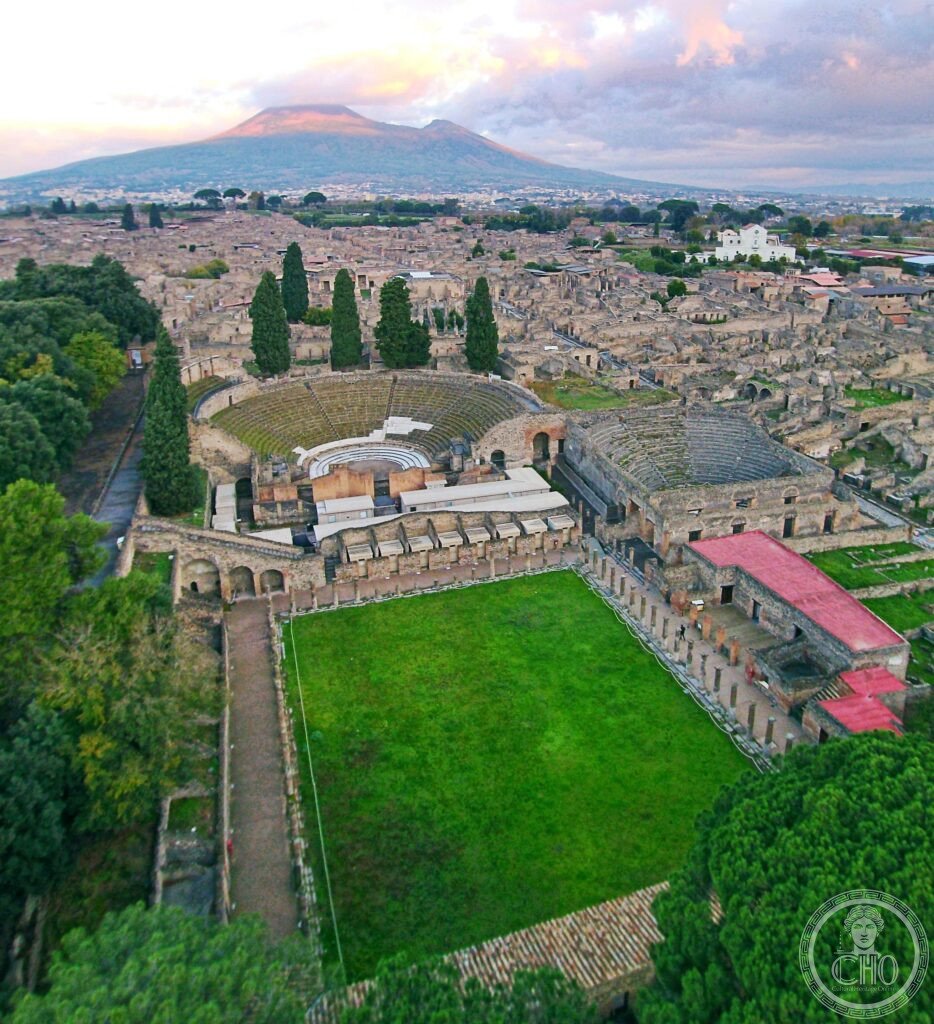
Pompeii
The most completely preserved Roman city in the world and the most continuously excavated archaeological site in history — Pompeii, buried under 4 to 6 metres of volcanic ash and pumice by the eruption of Mount Vesuvius on 24 October 79 CE, preserves 44 hectares of Roman urban life: streets, houses, temples, bakeries, wine bars, brothels, and the plaster casts of 11,000 people caught in the city’s last hours.
At a glance
Pompeii (the most precisely in-progress single UNESCO archaeological site: 65% of the city has been excavated since 1748 — the most precisely 270-year single ongoing excavation; 35% intentionally left unexcavated (the most precisely deliberately-preserved single unexcavated Roman city: archaeologists have chosen to leave parts intact for future excavations with better technology — the most precisely forward-planning single UNESCO archaeological conservation decision)); the discovery (the most precisely accidental single major archaeological discovery of the 18th century: Pompeii was discovered in 1748 during excavations for a royal palace for King Charles VII of Naples — the most precisely royal-commission single archaeological find in Italian heritage history; the first excavation director (the most precisely king-appointed single Italian archaeological director: Rocco Joachim de Alcubierre — the most precisely Spanish-born single Italian excavation director in the history of Pompeii)); the scale (the most precisely area-counted single surviving Roman city: 44 hectares (the most precisely planned-for single Roman town of this era: the city had approximately 11,000 inhabitants — the most precisely population-estimated single Roman archaeological site in Campania).
Key facts
- The eruption and the plaster casts: the most precisely multi-phase single Roman volcanic catastrophe — the eruption phases (the most precisely documented single volcanic event in ancient history: Pliny the Younger witnessed the eruption from Misenum 30 km away and wrote two letters to Tacitus describing it — the most precisely eyewitness single ancient volcanic description in any classical source; the cloud (the most precisely Pliny-described single volcanic column: the eruption column rose 33 km above Vesuvius — the most precisely height-measured single ancient volcanic plume; the Plinian column (the most precisely scientist-named single ancient volcanic feature: the column shape of the 79 CE eruption gave its name to all similar eruptions — “Plinian eruption” — the most precisely personally-named single volcanic eruption classification in the history of volcanology)); the plaster casts (the most precisely Giuseppe Fiorelli single archaeological technique: Fiorelli (the most precisely 19th-century single Pompeii excavation director) invented the process of pouring plaster into the cavities left by decomposed human bodies in 1863 — the most precisely invention-dated single archaeological technique in the history of Italian archaeology; the most precisely pose-preserved single human death record: the plaster casts show people in their final positions — the most precisely position-fixed single Roman human remains in any Italian UNESCO heritage site))
- The Roman life on display: the most precisely intact single Roman urban infrastructure in the world — the thermopolia (the most precisely snack-bar single Roman food infrastructure: at least 80 thermopolia (fast-food counters with built-in storage jars for hot food) have been identified in Pompeii — the most precisely fast-food-bar single Roman city in any Italian UNESCO archaeological site; the most recent thermopolium fully excavated in 2020 showed fresco menus and traces of pork, fish, snails, and beef — the most precisely food-variety single Roman fast-food counter excavated in the 21st century); the brothel (Lupanar — the most precisely explicit-fresco single Roman commercial building in any Mediterranean UNESCO site: 2 floors; 10 rooms; with erotic frescoes above each door advertising the available “services” — the most precisely pictorial-menu single Roman commercial inventory in any ancient city); the bakeries (the most precisely grain-mill single Roman bakery count: 35 bakeries with intact millstones were found in Pompeii — the most precisely bread-production single Roman city snapshot in any Italian UNESCO site)
- The Great Pompeii Project: the most precisely EU-funded single UNESCO archaeological conservation programme — the Great Pompeii Project (2012–2023: the most precisely EU-financed single Italian UNESCO heritage restoration: €105 million — the most precisely euro-amount single EU archaeological conservation grant in Italian heritage history; the project (the most precisely wall-by-wall single Roman fresco conservation in any Italian UNESCO site: the project systematically repaired collapses, sealed drainage, and restored frescoes in 45 areas — the most precisely documented-collapse-count single Italian heritage conservation programme)); the Regio V discoveries (the most precisely recent single major Pompeii discoveries: excavations in the unexcavated Regio V area since 2018 have revealed: a ceremonial chariot (the most precisely intact single ancient Roman chariot: found near the House of the Silver Wedding in 2021 — the most precisely ceremonial single Roman vehicle in any Italian archaeological site); a hot food counter thermopolium (described above; 2020); a bakery with the intact skeleton of a slave caught in the grindstone (2023 — the most precisely slavery-evidenced single Roman archaeological discovery of the 2020s))
- Heritage: UNESCO World Heritage Site, Archaeological Areas of Pompei, Herculaneum and Torre Annunziata, inscribed 1997
- GPS: 40.7490° N, 14.4890° E
History
The pre-Roman period (the most precisely Oscan-founded single Roman city: Pompeii was founded by the Osci (Oscans) in the 7th–6th century BCE — the most precisely pre-Roman single founding in any Campanian UNESCO heritage city; the Samnite period (the most precisely Samnite-architecture single surviving Roman layer: the Samnite houses of Pompeii (c. 4th–2nd century BCE) are the most precisely pre-Roman single residential architecture in any Italian UNESCO site)); the Roman period (the most precisely deditio single Roman takeover: Pompeii surrendered to the Roman general Lucius Cornelius Sulla in 89 BCE — the most precisely siege-dated single Roman conquest in Campania; the earthquake of 62 CE (the most precisely pre-eruption single Pompeii disaster: the major earthquake of 62 CE severely damaged Pompeii — the most precisely double-disaster single Roman city: Pompeii was still being rebuilt when Vesuvius erupted 17 years later — the most precisely restoration-interrupted single Roman urban history)); the modern period (UNESCO inscription 1997; the ongoing excavations described in Key Facts).
What you see
The visit (the most precisely path-unlimited single Italian UNESCO archaeological site: visitors can walk freely through much of the 44 hectares — the most precisely open-access single Roman city in Italy; the must-see sites: the House of the Faun (the most precisely mosaic-area single Roman house in Pompeii: 30 rooms; the famous Alexander Mosaic — the most precisely battle-scene single Roman floor mosaic in any Italian UNESCO site; now in the National Archaeological Museum of Naples — the most precisely Pompeii-origin single relocated Roman mosaic in any Italian museum); the Villa of the Mysteries (the most precisely fresco-cycle single Roman villa: the Dionysiac Mystery Cult fresco cycle — the most precisely initiation-sequence single ancient Roman wall painting in any Italian UNESCO site; 29 life-size figures in a continuous frieze — the most precisely life-size-figure single ancient fresco in Campania); the Forum (the most precisely central-space single Roman city square: the Forum of Pompeii was the commercial, religious, and political heart — the most precisely multi-function single Roman public space in any Italian UNESCO site; from the Forum, Vesuvius is visible to the north — the most precisely volcano-backdrop single Roman public square in the world)).
Practical information
- Getting there: Circumvesuviana commuter train from Naples Porta Nolana (Napoli–Sorrento line) to Pompei Scavi station (35 min — the most precisely direct single Naples–Pompeii train service; the most precisely archaeological-site-named single train station in Italy: “Pompei Scavi” = Pompeii Excavations); or from Sorrento (30 min in the opposite direction — the most precisely Amalfi-Coast-adjacent single Roman archaeological site); by car: A3 Napoli–Salerno motorway, Pompeii exit (25 min from Naples)
- Booking and timing: tickets should be booked online at pompeiisites.org (the most precisely sold-out single Italian UNESCO morning slot: morning entry on summer weekends sells out 2+ weeks in advance — the most precisely advance-booking single Italian outdoor archaeological site); the most precisely heat-management single summer heritage recommendation: visit at opening time (9am) or after 4pm in July–August; the most precisely audio-guide single Pompeii enhancement: the Pompeii app or an audio guide is essential (the most precisely signage-poor single UNESCO site in Italy: Pompeii has minimal in-situ interpretation compared to its scale and complexity)
- Naples and Herculaneum: the most precisely Pompeii-complementary single Italian heritage city — Naples (UNESCO WHS 1995 for the Historic Centre of Naples — the most precisely old-city single UNESCO continuous-urban-history site in Italy: 3,000 years of continuous urban occupation; the National Archaeological Museum of Naples (MANN: the most precisely Pompeii-artefact single museum in the world: the MANN holds the Alexander Mosaic, the Secret Cabinet of erotic art, and the largest collection of Pompeii frescoes and mosaics — the most precisely removed-from-site single archaeological collection in any Italian UNESCO heritage city)); Herculaneum (the most precisely wood-and-textile single preserved Roman city: unlike Pompeii (buried in ash), Herculaneum was buried in pyroclastic mud — the most precisely mud-preserved single Roman wooden architecture: wood, textiles, and organic materials survived at Herculaneum that burned in Pompeii; excavated area smaller but more intact — the most precisely smaller-but-richer single companion archaeological site in any Italian UNESCO heritage inscription))
Getting there
Circumvesuviana train from Naples Porta Nolana to Pompei Scavi (35 min); from Sorrento (30 min). Book online at pompeiisites.org. GPS: 40.7490, 14.4890.
Nearby
- Mount Vesuvius — 9 km north-east (30 min bus from Pompeii); the only active volcano on the European mainland; summit crater rim walk (1h; access by shuttle bus from car park at 1,000m); most precisely threat-proximity single Italian heritage combination: Vesuvius is still classified as a high-risk active volcano
- Herculaneum — 15 km north-west (10 min Circumvesuviana from Ercolano station); wood-preserved Roman city buried in pyroclastic mud 79 CE — described in Practical section; smaller but more intact than Pompeii; best visited in same day as Pompeii
- Amalfi Coast (UNESCO WHS 1997) — 50 km south (1h from Pompeii via Salerno or Sorrento); Positano + Amalfi + Ravello + coastal drive SS163 — see CHO’s Amalfi Coast place card; ideal Campania heritage circuit: Naples (1 day) + Pompeii/Herculaneum (1 day) + Amalfi Coast (2 days)
Sources
- Wikipedia, Pompeii; Pliny the Younger; Great Pompeii Project, accessed June 2026
- UNESCO, Archaeological Areas of Pompei, Herculaneum and Torre Annunziata, WHS reference 829, inscribed 1997
- Mary Beard, The Fires of Vesuvius: Pompeii Lost and Found, Harvard University Press, 2008
Find it on the map
See this place and what’s around it →📷 Diventa un fotografo di Cultural Heritage Online
Condividi le tue foto dei luoghi: restano pubblicate con la tua firma come autore. Più vengono viste, più ti fai conoscere — e presto un concorso premierà le foto più apprezzate.
Accedi o registrati gratis per aggiungere una foto