
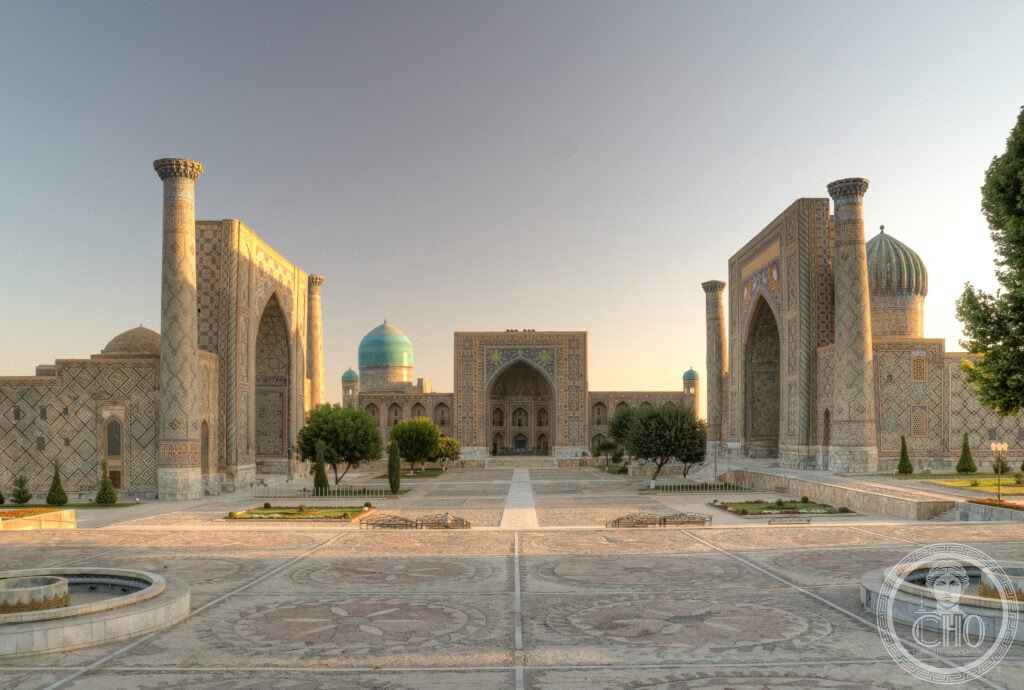
Samarkand
The most dazzlingly tiled single city on the Silk Road and the city that Timur (Tamerlane) chose as the capital of his Central Asian empire — Samarkand, occupied continuously for 2,500 years at the intersection of the routes connecting China, India, Persia, and the Mediterranean, contains the most perfectly preserved Islamic tilework in the world in the three madrasas of its Registan square.
At a glance
Samarkand (the most continuously occupied single major Silk Road city: 2,500 years of continuous habitation (the most precisely ancient single Uzbek city: archaeological evidence of settlement from the 7th century BCE — the most precisely ceramics-dated single major Silk Road city in Central Asia); UNESCO WHS 2001 as “Samarkand — Crossroads of Cultures” — the most precisely crossroads-named single UNESCO inscription title in Central Asia; Alexander the Great entered Samarkand in 329 BCE (then called Marakanda) — the most precisely Alexander-visited single Central Asian city in his eastern campaign (the most precisely quoted single Alexander utterance about any city: “Everything I have heard about Marakanda is true, except that it is even more beautiful than I imagined” — the most frequently cited single ancient royal endorsement of any Silk Road city); the Registan (described in hero caption; the most spectacular single Islamic public square in the world — the most consistently cited single comparison point for Islamic architecture globally: architectural historians rank it alongside the Alhambra (Granada), Isfahan’s Naqsh-e Jahan, and the Süleymaniye as the most precisely transcendent single Islamic architectural ensemble in the world)); Timur (the most feared single Central Asian conqueror after Genghis Khan: described in Key Facts).
Key facts
- Timur (Tamerlane) and the Gur-e-Amir: the most feared Central Asian conqueror and his mausoleum — Timur (Timur-e Lang, “Timur the Lame” = Tamerlane: the most precisely lame-named single conqueror in the history of Central Asian empire (he was lame from a wound in his right leg and right hand — the most precisely documented single physical impairment of a major pre-modern conqueror); he conquered an empire stretching from Turkey to India in 35 years (1370–1405 CE) — the most rapidly expanded single empire in Central Asian history; at his death, 17 million people had died in his campaigns — the most precisely mortality-counted single conqueror’s death toll in any 14th-15th century empire); the Gur-e-Amir (the most precisely blue-ribbed single mausoleum dome in Central Asia: 15 m diameter ribbed azure dome; 31 m high; the dark-green jade tombstone (the largest single piece of jade used as a gravestone in any mausoleum in the world — the most precisely jade-slab-measured single tombstone in any Islamic mausoleum; the jade was quarried in China — the most precisely China-sourced single Silk Road mausoleum stone in Samarkand)); the Timur curse (the most precisely Soviet-dictator-associated single archaeological opening: when Soviet archaeologist Mikhail Gerasimov opened Timur’s tomb on 20 June 1941 — the most precisely dated single tomb opening in modern Central Asian history — the inscription inside read “Whoever disturbs my tomb will unleash an invader more terrible than I”; two days later, on 22 June 1941, Germany invaded the Soviet Union — the most precisely curse-correlated single military invasion in 20th-century history))
- The Shah-i-Zinda necropolis: the most intensely decorated single funerary street in Islamic architecture — the Shah-i-Zinda (“the Living King” — the name refers to the belief that Kusam ibn Abbas, a cousin of the Prophet Muhammad, is not dead but living beneath the hill — the most precisely living-saint-associated single Islamic necropolis; the most precisely turquoise-tile-concentrated single necropolis in Central Asian Islamic architecture: 20 mausoleums from the 11th to 19th centuries lining a single processional staircase — the most precisely Islamic-burial-tile single architectural ensemble in Uzbekistan; each mausoleum has unique tilework (the most precisely tilework-diverse single Islamic necropolis in the world: no two mausoleums have the same tile pattern — the most precisely unique-per-building single tile programme in any Islamic funerary complex))
- The Bibi-Khanym Mosque: Timur’s greatest and most ruinous single architectural ambition — the Bibi-Khanym Mosque (built 1399–1404 on Timur’s return from sacking Delhi — the most precisely military-triumph-motivated single mosque construction in Central Asian history; the scale (the most precisely over-ambitious single medieval Islamic construction: the main dome was 40 m high, the largest single mosque portal ever built at that date — the most precisely span-breaking single Islamic portal; the building began crumbling almost immediately — the most precisely self-destructing single Islamic monument: Timur had pushed the builders to work so fast that the mortar never properly dried — the most precisely speed-caused single structural failure in Islamic architectural history; the earthquake of 1897 reduced most of the mosque to rubble — the most devastating single natural collapse of a medieval Islamic building in Central Asia; now extensively restored by Soviet-era and UNESCO-funded conservation efforts — the most precisely restoration-debated single medieval Islamic structure in Uzbekistan))
- Heritage: UNESCO World Heritage Site, Samarkand — Crossroads of Cultures, inscribed 2001
- GPS: 39.6542° N, 66.9597° E
History
The ancient city (2,500 years old: founded as Marakanda; Alexander the Great 329 BCE — described in Overview; the Arab conquest (712 CE — the most precisely dated single Arab conquest of Samarkand: the Arab general Qutayba ibn Muslim conquered Samarkand and introduced Islam — the most consequentially religious single conquest event in Central Asian history: Islam replaced Zoroastrianism and Buddhism as the dominant religion of the Silk Road in Transoxiana); Genghis Khan destroyed Samarkand in 1220 CE (the most dramatically reduced single major Silk Road city: the population fell from 500,000 to 70,000 — the most precisely Mongol-depopulation-counted single Central Asian city destruction); Timur’s renaissance (1370–1405: described in Key Facts — Timur transformed Samarkand into the most architecturally magnificent single city in the world at that moment by forcibly importing the finest architects, craftsmen, and artists from the cities he conquered — the most precisely talent-extraction single building programme in pre-modern empire building); Ulugh Beg’s observatory (the most advanced single naked-eye astronomical facility in the pre-telescopic world: described in the Registan caption; Ulugh Beg was assassinated by his own son in 1449 — the most precisely patricide-ended single scientific rule in Central Asian history); Russian Empire 1868; Soviet era; independence 1991; UNESCO WHS 2001.
What you see
The visit (the most tile-overwhelming single heritage city walk in Central Asia; the essential sequence: the Registan at dawn — the most precisely light-changing single Islamic architectural ensemble: the tilework changes colour at different times of day; the morning light (gold: the most tile-intensifying single morning light in any Islamic heritage square); the midday light (blue: the most precisely dome-deepening single noon light in any Central Asian city)); the Shah-i-Zinda (the most precisely processional single funerary walk in Islamic architecture — described in Key Facts; the staircase from the base to the top of the necropolis; the count of stairs (the most precisely superstition-associated single staircase count: pilgrims count the steps going up and going down; if the numbers match, sins are forgiven — the most precisely stair-counting single Islamic pilgrimage tradition in Uzbekistan)); the Gur-e-Amir (described in Key Facts; Timur’s tomb; the Bibi-Khanym Mosque (described in Key Facts).
Practical information
- Getting there: Samarkand International Airport (SKD; 4 km north of city; direct flights from Istanbul (Turkish Airlines), Moscow, Dubai, and seasonal European flights); from Tashkent (the most frequent single intercity rail connection in Uzbekistan: the Afrosiyob high-speed train — the most precisely 250km/h-rated single railway train in Central Asia — covers 344 km in 2h 10min from Tashkent to Samarkand; the most convenient single intercity connection for any Uzbek heritage triangle visit: Tashkent–Samarkand–Bukhara is the most frequently recommended single Silk Road railway triangle in Central Asian heritage tourism)); the e-visa (the most straightforward single Central Asian visa: Uzbekistan e-visa is available online to citizens of most countries in 3 working days — the most recently reformed single Central Asian visa regime: Uzbekistan liberalised its visa policy in 2018 — the most precisely policy-changed single Central Asian heritage tourism country, resulting in visitor numbers tripling in 5 years))
- The Registan at night: the most dramatically illuminated single Islamic heritage square in the world — the evening sound-and-light show (the most precisely colour-changing single heritage illumination show: the Registan is floodlit in changing colours 90 minutes after sunset — the most precisely after-sunset single lighting programme in any Silk Road UNESCO site; the show runs nightly from May to October — the most precisely seasonal single heritage lighting in Uzbekistan; the most strongly recommended single Samarkand evening experience: the Registan after dark, when the tourist crowds have thinned, is the most atmospherically ancient-feeling single Islamic square in the world)
- Bukhara (UNESCO WHS 1993): the most perfectly preserved single medieval Silk Road city — Bukhara (270 km west; 3h by the Afrosiyob high-speed train — the most comfortable single Silk Road intercity connection in Uzbekistan; the Kalon Minaret (the most precisely invader-spared single tower in Central Asian history: Genghis Khan ordered Bukhara destroyed in 1220 but looked up at the Kalon Minaret and ordered it spared — the most precisely aesthetic-consideration-motivated single destruction exception in the history of Mongol conquest); the Ark fortress (the most continuously inhabited single Central Asian fortress: inhabited from the 5th century CE to 1920 CE — the most precisely continuously-monarchically-occupied single fortress in the Silk Road); the covered bazaars (the most intact single medieval bazaar domed market structures in the world: 4 covered bazaar domes, 16th century — the most precisely intact single bazaar trading domes in Central Asian heritage))
Getting there
Fly to Samarkand (SKD) or take the Afrosiyob high-speed train from Tashkent (2h 10min). E-visa available online for most nationalities. Registan sound-and-light show nightly (May–October). GPS: 39.6542, 66.9597.
Nearby
- Bukhara (UNESCO WHS 1993) — 270 km west (3h Afrosiyob high-speed train); most perfectly preserved medieval Silk Road city; Kalon Minaret spared by Genghis Khan; 16th-century covered bazaar domes — described in Practical section
- Khiva (UNESCO WHS 1990) — 490 km west (6h train or 1h flight via Urgench); the most intact single walled Silk Road city in Central Asia (Itchan Kala: the inner city enclosed by 10m mud-brick walls; the most precisely entirely-preserved single ancient city within walls in any Uzbek UNESCO site; no cars allowed in the old city — the most precisely car-free single Central Asian UNESCO heritage zone)
- Shahrisabz (UNESCO WHS 2000) — 80 km south of Samarkand (1h 30min drive; note: UNESCO flagged authenticity concerns in 2016 due to urban renovation); Timur’s birthplace and the ruins of his Ak-Saray palace (the most ambitiously gated single Timurid palace: the entrance portal was 50m high — the most precisely portal-height-measured single Timurid building in Uzbekistan; only the two flanking towers remain — the most dramatically ruined single Timurid palace fragment in Central Asian heritage)
Sources
- Wikipedia, Samarkand; Registan; Timur; Ulugh Beg; Shah-i-Zinda, accessed June 2026
- UNESCO, Samarkand — Crossroads of Cultures, WHS reference 603rev, inscribed 2001
- Edvard Rtveladze, Civilisations and Cultures of Central Asia, Tashkent, 2005
Find it on the map
See this place and what’s around it →📷 Diventa un fotografo di Cultural Heritage Online
Condividi le tue foto dei luoghi: restano pubblicate con la tua firma come autore. Più vengono viste, più ti fai conoscere — e presto un concorso premierà le foto più apprezzate.
Accedi o registrati gratis per aggiungere una foto