
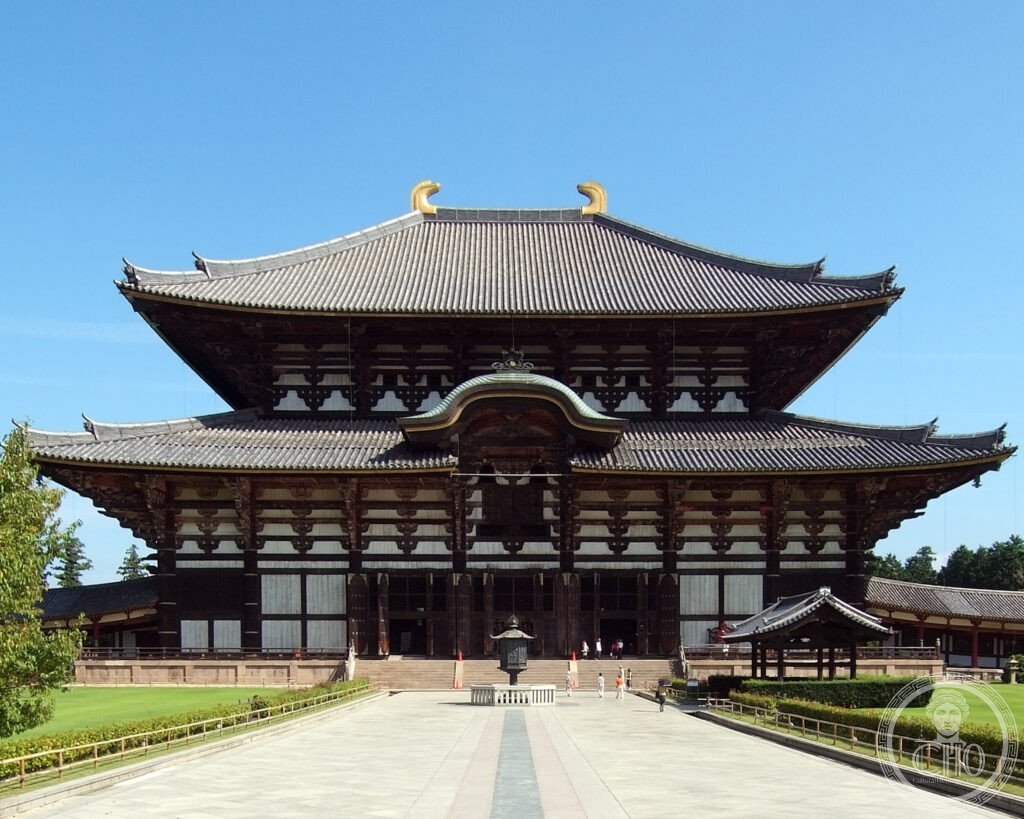
Nara was Japan’s first permanent capital and still holds the world’s largest wooden building, the Daibutsuden of Tōdai-ji, together with its bronze Great Buddha. Sika deer roam freely through the park linking the temples and shrines, making this one of the more unusual encounters with monumental Buddhist architecture anywhere in Japan.
At a glance
Nara was established in 710 CE by Empress Genmei as Heijō-kyō, Japan’s first permanent capital, and remained the seat of imperial government until 794. The historic core was inscribed by UNESCO in 1998 as the Historic Monuments of Ancient Nara, a listing covering eight properties: the temples of Tōdai-ji, Kōfuku-ji, Gangō-ji and Tōshōdai-ji, the Shinto shrine of Kasuga Taisha and the adjoining Kasugayama Primeval Forest, a Zen temple, and the site of the former Heijō Palace.
Much of this is arranged around Nara Park, home to over 1,200 sika deer that move freely among visitors and have been treated as a protected species since 1998.
Key facts
- Daibutsuden (Great Buddha Hall), Tōdai-ji: the current building, completed in 1709, measures 57 metres wide, 50 metres deep and 49 metres high, and is the largest wooden building standing anywhere in the world, even though it is only about two-thirds the width of the original 8th-century hall, which was 88 metres wide.
- The Great Buddha (Daibutsu): a bronze statue 14.7 metres tall and weighing 498 tonnes, cast in 752 CE using bronze equivalent to three years of Japan’s entire national copper output.
- Kasuga Taisha: founded in 768 CE by the Fujiwara clan, the shrine holds around 3,000 bronze and stone lanterns, all lit together during the Mantōrō festivals in February and August.
- Kōfuku-ji five-storey pagoda: originally built in 730 CE, it stands roughly 50 metres high and is the second tallest wooden pagoda in Japan after Tō-ji in Kyoto.
- Heritage status: inscribed by UNESCO in 1998 as Historic Monuments of Ancient Nara.
- Location: 34.6882° N, 135.8049° E.
History
Nara period Japan, from 710 to 794 CE, was centred on Heijō-kyō, a capital laid out on a chequerboard grid modelled directly on Chang’an, the Tang dynasty capital of China. The era was marked by state-sponsored Buddhism: Emperor Shōmu ordered the construction of a provincial temple, or kokubunji, in every one of Japan’s provinces, and commissioned the casting of the Great Buddha at Tōdai-ji, completed in 752 CE.
The period also produced the Man’yōshū, an anthology of 4,516 poems compiled around 759 CE and one of the principal sources for the study of early Japanese language.
In 794 the imperial court relocated to Kyoto, then called Heian-kyō, a move driven in part by a wish to reduce the political influence that the great Buddhist monasteries of Nara had accumulated. Tōdai-ji itself was destroyed and rebuilt three times over the following centuries: burnt by the Taira clan in 1180 and rebuilt by 1203, burnt again during civil war in 1567, and finally rebuilt to its present, reduced form in 1709.
What you see
The approach to Tōdai-ji runs through the Nandaimon, the Great South Gate standing 25.5 metres high, rebuilt in 1203 on the footprint of the original 8th-century structure and guarded by two Niō statues each 8.35 metres tall. Beyond it stands the Daibutsuden itself, housing the bronze Great Buddha. Inside the hall, one of the supporting pillars has a hole cut through its base said to be the same size as the Great Buddha’s nostril; visitors sometimes queue to crawl through it, a custom said to bring wisdom.
A walk of around thirty minutes through the deer park leads to Kasuga Taisha, best seen in the evening when its lanterns are lit. Nara Park itself is where most visitors encounter the sika deer at close quarters; vendors sell deer crackers, or shika-senbei, and the deer will take these directly from visitors’ hands. Kōfuku-ji’s five-storey pagoda, a short walk from Kintetsu Nara station, is one of the most recognisable landmarks in the park, its silhouette often seen together with grazing deer.
Practical information
- Visiting Tōdai-ji, the Daibutsuden and the deer park: opening times and admission arrangements change, so it is worth checking Tōdai-ji’s own information before travelling.
- Nara Tokae lantern festival: held in early to mid-August, when around 20,000 candles are lit along the paths of Nara Park in the evening, alongside fireflies earlier in the month.
- Kasuga Taisha’s Mantōrō festivals: take place in February and August, when all the shrine’s lanterns are lit simultaneously.
Getting there
Nara is most commonly reached from Kyoto, either by the Kintetsu Kyoto Line limited express to Kintetsu Nara station, a journey of around 35 minutes, or by the JR Nara Line to Nara station, which takes about 45 minutes. From Osaka, the Kintetsu Osaka Namba to Kintetsu Nara express takes roughly 36 minutes. Nara works well as a day trip from either city.
Nearby
- Hōryū-ji Temple — about 12 kilometres south-west, some 20 minutes by JR Yamato-ji Line; its West Precinct contains buildings dating from 607 CE, including a five-storey pagoda and main hall, and is separately inscribed by UNESCO as Buddhist Monuments in the Hōryū-ji Area.
- Kyoto — about 45 minutes by Kintetsu express; the city’s historic monuments were inscribed by UNESCO in 1994 and include seventeen temples and shrines.
- Osaka and Osaka Castle — about 36 minutes from Kintetsu Nara; the castle, built for Toyotomi Hideyoshi in 1583, has gold-leaf decoration on its tower and is set within Osaka-jo Park, surrounded by a moat.
Sources
- Wikipedia, Tōdai-ji
- Wikipedia, Nara period
- Wikipedia, Kasuga Taisha
- Wikipedia, Kōfuku-ji
- UNESCO, Historic Monuments of Ancient Nara
Find it on the map
See this place and what’s around it →📷 Become a Cultural Heritage Online photographer
Share your photos of places: they stay published under your name as the author. The more they're seen, the more you get noticed — and soon a contest will reward the most appreciated photos.
Log in or sign up free to add a photo