

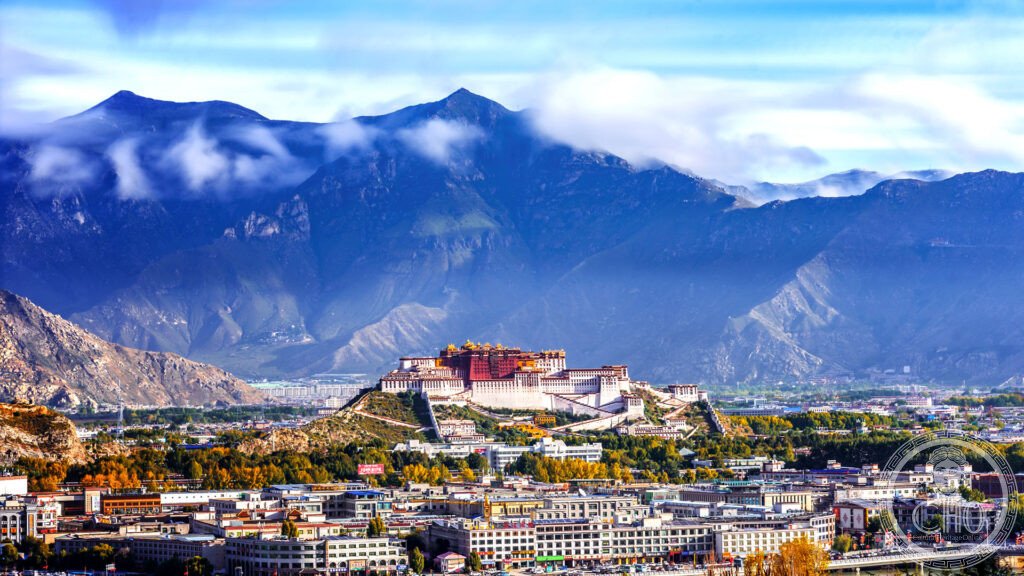
Potala Palace — Lhasa

Potala Palace Lhasa Tibet China UNESCO World Heritage Dalai Lama
The Potala Palace from the south-west (the most dramatically sited single palace in Asia: built on Marpo Ri (Red Hill; 3,700 m above sea level — the most precisely altitude-positioned single palace in the world); the palace rises 117 m above the surrounding plain (the most precisely height-measured single palace above its urban plain in Asia); 13 storeys; 1,000 rooms; 10,000 shrines; 200,000 statues — the most precisely inventory-counted single Tibetan Buddhist palace in the history of the tradition; the White Palace (Potrang Karpo: the most recently completed section — 1648–1694 CE; the outer administrative and residential complex; the most precisely winter-palace-function single section of the Potala) and the Red Palace (Potrang Marpo: the older central religious section containing the funerary stupas of the Dalai Lamas — the most precisely Dalai-Lama-mausoleum single section of the Potala; the stupa of the 5th Dalai Lama (the most elaborately jewelled single stupa in Tibet: 3.7 m high, covered in gold and 18,680 pearls — the most precisely pearl-counted single Buddhist funerary monument in any Tibetan palace); the most dramatically vertical single monumental landscape in Central Asia), Lhasa, Tibet Autonomous Region, People’s Republic of China — UNESCO World Heritage Site (Potala Palace, Lhasa) 1994 (extended 2000, 2001). Photo via Wikimedia Commons.
Lhasa, Tibet Autonomous Region, China (3,656 m above sea level = most precisely altitude-challenged UNESCO site accessible by regular transport) · Potala Palace (built 1645–1694 by 5th Dalai Lama; 117m above city; 1,000 rooms; 10,000 shrines; 200,000 statues; 5th Dalai Lama stupa = 18,680 pearls + gold-covered); Jokhang Temple (639 CE; holiest Buddhist shrine in Tibet; butter lamp offerings; Barkhor circumambulation circuit); residence of Dalai Lamas until 1959 (Tenzin Gyatso (14th) fled to India); permits required (foreigners: Tibet Travel Permit + Lhasa city permit); high-altitude risk (altitude sickness; acclimatise 2 days minimum) · UNESCO WHS (Historic Ensemble of the Potala Palace, Lhasa) 1994

Potala Palace — Lhasa

The most dramatically sited palace in the world and the spiritual and administrative centre of Tibetan Buddhism for three centuries — the Potala Palace in Lhasa, built between 1645 and 1694 by the Fifth Dalai Lama at 3,700 metres above sea level, dominated the Tibetan plateau for 350 years as both royal residence and national religious monument before the Fourteenth Dalai Lama fled to India in 1959.

At a glance

The Potala Palace (UNESCO WHS 1994 as the “Historic Ensemble of the Potala Palace, Lhasa”; extended to include the Jokhang Temple in 2000 and Norbulingka in 2001; the most altitude-sited single UNESCO WHS accessible by regular transport: at 3,700 m above sea level — the most precisely altitude-limited heritage experience in the world (the most strongly recommended single heritage acclimatisation protocol: 2 days in Lhasa minimum before attempting the Potala stairs — the most literally breathless single heritage climb in any UNESCO palace); the most precisely politically sensitive single UNESCO site in contemporary China: the Potala Palace is the symbol of Tibetan sovereignty and Dalai Lama rule — the most internationally contested single heritage building in Chinese administration; the Dalai Lama (Tenzin Gyatso, the 14th Dalai Lama, who fled to India in 1959 — the most precisely exile-dated single head of state in the history of a UNESCO World Heritage site); access (the most bureaucratically complex single UNESCO heritage visit in Asia: foreign visitors require a Chinese visa + Tibet Travel Permit + Lhasa City Permit — the most permit-intensive single UNESCO site visit in the world; only 2,300 visitors per day permitted at the Potala; the most strictly visitor-limited single Chinese heritage site).

Key facts

  • The architecture: the most vertically monumental single palace in Asia — the Potala (described in hero caption; 13 storeys; 117 m above city plain; 1,000 rooms; 10,000 shrines; 200,000 statues; the construction (the most precisely phased single great Asian palace: the White Palace (1648–1694 CE: the most precisely 5th-Dalai-Lama-commissioned section; built in 50 years by the most administratively powerful single Dalai Lama in Tibetan history: the Great Fifth — Ngawang Lobsang Gyatso (1617–1682) — unified Tibet politically and spiritually — the most personally accomplished single Dalai Lama in the history of the institution); the Red Palace (the older central core; rebuilt and expanded 1690–1694 CE after the White Palace completion — the most precisely sequenced single palace expansion in Central Asian history)); the foundations (the most altitude-challenged single palace structural engineering in Asia: the palace is built directly into and onto Marpo Ri (Red Hill): the most precisely geological foundation integrated into any Asian palace); the construction materials (the most precisely Tibetan-tradition single building material: butter (the most traditionally Tibetan single mortar component: the foundations include large quantities of copper (molten copper was poured between the foundation stones — the most precisely anti-freeze single ancient foundation technique in any alpine palace))))
  • The funerary stupas of the Dalai Lamas: the most precisely preserved sequence of royal tombs in Tibet — the stupas (the most precisely stupa-numbered single palace interior in Tibetan Buddhism: the Red Palace contains the funerary stupas of 8 Dalai Lamas (13th-century to 20th-century — the most precisely dated single series of Buddhist royal tombs; the stupa of the 5th Dalai Lama is described in hero caption: 18,680 pearls + gold-covered = the most precisely pearl-counted single Buddhist funerary monument in Tibet; the stupa of the 13th Dalai Lama (Thubten Gyatso: d. 1933): 590 kg of gold and 200,000 precious stones — the most precisely jewel-quantified single stupa construction in the history of Tibetan Buddhism)); the only Dalai Lama without a stupa in the Potala is the 14th (the current Dalai Lama, Tenzin Gyatso — the most internationally known single living exile in the history of UNESCO heritage sites))
  • The Jokhang Temple: the holiest Buddhist shrine in Tibet and the centre of Lhasa pilgrimage — the Jokhang (the most sacred single building in Tibetan Buddhism: the Jokhang Temple (639 CE — the most precisely dated single founding year of any Tibetan Buddhist temple; built by King Songtsen Gampo of the Tibetan Empire — the most consequentially Buddhist single Tibetan king (responsible for the adoption of Buddhism in Tibet and the creation of the Tibetan script — the two most culturally consequential single acts in Tibetan civilizational history)); the Jowo Shakyamuni statue (the most sacred single Buddha statue in Tibet: the 1.5 m gold statue of the Buddha as a 12-year-old — the most precisely age-specific single major Buddha image in Tibetan Buddhism; brought to Tibet by Princess Wencheng of the Tang dynasty in 641 CE — the most precisely diplomatically gifted single sacred object in the history of Chinese-Tibetan relations)); the Barkhor (the most precisely circumambulation-path-defined single pilgrimage circuit in any Tibetan city: the Barkhor circuit around the Jokhang is the most continuously walked single pilgrimage path in Lhasa — hundreds of pilgrims walk the circuit daily in clockwise direction — the most precisely Buddhist-cosmological single direction of circumambulation))
  • Heritage: UNESCO World Heritage Site, Historic Ensemble of the Potala Palace, Lhasa, inscribed 1994 (Jokhang 2000, Norbulingka 2001)
  • GPS: 29.6573° N, 91.1175° E

History

The founding (the site of the Potala has been sacred since the 7th century CE: King Songtsen Gampo (the most unifying single Tibetan king: unified the Tibetan Empire; adopted Buddhism; created the Tibetan script; the most individually transformative single ruler in Tibetan history) built a small palace on Marpo Ri around 637 CE; the current Potala was built by the 5th Dalai Lama beginning in 1645 — the most personally motivated single great palace construction in Central Asia: the 5th Dalai Lama built the Potala after unifying Tibet under Gelug Buddhist rule (the most politically consequential single act of Buddhist institution-building in 17th-century Central Asia)); the Dalai Lamas (the most precisely succession-counted single line of Buddhist leaders: 14 Dalai Lamas from 1391 to the present — the most continuously held single title in the history of Tibetan Buddhism; the 13th Dalai Lama declared Tibet an independent state in 1913 — the most precisely independence-declared single Tibetan political act in the 20th century; the 14th Dalai Lama fled Tibet on 17 March 1959 after the failure of the Tibetan uprising — the most precisely exile-dated single departure from a UNESCO heritage palace in world history); UNESCO WHS 1994.

What you see

The visit (the most permit-intensive single UNESCO heritage visit in the world: described in Overview section; the most altitude-challenging single palace climb: 1,000 stairs inside the palace; the acclimatisation (the most strongly medically recommended single heritage acclimatisation in the world: altitude sickness at 3,700 m is a real risk; symptoms appear within hours of arrival from low altitude; the standard protocol (2–3 days in Lhasa at rest + no alcohol + drink water + Diamox medication if susceptible — the most precisely pharmaceutical single heritage visit preparation in any UNESCO site)); the essential sequence: the Potala (exterior viewing from the Potala Square — the most dramatically framed single palace in any central Asian city; the interior tour (timed 1h with mandatory guide — the most strictly time-limited single UNESCO palace interior visit in China)); the Jokhang Temple (the most spiritually active single tourist-and-pilgrim co-presence in any Tibetan heritage building: Tibetan pilgrims prostrating themselves on the Barkhor square simultaneously with international tour groups entering the temple); the Norbulingka (Dalai Lama’s summer palace: the most precisely garden-palace-designed single Tibetan summer residence; less visited than the Potala but the most personally intimate single Dalai Lama heritage space in Lhasa).

Practical information
  • Getting there: Lhasa Gonggar Airport (LXA; 62 km south of the city — the most dramatically mountain-overflown single airport approach in Asia; the most altitude-sensitive single landing in commercial aviation: at 3,570 m — the second-highest commercial airport in the world; passengers often experience the first altitude effects on landing); the permits (Chinese visa (the most rigorously checked single entry document for Lhasa visitors: must specify Tibet); Tibet Travel Permit (obtained through a licensed Tibetan travel agency — the most agency-dependent single permit in Chinese tourism: cannot be obtained independently (the most precisely agency-monopolised single permit system in Chinese heritage tourism)); Lhasa City Permit; the permits must be arranged before departure — the most advance-planning-intensive single UNESCO heritage visit in Asia; it is not possible to obtain permits on arrival)); trains (the Qinghai–Tibet Railway (the most engineering-extraordinary single railway in Asia: the line crosses the Tibetan Plateau at altitudes above 4,000 m for 960 km — the most precisely altitude-maintained single railway route in the world; the highest point (Tanggula Pass: 5,072 m) is the highest point of any railway on Earth; supplemental oxygen is provided to passengers — the most precisely oxygenated single passenger experience in commercial rail travel)); 36h from Xian; the most dramatically landscape-changing single rail journey in China))
  • The Tibetan plateau and Namtso Lake: the most dramatically altitude-positioned sacred lake on Earth — Namtso Lake (200 km north-west of Lhasa; the most precisely altitude-high sacred lake in Tibetan Buddhism (4,718 m above sea level — the highest large lake in the world; the most precisely altitude-measured single Tibetan pilgrimage lake; the second-largest saltwater lake in China — the most precisely saline single Tibetan lake); the Tashi Dor peninsula (the most dramatically sited single monastery on any Tibetan lake island: the red-and-white monastery on the rock outcrop in the lake — the most precisely isolated single Buddhist monastery in any Tibetan lake)); a day trip from Lhasa (the most altitude-escalating single day trip in any UNESCO-adjacent heritage zone: ascending from 3,650 m to 4,718 m in 4 hours — the most strongly recommended single acclimatisation-requiring day trip in Tibet))
  • Shigatse and the Tashilhunpo Monastery: Tibet’s second city and the seat of the Panchen Lama — Shigatse (280 km west of Lhasa; 4h by road; the Tashilhunpo Monastery (the most precisely Panchen-Lama-associated single monastery in Tibet: the seat of the Panchen Lamas since 1642 — the most precisely second-in-command single Tibetan Buddhist institution; the Maitreya Buddha statue (the most precisely future-Buddha-scale single statue in Tibet: 26.2 m tall — the tallest single Buddha statue inside any monastery in Tibet; covers 600 m² of floor space — the most spatially consuming single Buddha in Tibetan Buddhism)); Gyantse (100 km east of Shigatse; the Kumbum Chorten (the most precisely multi-storey single Tibetan stupa: 108 chapels arranged on 9 floors — the most precisely Buddhist cosmology-encoded single stupa in Tibet))

Getting there

Chinese visa + Tibet Travel Permit (via licensed agency, arranged in advance) + Lhasa City Permit required. Fly to Lhasa Gonggar (LXA) or take the Qinghai-Tibet Railway (36h from Xian; highest railway on Earth; oxygen supplied). Acclimatise 2–3 days minimum before climbing Potala. Potala max 2,300 visitors/day; book in advance. GPS: 29.6573, 91.1175.

Nearby

  • Jokhang Temple (UNESCO WHS 2000) — 2 km south-east of Potala (30 min walk or 10 min taxi); holiest Buddhist shrine in Tibet — described in Key Facts section; the essential Lhasa sequence: Potala (morning) + Barkhor circuit walk + Jokhang (afternoon)
  • Namtso Lake — 200 km north-west (4h drive; day trip or overnight); highest large lake in world (4,718m) + Tashi Dor monastery — described in Practical section; requires an additional Lake Permit
  • Shigatse and Tashilhunpo Monastery — 280 km west (4h drive); seat of Panchen Lamas + 26.2m Maitreya Buddha statue — described in Practical section

Sources

  • Wikipedia, Potala Palace; Jokhang; 14th Dalai Lama; Qinghai–Tibet Railway, accessed June 2026
  • UNESCO, Historic Ensemble of the Potala Palace, Lhasa, WHS reference 707, inscribed 1994
  • Pico Iyer, The Open Road: The Global Journey of the Fourteenth Dalai Lama, Bloomsbury, 2008

Hero image: Potala Palace Lhasa, Wikimedia Commons. Editorial text © Cultural Heritage Online, 2026.

📷 Diventa un fotografo di Cultural Heritage Online

Condividi le tue foto dei luoghi: restano pubblicate con la tua firma come autore. Più vengono viste, più ti fai conoscere — e presto un concorso premierà le foto più apprezzate.

Accedi o registrati gratis per aggiungere una foto
📋 Copy & share on social
Scroll to Top