
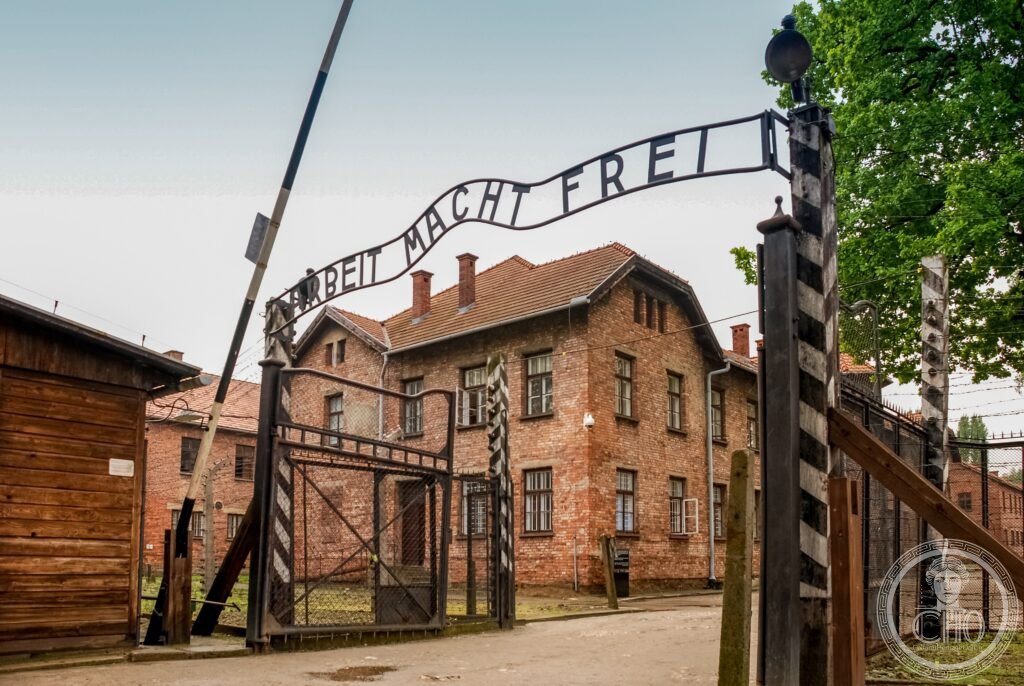
Auschwitz-Birkenau Memorial and Museum

Auschwitz-Birkenau concentration camp main gate Poland UNESCO World Heritage
Auschwitz-Birkenau (the main gate of the Auschwitz I camp (the original Stammlager camp) with the infamous sign “Arbeit macht frei” (“Work sets you free” — the most cynically ironic single inscription in the history of human language: approximately 1.1 million people were killed in the Auschwitz-Birkenau complex, the vast majority of whom entered through this or the Birkenau gate; the sign is the most photographically reproduced single gate inscription in the history of genocide memorials); Auschwitz I (the original camp (Stammlager): opened June 1940 as a political prison for Polish political prisoners; Block 11 (the most feared single building in the camp: the “Death Block”; the punishment cells in the basement where prisoners were left to die in standing cells — the most claustrophobic form of punishment used in the camp; the execution wall in the yard (the Black Wall) where approximately 20,000 people were shot — the most precisely used single execution site in the Auschwitz I camp); the Zyklon B test (the most consequential single chemical experiment in the history of the Holocaust: the first use of Zyklon B as a killing agent was tested on Soviet POWs in Block 11 on 3 September 1941 — the most precisely dated single innovation in industrial murder in the history of the Holocaust)), Auschwitz-Birkenau State Museum, Oświęcim, Małopolska, Poland — UNESCO World Heritage Site 1979. Photo via Wikimedia Commons.
Oświęcim, Małopolska, Poland · opened 1940 (Auschwitz I) + 1942 (Birkenau/Auschwitz II) by Nazi Germany; ~1.1 million people murdered (approximately 1 million Jews + 70,000-75,000 Poles + 21,000 Roma + 15,000 Soviet POWs + 10,000 others); the largest single German Nazi extermination complex; 4 crematoria + gas chambers at Birkenau (most industrial killing facility in the Holocaust); liberation 27 January 1945 (Red Army; International Holocaust Remembrance Day); 2.3M visitors/year (most visited memorial site in the world); Arbeit macht frei gate; Žegota; Witold Pilecki voluntary undercover prisoner (most courageous act of voluntary self-imprisonment in war history) · UNESCO World Heritage 1979

Auschwitz-Birkenau Memorial and Museum

The largest and most systematically lethal of the Nazi German concentration and extermination camps and the site that has come to represent the Holocaust in its entirety — Auschwitz-Birkenau, where approximately 1.1 million human beings were murdered between 1940 and 1945, is the most morally significant single heritage site on Earth, the place that compels every visitor to confront what industrialised state murder looks like when its physical evidence is preserved.

At a glance

Auschwitz-Birkenau (UNESCO WHS 1979; the most morally unambiguous single heritage inscription in UNESCO history: inscribed under the extraordinary title “Auschwitz Birkenau: German Nazi Concentration and Extermination Camp (1940–1945)” — the only UNESCO World Heritage Site explicitly named after a perpetrator nation and an atrocity — the most precisely described single crime in any UNESCO inscription; the most deliberately named single WHS title in the history of the programme (the title was chosen to ensure that no ambiguity remained about who built and operated the camp); the complex (the main camp Auschwitz I (the original camp; opened June 1940; 28 brick buildings; the Arbeit macht frei gate) and Auschwitz II-Birkenau (opened 1942; 3 km from Auschwitz I; the main extermination complex: the largest concentration and extermination camp ever built; 300 wooden and brick barracks; 4 crematoria with gas chambers; the capacity to gas 4,756 people per day (the most precisely calculated killing capacity of any facility in the history of mass murder))); the victims (approximately 1.1 million people were killed in the complex — the most precisely estimated single Holocaust death toll: approximately 1 million Jews (the most single-site Jewish death toll in the Holocaust); 70,000–75,000 Polish political prisoners; 21,000 Roma; 15,000 Soviet POWs; 10,000 others)).

Key facts

  • The industrial system of murder: the most precisely documented single system of mass killing in history — the Birkenau (Auschwitz II) extermination apparatus (the most industrially organised single killing facility in the Holocaust: the 4 crematoria with integrated gas chambers (the most precise single killing schedule in any concentration camp: each gas chamber could hold 2,000 people; the killing time was 15–20 minutes; the combined capacity was approximately 4,756 people per 24 hours — the most precisely calculated killing rate in any human enterprise of murder); the rail line (the most consequentially extended single railway spur in the history of the Holocaust: the rail line was extended from the main Auschwitz station 2 km into the Birkenau camp in 1944 — the most precisely timed single logistical improvement in the Holocaust: the extension was made specifically to accelerate the deportation and killing of Hungarian Jews (437,402 deported from Hungary in 56 days in May–July 1944 — the most rapidly executed single mass deportation in the Holocaust); the Sonderkommando (the most psychologically tormented single group in the history of the Holocaust: the Jewish prisoners forced to work in the crematoria — the most precisely documented group of forced participants in mass murder; the Sonderkommando revolt of 7 October 1944 — the only armed uprising within the crematorium complex — the most courageous single act of resistance in the history of the Auschwitz camp))
  • The evidence and the archives: the most extensively documented single crime in history — the documentation (the most comprehensive single archival record of a perpetrator bureaucracy in the history of genocide: 65 km of documents in the Auschwitz-Birkenau State Museum archive — the most precisely measured single paper archive of a crime in world legal history; the evidence base for the Nuremberg Trials (the most legally consequential single historical trial in the history of international law) included the Auschwitz documentation as the most precisely evidenced single count of murder in the history of criminal prosecution); the exhibits (the most affecting single museum exhibition in the world: the Auschwitz I museum buildings contain the property of the victims (the shoes (80,000 pairs of shoes on display — the most precise single material evidence of an individual human life in any memorial museum in the world), the hair (approximately 2 tonnes of human hair (the most viscerally undeniable single physical evidence of mass murder in any World Heritage Site), the spectacles (the most individually humanising single exhibit in any Holocaust museum: each pair of glasses represents a person who wore them), the suitcases (the most poignant single evidence of the victims’ expectation of survival: suitcases labelled with names and addresses — the most precisely personalised single evidence of those who did not know they were going to die))
  • Witold Pilecki — the most courageous act of voluntary imprisonment in war history: the most remarkable single individual act of resistance in the Holocaust — Witold Pilecki (the only known person to voluntarily allow themselves to be arrested by the Nazis and sent to Auschwitz (1940–1943) — the most courageous single act of voluntary self-imprisonment in the history of warfare; Pilecki organised the Auschwitz resistance movement from inside the camp; escaped March 1943; submitted reports to the Polish Home Army and to the British intelligence services detailing the extermination process — the most precisely evidenced early warning of the Holocaust available to Allied governments; the British intelligence response to Pilecki’s reports was dismissed as exaggeration — the most consequentially disbelieved single intelligence report in the history of the Holocaust; Pilecki was executed by the post-war Communist Polish authorities in 1948 — the most unjust single post-war execution of a resistance hero in Polish history)
  • Heritage: UNESCO World Heritage Site, Auschwitz Birkenau German Nazi Concentration and Extermination Camp (1940–1945), inscribed 1979
  • GPS: 50.0274° N, 19.2023° E

History

The camp’s origins (Auschwitz I was established in June 1940 by the SS on the orders of Reichsführer-SS Heinrich Himmler (the most consequentially ordered single camp establishment in the history of the Holocaust) in a former Polish Army barracks in the town of Oświęcim (German: Auschwitz); initially a political prison for Polish political prisoners and POWs; the escalation to mass killing (the most precisely dated escalation in Holocaust history: the mass killing of Jews began at Auschwitz-Birkenau in 1942 as part of the “Final Solution to the Jewish Question” (the Wannsee Conference: 20 January 1942 — the most bureaucratically organised single meeting in the history of genocide); the Hungarian deportations (May–July 1944: the most rapidly executed single mass deportation in the Holocaust (437,402 people in 56 days): the most precise single evidence of the speed achievable by the Nazi killing machine at its 1944 peak)); the liberation (27 January 1945: the Red Army liberated Auschwitz — the most precisely celebrated single liberation date in the history of the Holocaust; adopted as International Holocaust Remembrance Day by the United Nations in 2005 — the most globally institutionalised single memorial date in the history of genocide); UNESCO WHS 1979.

What you see

The visit (the most carefully guided single UNESCO heritage site in the world: all visits to Auschwitz-Birkenau are conducted by licensed guides (the most strictly regulated single guide profession in any Polish heritage site; the most respectful single visit format in any World Heritage memorial); the visit sequence (Auschwitz I (the main camp: the exhibition buildings, the barracks, the Arbeit macht frei gate, Block 11, the Black Wall, the first gas chamber and crematorium (the most important single preserved physical evidence of gas-chamber killing at Auschwitz I — the only intact gas chamber at the site; the four Birkenau crematoria and gas chambers were destroyed by the SS before their retreat)) + Auschwitz II-Birkenau (the most devastatingly scaled single heritage site: the 3 km drive or 2 km walk to Birkenau; the arrival ramp where trains unloaded (the most precisely photographed single selection scene in the Holocaust: the Birkenau arrival ramp photos taken by an SS officer in May–June 1944 are the only photographs taken during the selection process — the most precisely documented single day of mass murder in any photographic archive in the history of the Holocaust)); the visit duration (the most carefully timed single memorial visit in Europe: the minimum respectful visit is 3h 30min; a full day (6–7h) is more appropriate for the scale of what is being witnessed)).

Practical information

  • Getting there: Kraków (66 km east; the most convenient base: Kraków John Paul II International Airport (KRK; direct flights from most European cities); from Kraków, the most convenient approach is the direct Auschwitz bus (the PKS Oświęcim bus from Kraków Główny bus station: 1h 30min; runs hourly; the most frequently used single public transport connection to any Holocaust memorial in Europe) or the Kraków–Oświęcim train (1h 30min; less frequent); by car (the A4 motorway from Kraków to Oświęcim; 1h); the booking (the most important logistical fact: individual (non-group) visitors must book a Study Visit online (3.5h minimum) at auschwitz.org — the most systematically structured single memorial admission in Europe; free admission; the most accessed single free UNESCO heritage site in Central Europe; summer months (June–August) are fully booked months in advance — the most over-subscribed single UNESCO memorial site in Europe); the dress code (the most respectful single dress guideline in any Polish museum: dressed appropriately — no sleeveless or extremely casual clothing; the most consistently respected single dress guideline at any Central European heritage memorial))
  • Kraków — the finest medieval and Renaissance city in Poland: the most completely intact Gothic and Renaissance cityscape in Central Europe — Kraków (the Kraków Historic Centre (UNESCO WHS 1978 — one of the first 12 UNESCO WHS inscriptions in the world; the most historically fortuitous single city to escape World War II largely intact: Kraków was the Nazi General Government capital (1939–1945) and was abandoned by the Germans without a fight in January 1945 — the most fortunate single act of urban abandonment in the history of European warfare); the Main Market Square (Rynek Główny: the largest medieval market square in Europe: 200 m × 200 m (the most precisely measured single medieval urban public space in Poland); the Cloth Hall (Sukiennica: the most historically significant single commercial building in any Central European medieval market square; rebuilt in Renaissance style 1555–1559 — the most precisely dated single Polish Renaissance reconstruction); the Wawel Royal Castle (the most politically important royal residence in Polish history: the seat of Polish kings from Casimir I in 1038 until the capital moved to Warsaw in 1609 — the most consequential single royal residence transfer in Polish history))
  • Wieliczka Salt Mine (UNESCO WHS 1978): the most extraordinary subterranean heritage landscape in Europe — Wieliczka (15 km south-east of Kraków; 1h by bus; the salt mine operated continuously from the 13th century to 2007 — the most continuously operated single industrial mine in Europe; the underground chambers (the most architecturally surprising single underground space in Poland: the Chapel of St Kinga (35 m long; 10 m wide; 12 m high; entire chapel carved from salt including the altar, the chandeliers (salt crystal candelabras), and the relief sculptures — the most extensively salt-carved single underground religious space in the world; the most visited subterranean heritage attraction in Europe: 1.5 million visitors per year))

Getting there

From Kraków 66 km: bus from Kraków Główny bus station (1h 30min; hourly) or train (1h 30min). Book online at auschwitz.org (mandatory; free; months in advance for summer). Minimum Study Visit 3h 30min. GPS: 50.0274, 19.2023.

Nearby

  • Kraków Historic Centre (UNESCO WHS 1978) — 66 km east (1h 30min bus/train); finest medieval-Renaissance cityscape in Central Europe — described in Practical section; the essential Poland itinerary: Kraków (2 nights: Wawel + Main Square + Jewish Quarter Kazimierz) + Auschwitz day trip + Wieliczka Salt Mine day trip
  • Wieliczka Salt Mine (UNESCO WHS 1978) — 80 km east (1h 30min bus from Oświęcim or 35 min from Kraków); most extraordinary subterranean heritage in Europe — described in Practical section
  • Warsaw Historic Centre (UNESCO WHS 1980) — 300 km north (3h by train; PKP InterCity express); the most completely rebuilt single UNESCO heritage city in the world — Warsaw (the Old Town (rebuilt 1945–1953 after 85% destruction in World War II — the most extensively rebuilt single European city centre after WWII; the reconstruction is itself a UNESCO WHS: the most unusual inscription justification in European heritage (inscribed not for the original buildings but for the act of rebuilding — the most politically motivated single heritage inscription in European history; the reconstruction was based on 18th-century Canaletto paintings of Warsaw — the most artistically driven single urban reconstruction in the history of European heritage); the Warsaw Uprising Museum (the most emotionally powerful museum about an urban military uprising in Europe: the 1944 Warsaw Uprising (63 days; 200,000 civilian deaths — the most lethally suppressed urban uprising in the history of World War II))

Sources

  • Wikipedia, Auschwitz concentration camp; Auschwitz II-Birkenau; Witold Pilecki; Sonderkommando, accessed June 2026
  • UNESCO, Auschwitz Birkenau German Nazi Concentration and Extermination Camp (1940–1945), WHS reference 31, inscribed 1979
  • Primo Levi, If This Is a Man (Survival in Auschwitz), Einaudi, 1947

Hero image: Auschwitz-Birkenau memorial, Wikimedia Commons. Editorial text © Cultural Heritage Online, 2026.

📷 Diventa un fotografo di Cultural Heritage Online

Condividi le tue foto dei luoghi: restano pubblicate con la tua firma come autore. Più vengono viste, più ti fai conoscere — e presto un concorso premierà le foto più apprezzate.

Accedi o registrati gratis per aggiungere una foto
📋 Copy & share on social
Scroll to Top