
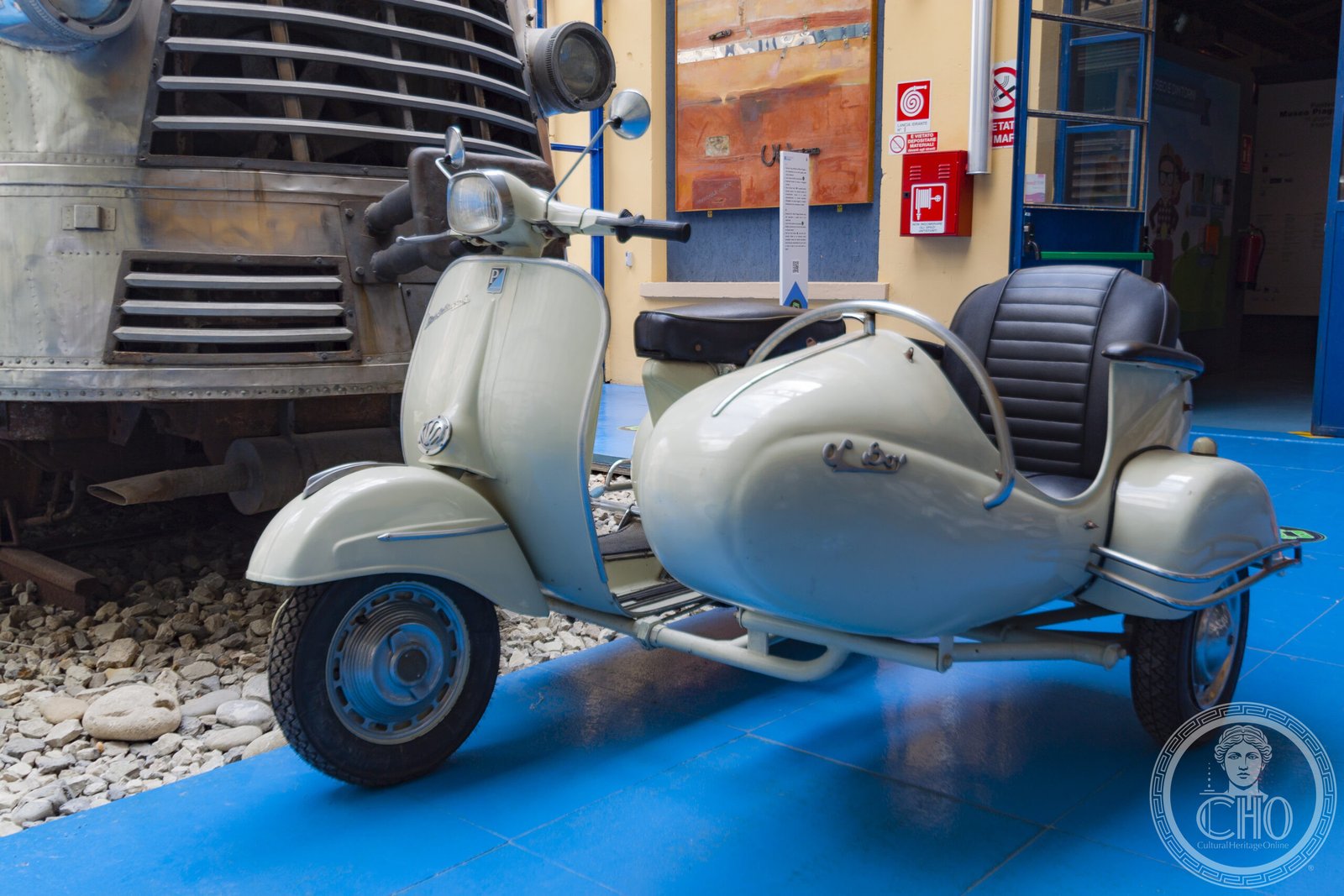

In the Tuscan town where Corradino D'Ascanio drew the first Vespa in 1946, the Museo Piaggio holds 200 vehicles that trace the history of Italy's most recognisable industrial design — a scooter that carried a generation out of the rubble of the war and into a mobile, modern life.
At a glance
The Museo Piaggio “Giovanni Alberto Agnelli” opened in 2000 on the site of the original Piaggio factory in Pontedera, Tuscany. Named after the son of Fiat chairman Giovanni Agnelli, who was Piaggio's administrator during the 1990s and died in 1997, the museum holds more than 200 historic vehicles including the complete range of Vespa scooters from the 1946 prototype to the present day, as well as Gilera motorcycles, Ape three-wheelers, Moto Guzzi examples, and prototype vehicles from Piaggio's aerospace and aviation work. The original factory building, an industrial complex built in the early twentieth century for aircraft and railway car production, provides an appropriate setting: wide, light-filled, with the scale of a manufacturing plant that made everything from dirigibles to fighter planes before it became synonymous with a motorscooter.
Key facts
- Opened: 29 March 2000
- Named after: Giovanni Alberto Agnelli (1964–1997), Piaggio administrator
- Address: Viale Rinaldo Piaggio 7, 56025 Pontedera (PI)
- GPS: 43.6604, 10.6327
- Collection: 200+ vehicles: Vespa, Gilera, Ape, Moto Guzzi, Derbi, prototypes
- Website: museopiaggio.it
- Restoration: architect Andrea Bruno converted the former tooling works, keeping the 1920s factory sections
History
Piaggio was founded in Sestri Ponente (Genoa) in 1884 by Rinaldo Piaggio, initially as a manufacturer of railway carriages, ship fittings, and luxury interiors. The company moved into aeronautics during the First World War, and between the wars became one of Italy's leading aircraft manufacturers — its P.108 heavy bomber was the most capable Italian aircraft of the Second World War. The Pontedera plant, established in 1921, produced aircraft fuselages, engines, and tram components.
At the end of the war, with the Pontedera plant severely damaged by Allied bombing and the Italian aircraft industry prohibited from operating under the peace treaty, Enrico Piaggio tasked engineer Corradino D'Ascanio with designing a vehicle that would democratise transport in a country with almost no private cars and very poor roads. D'Ascanio, an aircraft engineer who had designed an early helicopter, approached the problem without the assumptions of conventional motorcycle design: he eliminated the fuel tank from the frame, enclosed the engine in a housing, placed the spare wheel at the front for easy access (aircraft maintenance logic), and positioned the rider over the vehicle's centre of gravity rather than astride an engine. The result — the Vespa 98, introduced at the Turin Motor Show in April 1946 — was unlike any motorscooter before it.
The Vespa MP6 prototype, made in 1945, is among the museum's most significant objects: the original wooden mock-up and metal prototype from which D'Ascanio derived the production vehicle. Piaggio sold 2,484 Vespas in 1946 and 10,535 in 1947. By 1956 it had produced its millionth; by 2014, its 18 millionth.
What you see
The museum occupies the Officine Piaggio building in the original Pontedera complex — a wide, well-lit industrial hall whose high clerestory windows and steel-frame structure date to the interwar period. The spatial character is deliberately industrial: the exhibition does not try to romanticise the objects but to contextualise them within the factory processes that produced them. Archival photographs, production tooling, and the surviving Vespa MP6 prototype sit alongside production vehicles without the separation that a conventional museum display would impose.
The Vespa collection is the core of the building: chronologically arranged, it reads as both a design history and a social history — the scooter as liberation vehicle for postwar Italy, as export commodity, as subcultural signifier through mods and films (Roman Holiday, Quadrophenia), and as a design object with enough formal integrity to enter museum collections (New York's MoMA holds a 1946 Vespa 98). Adjacent galleries cover Gilera motorcycle racing heritage, Ape industrial vehicles, and Piaggio's aviation and aerospace work.
Practical information
- Opening hours: Typically Tuesday–Saturday 10:00–18:00; check museopiaggio.it
- Admission: Free (confirmed as of 2024)
- Time needed: 1.5–2 hours
- Highlights: Vespa MP6 prototype (1945), Vespa 98 (1946 first production), Moto Guzzi Falcone, Gilera 4-cylinder racers, Piaggio P.108 bomber archive
Getting there
Pontedera is served by the Pisa–Florence railway (Pisa Centrale: 20 minutes, Florence SMN: 50 minutes). From Pontedera–Casciana Terme station, the museum is 700 m on foot along Viale Rinaldo Piaggio — the factory complex is visible from the station exit. By car: Pontedera is on the Fi-Pi-Li (Florence–Pisa–Livorno) motorway, exit Pontedera Est.
Nearby
- Pisa — 20 km west, Piazza dei Miracoli (Campo Santo, Duomo, Torre Pendente)
- Lucca — 30 km north-west, intact Renaissance walls, Puccini birthplace
- Florence (Firenze) — 50 km east, historic centre UNESCO
- Volterra — 35 km south, Etruscan necropolis, medieval urban core
Sources
- Wikipedia (Italian): Museo Piaggio
- Museo Piaggio official: museopiaggio.it
- Wikipedia (English): Piaggio
- Wikimedia Commons: File:Piaggio Vespa in Museo Piaggio II.jpg, CC BY 2.0
- Nominatim / OpenStreetMap: GPS 43.6604, 10.6327
Find it on the map
See this place and what’s around it →📷 Become a Cultural Heritage Online photographer
Share your photos of places: they stay published under your name as the author. The more they're seen, the more you get noticed — and soon a contest will reward the most appreciated photos.
Log in or sign up free to add a photoIs this page about you?
This page is read by travellers and heritage enthusiasts who find it on Google. Tell us how you are connected to this place and we will take it from there.