
Turin is the most rational of Italian cities before anyone thought to call architecture Rationalist. Laid out on a grid by its dukes, lined with kilometres of arcades, it reads like a diagram of a city. So when modern architecture arrived between the wars, Turin took to it naturally: in barely fifteen years it raised Italy’s first true skyscraper, built a car factory with a test track on its roof, and handed two young modernists the commissions that started their careers. It did all this under Fascism, and it did it, being Turin, over coffee.
There is a reason the city was so ready to reinvent itself. Turin had been the first capital of a united Italy, from 1861, and then lost the role within a few years as the capital moved on to Florence and finally Rome. A proud city suddenly without its central purpose did what proud cities do: it reinvented itself, this time as the industrial engine of the nation, the company town of Fiat. The hunger to be modern that runs through the architecture of the 1920s and ’30s is partly that — a former capital proving it still mattered, in steel and concrete rather than in courts and palaces.
The first skyscraper
Start in Piazza Castello, the baroque heart of the city, and look up at the thing that does not belong: the Torre Littoria of 1934, a slim dark tower of nearly ninety metres dropped among the royal palaces. Built by Armando Melis de Villa and Giovanni Bernocco in steel and cladding, it was one of the first skyscrapers in Italy, and it was meant to shock — the modern age planting a flag in the old capital. Its name fixes its decade: Littoria, from the lictor’s bundle that was the symbol of Fascism.
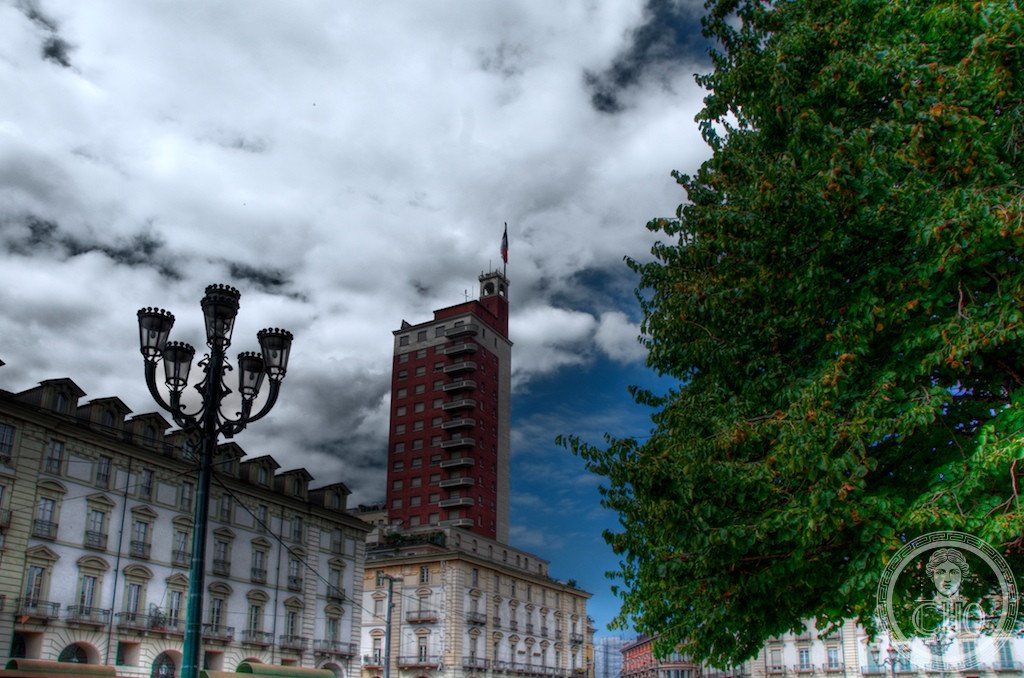
The tower is the overture to a whole inter-war Turin hiding in plain sight: the polished Art Déco of the Galleria San Federico of 1933, with its picture-palace cinema, and the marble-and-brass glamour of the Hotel Principi di Piemonte, opened in 1930 for the age of the sleeper train and the fast car.
That cinema is no accident. Before Rome and Cinecittà, Turin was the capital of Italian film: the city’s studios made the silent epics of the 1910s, among them the colossal Cabiria of 1914, and for a while the future of the medium was being invented here. The grand picture palaces of the 1930s, like the one inside the Galleria San Federico, were the heirs of that first golden age — which is why today the soaring Mole Antonelliana houses the National Cinema Museum. Turin has always been a city that bets on the modern and then turns it into ritual.

Rationalism arrives: the Gualino commissions
The decade’s most important Turin buildings were paid for by one man. Riccardo Gualino, a financier and art collector, commissioned a young pair of architects — Giuseppe Pagano and Gino Levi-Montalcini — to build him an office block and a house around 1928 to 1930. The Palazzo Gualino and the Casa Gualino were among the first fully Rationalist works in Italy: no ornament, just proportion, light and the honest grid of the windows. They look ordinary now only because they won the argument.
The two architects are worth knowing. Gino Levi-Montalcini was the brother of Rita Levi-Montalcini, the future Nobel laureate. Giuseppe Pagano went on to build the Bocconi University in Milan, edit the most influential architecture magazine in Italy, and then break completely with the regime he had once served — joining the Resistance, being arrested, and dying in the Mauthausen concentration camp in 1945. The lean, decent buildings he left in Turin are the start of that story; our Milan Rationalism walk follows it to its end.
The factory that raced on its roof
Turin was a one-company town, and the company was Fiat. Its monument is the Lingotto, the vast assembly plant finished in 1923 to a design by the engineer Giacomo Matté Trucco. Cars were built as they rose through five floors and emerged onto a banked test track on the roof — a ribbon of concrete in the sky, unlike anything else in Europe. Le Corbusier called it one of the most impressive sights in industry and put it in his manifesto of modern architecture. A later generation knew the rooftop track from the film The Italian Job of 1969, whose Mini Coopers chase across it. The factory closed in 1982 and was reborn, in a long conversion by Renzo Piano, as a complex of shops, concert halls, a hotel and an art gallery — Piano added a glass “bubble” meeting room and a jewel-box pavilion for the Agnelli family’s paintings, hung high over the old works. But the banked track is still there on the roof, and you can walk it.

Marble and the regime
Not all of inter-war Turin is so easy to admire. The stadium opened in 1933 was named for Mussolini and built for the mass spectacle the regime loved, sport turned into politics and architecture at once. It has been so heavily rebuilt since — it hosted the 2006 Winter Olympics and is home to Torino’s football club — that little original fabric remains, but it belongs on an honest walk precisely because it is uncomfortable. The architecture of these years was made for a dictatorship as often as it was made against one, and the same city holds both.
Nervi’s vault
The thread runs past 1945. The Torino Esposizioni complex, begun in 1938 as the city’s great exhibition ground, was crowned after the war by the engineer Pier Luigi Nervi with a ribbed concrete vault of almost impossible lightness — one of the masterpieces of twentieth-century engineering. It is the inter-war ambition for structure and span, set free into a freer post-war language, and a reminder that the story of Italian modern building did not stop with the fall of Fascism but was, in some hands, redeemed by it.
A city of cafés
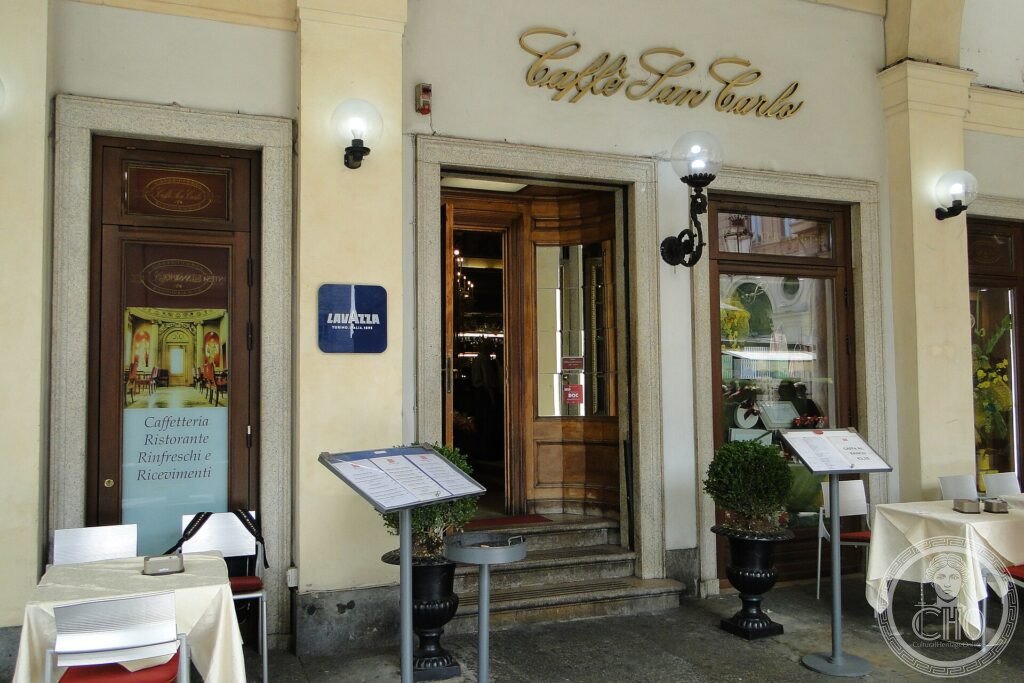
You cannot walk Turin honestly without stopping to drink. This is the spiritual home of the Italian aperitivo: modern vermouth was created here in the eighteenth century, and the ritual of the early-evening drink with something to eat grew up around it. The historic cafés are heritage in their own right — Caffè San Carlo, open since 1822; Caffè Mulassano of 1907, where the tramezzino sandwich was invented; the gilded rooms of Caffè Torino. Under the glass of the Galleria Subalpina, Baratti & Milano has sold pastries and chocolates since 1858 — and chocolate is its own Turin heritage, the home of the gianduiotto, the little hazelnut ingot born when Napoleon’s blockade made cocoa scarce. Order a bicerin, the city’s old layered drink of coffee, chocolate and cream, and you are tasting the same Turin that built the towers. The café and the skyscraper are not separate stories here. They are the same one.
How to walk it
Turin is made for walking, much of it under continuous porticoes that shrug off sun and rain — the central stops link easily on foot. Use the trams and the single metro line for the southern run to the stadium, the Valentino park and Lingotto; one daily ticket covers everything. The pleasure of the city is its rhythm: arcaded, unhurried, punctuated by coffee. Do the walk the way the place wants to be done, slowly and with frequent stops, and end on the Lingotto roof with the Alps on the horizon.
Is the architecture free to see?
Largely, yes. The towers, galleries and façades are all read from the street, and the Lingotto, now a public complex, lets you up to the rooftop track. The hotel and the stadium are working buildings, so admire them with discretion. Access to the Torino Esposizioni halls depends on what is being staged there.
How long does the Turin walk take?
A comfortable day. The central cluster is quick on foot; the southern stops are spread out and joined by tram, and the Lingotto rewards real time, roof included. With only a half-day, stay in the centre — the Torre Littoria, the Galleria San Federico and the cafés of Piazza San Carlo — and save Lingotto for another visit.
How should I think about the Fascist-era buildings?
Clearly and without flinching. Some of these buildings served a dictatorship and one still carries its old name; others were made by people who turned against it at the cost of their lives. The honest visitor holds both facts at once, which is also the most interesting way to look.
Walk it yourself. We have turned this route into a free CHO RoadBook — the stops in order, a map, and downloadable GPX and KML tracks for your phone: the Turin Modernism RoadBook.
Sources
- Pinacoteca Agnelli / Lingotto — the Fiat Lingotto factory and its rooftop track.
- MAUTO and city of Turin archives — inter-war Turin architecture.
- Fondazione Pier Luigi Nervi — the Torino Esposizioni vault.
- Museo del Risparmio / city café histories — Caffè San Carlo, Mulassano and the Turin aperitivo.