
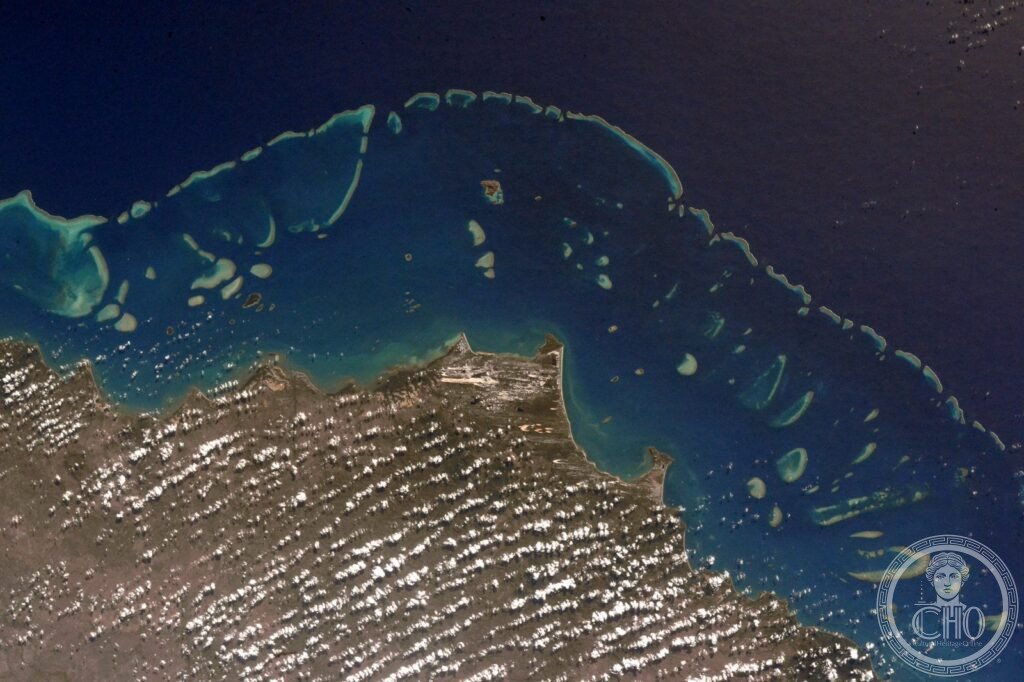
The world’s largest coral reef system and the most biologically diverse marine environment on Earth — the Great Barrier Reef, stretching 2,300 kilometres along the Queensland coast, encompasses 3,000 individual reef systems, 900 islands, and more species of marine life than any equivalent area of ocean on the planet, and faces unprecedented threats from ocean warming and bleaching.
At a glance
The Great Barrier Reef (UNESCO WHS 1981; the largest living structure on Earth visible from space; the UNESCO WHS is the Great Barrier Reef Marine Park — 344,400 km² of ocean from Cape York in the north to Bundaberg in the south; the reef itself extends approximately 65–250 km from the Queensland coast; the outer reef (the true Great Barrier Reef; the ribbon of coral rising from the deep Coral Sea; most snorkelling and diving operations reach the outer reef in approximately 1h 30min–2h by fast catamaran from Cairns or Port Douglas); the inner reef and islands (the Whitsunday Islands (74 islands between the coast and the outer reef; the most sheltered and the best for sailing); the Coral Sea beyond the outer reef (the deepest part of the marine park; accessible by liveaboard diving only); the Great Barrier Reef Marine Park Authority (GBRMPA; the Australian federal agency managing the marine park; the most complex marine protected area management authority in the world; the zoning system (the GBRMPA divides the marine park into 8 zones from fully open to completely closed for conservation; the green zones (no-take zones; approximately 33% of the total area; the most effective tool for maintaining reef biodiversity)); the coral bleaching emergency (the most serious conservation crisis facing any UNESCO WHS in the 21st century: 5 mass bleaching events since 2016; caused by sea surface temperatures rising above coral tolerance thresholds (bleaching occurs when water temperature exceeds the average summer maximum by 1°C for more than 4 weeks; at 2°C above threshold, bleaching causes mass mortality; the GBR has experienced 2°C+ events in 2016, 2020, 2022, and 2024; the most alarming marine temperature data in Australian conservation history)).
Key facts
- Coral biology and reef structure: the living architecture of the GBR — the coral polyp (the builder of the Great Barrier Reef; a coral polyp is a tiny soft-bodied animal related to sea anemones (phylum Cnidaria); polyps range from 1 mm to 30 cm in diameter; a coral colony (the structure visible to a snorkeller) is made up of thousands to millions of individual polyps connected by tissue; the coral skeleton (calcium carbonate; polyps extract calcium and carbonate ions from seawater and deposit them as aragonite — the most efficient biological calcium carbonate precipitation system in the natural world; over thousands of years the accumulated calcium carbonate skeletons of billions of polyps form the coral reef structures; the Great Barrier Reef as a structure (the modern Great Barrier Reef is approximately 500,000 years old in its current position; it has grown over a much older geological framework); the symbiotic zooxanthellae (the most important biological relationship in coral reef ecology: coral polyps host single-celled dinoflagellates (zooxanthellae) in their tissue; the zooxanthellae photosynthesise and provide up to 90% of the coral’s energy needs; the coral polyp in return provides CO₂ and shelter; when water temperatures rise, the zooxanthellae produce toxic reactive oxygen species (the most counterintuitive result in reef biology: the coral’s energy source becomes its poison at elevated temperatures); the polyp expels the zooxanthellae as a survival response — this is coral bleaching (the coral turns white because it has lost its photosynthetic partners; it can re-absorb zooxanthellae if temperatures return to normal within about 8 weeks; if the heat stress continues, the coral starves and dies))
- James Cook and the Endeavour: the most famous maritime accident in Australian history — Captain James Cook (1728–1779; the most important navigator in the history of the Pacific Ocean; the first European to chart the east coast of Australia); the 1770 voyage (the HM Bark Endeavour ran aground on a section of the inner Great Barrier Reef now called Endeavour Reef on 11 June 1770 at 11pm — the most consequential marine grounding in Australian history; the crew threw 50 tonnes of material overboard (including 6 of the ship’s cannon — the most dramatically jettisoned naval weapons in Pacific history) to refloat the ship; a piece of coral (a large lump that had broken off and become lodged in the hole in the hull) actually saved the ship by acting as a natural plug; Cook beached the ship at the mouth of a river (now Cooktown) for 7 weeks of repairs; the Cooktown site is the most important single site of early European contact with Australia outside Sydney Cove); the charts (Cook’s charts of the GBR (produced under conditions of extreme stress during the 1770 voyage) were so accurate that they remained the primary navigation reference for ships in the GBR for over 100 years — the most enduring navigational achievement in Pacific maritime history)
- Diving and snorkelling the reef: the access routes to experiencing the GBR — the reef experience (the most important single question for any GBR visitor: which reef and which operator? The outer reef (the Agincourt Ribbon Reef system north of Port Douglas; the finest outer reef for water clarity and coral health; accessible only via fast catamaran — 1h 30min from Port Douglas); the Coral Sea (liveaboard diving; accessible only for certified divers willing to commit to 3–7 nights at sea; the finest diving in Australia; the visibility (the Coral Sea visibility can reach 60 m — the most transparent offshore water in Australian recreational diving); the reef shark concentrations (the grey reef shark (Carcharhinus amblyrhynchos); the whitetip reef shark (Triaenodon obesus); and the silvertip shark (Carcharhinus albimarginatus) are all routinely seen at the outer reef and Coral Sea; the most reliably shark-populated recreational dive sites in Australia)); the Whitsundays (the best sailing destination in Australia; the Whitehaven Beach (the finest beach in Australia: 7 km of pure white silica sand; the Hill Inlet lookout (the swirling pattern of white silica sand and tidal water visible from above is the most photographed tidal beach feature in Australia)); the Great Barrier Reef Islands (the reef islands accessible for day trips or camping — Fitzroy Island (30 min from Cairns; the finest snorkelling directly from the beach of any island accessible from Cairns); Lady Musgrave Island (the southern GBR; the finest coral lagoon at any island accessible from the coast))
- Heritage: UNESCO World Heritage Site, Great Barrier Reef, inscribed 1981
- GPS: -18.2871° N, 147.6992° E
History
Aboriginal and Torres Strait Islander connection to the reef (the most ancient human relationship with the Great Barrier Reef: approximately 70 Aboriginal and Torres Strait Islander groups have traditional sea country associations with the GBR; the most significant traditional practices (the reef has been a source of food (fish, dugong, turtle), navigation reference points, and spiritual connection for at least 60,000 years — the longest continuous cultural association with any marine environment in the world; the traditional sea law (each clan group has specific rights and responsibilities for particular reefs and sea areas; the most elaborate customary marine rights system in any reef environment; the sea country boundaries are maintained through ceremony, song, and story)); European exploration (the Dutch navigator Willem Janszoon (1605 CE; the first confirmed European sighting of the Australian coast, in the Gulf of Carpentaria); Abel Tasman (1642; first to circumnavigate Australia without seeing the east coast); Bougainville (1768; passed north of the reef); Cook (1770; see above)); the pearling and trepang industries (the 19th-century pearling industry along the Queensland coast; the Japanese divers (the largest single group of overseas workers in the Australian pearling industry; the Broome Chinatown — Australia’s most culturally diverse heritage precinct created by the pearling industry); the trepang trade (sea cucumber; the most important pre-European maritime commerce between Asia and Australia)); the Great Barrier Reef Marine Park (established 1975; the first legislation specifically to protect the GBR; UNESCO WHS 1981; the first mass bleaching event (1998 El Niño); the bleaching crisis from 2016 onwards).
What you see
The Great Barrier Reef visit (the two primary gateways: Cairns (the most visited GBR gateway city; the most reef operators; the largest selection of day trips; the busiest airport on the Queensland coast (Cairns Airport; CNS; direct flights from Sydney, Melbourne, Brisbane, and Singapore; the best international gateway for the northern GBR); Port Douglas (50 km north of Cairns; the most upmarket GBR gateway; quieter than Cairns; direct access to the Agincourt Ribbon Reef (the outer reef closest to the coast and the finest outer reef accessible from any Queensland port); the Quicksilver and Wavelength catamarans (the finest day-trip operators to the outer reef from Port Douglas)): the day trip (the standard experience: fast catamaran 1h 30min to the outer reef; 2–3 hours on the reef; guided snorkelling (the most efficient way to see the best coral heads and fish without diving certification); scuba diving for certified divers (the finest single dive site accessible on a day trip from Cairns: the Cod Hole (adjacent to the Ribbon Reefs; famous for the giant potato cod (Epinephelus tukula) that can be fed by hand — the most approachable large fish in the Australian reef; up to 2 m long); the underwater observatory pontoons (at the Agincourt Reef, the most comfortable semi-submersible access to the reef interior for non-swimmers).
Practical information
- Getting there: Cairns Airport (CNS; direct flights from Sydney (3h; daily), Melbourne (4h; daily), Brisbane (2h 30min; very frequent), Singapore (5h 30min; Qantas and Singapore Airlines); the most important hub for international visitors to the northern GBR; the GBR entry season (there is no closed season for the GBR, but June–October is the dry season (the clearest water; the lowest rainfall; the most comfortable diving conditions); November–April is the wet season (the stinger season: the Australian box jellyfish (Chironex fleckeri; the most venomous marine animal in the world; responsible for more deaths in Australia than any other marine creature; present in near-shore tropical waters November–May; stinger suits are mandatory in near-shore waters in this season for all swimmers; the outer reef is largely free of box jellyfish as the adult animals prefer near-shore brackish waters; the most important safety distinction in GBR tourism); the irukandji jellyfish (the tiny (2.5 cm) but extremely venomous jellyfish; present on the outer reef year-round but most common November–April; causes Irukandji syndrome (the most unpleasant marine sting syndrome in Australia: severe back pain, headache, nausea, vomiting, and a “sense of impending doom” — the most alarming symptom name in any medical description of marine envenomation); treatment: hospital observation for 24h; rare fatalities but frequent hospitalisation)
- The Daintree Rainforest (UNESCO WHS 1988): the oldest tropical rainforest on Earth — the Wet Tropics of Queensland (UNESCO WHS 1988; the world heritage area encompassing the Daintree Rainforest and surrounding wet tropical forests; the oldest continuously surviving tropical rainforest on Earth (the Daintree is part of the Gondwanan rainforest that covered Australia approximately 135 million years ago; the most ancient living tropical forest in the world in its current form; the biodiversity (12 of the 19 ancient plant families (the most ancient plant lineages) found worldwide are represented in the Wet Tropics; the most important living botanical archive of Gondwanan flora on Earth)); the Mossman Gorge (the most popular single destination in the Daintree for day visitors from Port Douglas; the crystal-clear Mossman River running through granitic boulders under dense rainforest canopy; the finest freshwater swimming in tropical Queensland); the Cape Tribulation (the point where the rainforest meets the reef — the only place in the world where two UNESCO World Heritage Sites are adjacent; the beach at Cape Trib (the most atmospheric beach on the Australian coast: tropical rainforest reaching directly to the white sand beach; the Coral Sea beyond))
- Townsville and Magnetic Island: the finest urban reef gateway in Australia — Townsville (the largest city in tropical Queensland; the gateway to the Yongala wreck — the most famous wreck dive in Australia (the SS Yongala; 109 m long; sunk in a cyclone 1911; lying in 14–28 m; the marine life on the Yongala (the most extraordinary marine biodiversity concentration of any dive site in Australia: bull sharks, tiger sharks, marble rays, sea snakes, large schools of barracuda and trevally, turtle nesting colonies, maori wrasse — the highest density of large pelagic and reef species within a single dive site anywhere in Australia)); Magnetic Island (25 min by ferry from Townsville; the most accessible national park island from any Queensland city; 2,700 ha of national park; the finest koala spotting in Queensland (the most reliably and easily seen wild koala population in tropical Australia; approximately 800 koalas on the island); the Arcadia and Horseshoe Bay beaches (the finest beaches on Magnetic Island))
Getting there
Cairns Airport (CNS; direct from Sydney 3h, Melbourne 4h, Singapore 5h 30min). Day-trip catamarans to outer reef from Cairns and Port Douglas. Best season: June–October (dry, clear water). GPS: -18.2871, 147.6992.
Nearby
- Daintree Rainforest — 110 km north of Cairns (1h 30min by road); the oldest tropical rainforest on Earth and the only place where two UNESCO WHS meet (reef + rainforest) — described in the Practical section; the essential northern Queensland combination: 2 days at Cairns + outer reef, 1 day Mossman Gorge + Cape Tribulation, 1 day Kuranda (the most scenic railway in Queensland: the Kuranda Scenic Railway from Cairns climbs 328 m through 15 tunnels and 37 bridges through the rainforest; the most spectacular 75-minute train journey in Australia)
- Whitsunday Islands — 1,000 km south of Cairns (1h 30min by air to Hamilton Island (HTI)); the finest sailing waters in Australia and the gateway to the southern GBR — the Whitsundays (74 islands between the Queensland coast and the outer reef; the best sailing destination in Australia (charter catamaran; 3–7 days; the most active way to see the GBR islands); Whitehaven Beach (7 km of pure white silica sand; accessible only by boat; the finest beach in Australia; the Hill Inlet lookout (the most photographed tidal beach pattern in Australia; the swirling white sand and blue water visible from the hill above the northern end of the beach))
- Sydney (as entry city for international visitors) — 2,300 km south of Cairns (3h by air); the most important international gateway for Australia — Sydney (Sydney Harbour (the most beautiful natural harbour in the world by general consensus; the Sydney Harbour Bridge (1932; the largest steel arch bridge in the world; the BridgeClimb (the most popular single guided tourist experience in Australia: climbing to the summit of the arch 134 m above Sydney Harbour; the most vertically dramatic urban experience in Australia); the Sydney Opera House (UNESCO WHS 2007; Jørn Utzon; 1973; the most important building of the 20th century in Australia and one of the most important in the world; the most recognisable single building in the southern hemisphere; the shell-form roof (the most imitated roofline in 20th-century architecture); the Bennelong Restaurant (the finest single restaurant experience in Australia: dining inside the opera house shells with views across the harbour))
Sources
- Wikipedia, Great Barrier Reef; Coral bleaching; James Cook, accessed June 2026
- UNESCO, Great Barrier Reef, WHS reference 154, inscribed 1981
- Great Barrier Reef Marine Park Authority, Annual Report 2023–24, GBRMPA, 2024
Find it on the map
See this place and what’s around it →📷 Become a Cultural Heritage Online photographer
Share your photos of places: they stay published under your name as the author. The more they're seen, the more you get noticed — and soon a contest will reward the most appreciated photos.
Log in or sign up free to add a photo