

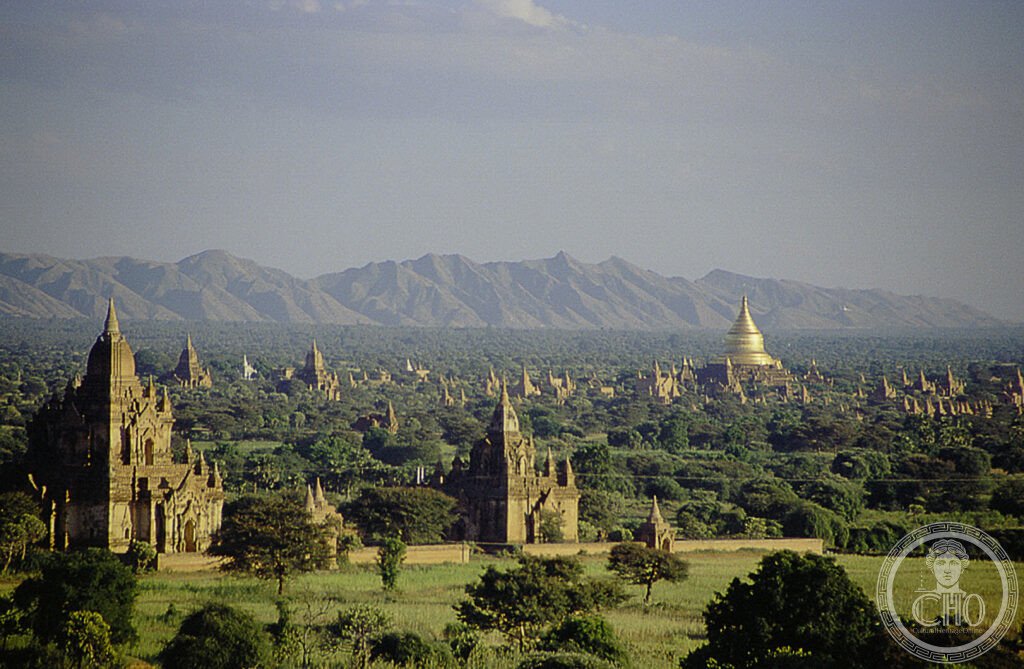
The most extraordinary archaeological landscape in Southeast Asia and the greatest concentration of Buddhist architecture in the world. Bagan, on the vast plain of the Irrawaddy River in central Myanmar, preserves approximately 3,500 Buddhist temples, pagodas, and monasteries built between the 9th and 13th centuries CE by the kings of the Pagan Empire, the first unified Burmese state.
At a glance
The Bagan Archaeological Zone became UNESCO WHS 2019, after a 23-year delay in which UNESCO withheld inscription in protest at the military junta’s restoration programme: the cement-and-brick rebuilds of the 1990s used modern materials and forms with little relation to the originals, changing the silhouettes of famous pagodas while claiming to restore them — the most controversial restoration campaign in Southeast Asian heritage history. Approximately 3,500 Buddhist religious structures survive, against an estimated 10,000 at the height of the Pagan period, and the loss is largely from earthquakes: the one of 1975 damaged approximately 5,000 structures and that of 2016 approximately 400. The zone covers 104 km² and is the largest single concentration of Buddhist religious architecture in the world. The Pagan Kingdom, the first unified Burmese state, was founded about 849 CE, and its great age ran from 1044 to 1287 CE under the dynasty of Anawrahta, r. 1044–1077 CE. He founded the empire, is the most important king in Burmese history, and converted the country to Theravada Buddhism: after conquering the Mon kingdom of Thaton in 1057 he brought back the Pali scriptures together with 30 elephant-loads of Mon monks and craftsmen, the most consequential religious conquest in Burmese history. The end came in 1287 CE, when the Mongol armies of Kublai Khan invaded and sacked Pagan: the kingdom collapsed, the city was largely abandoned, and it remains the most important military defeat of the Burmese Middle Ages.
Key facts
- The great temples of Bagan: the four essential structures. The Ananda Temple, about 1105 CE, was built by King Kyanzittha, r. 1084–1113 CE, the third king of the Pagan Empire and the most architecturally accomplished patron of the dynasty; it is the most perfectly preserved large temple in Bagan. The plan is a large cube with 4 projecting vestibules forming a perfect cross, crowned by a gilded spire — the most beautiful in Bagan, visible for several kilometres. Inside stand 4 standing Buddha images, each 9.5 m high, facing the 4 cardinal directions, the finest of their kind here: the wood of 2 of the 4 is considered original 12th-century work, the oldest surviving large wooden Buddhist images in Myanmar. The Dhammayangyi Temple is the largest by footprint. Narathu ordered it, r. about 1167–1170 CE, a usurper who murdered his father and his elder brother and remains the most hated king in Bagan history; tradition says he executed workmen whose brickwork joints were wide enough to admit a needle, the most extreme quality control in ancient Burmese building. Its interior passages were found bricked up, the most enduring mystery in Bagan archaeology. Tradition holds that Narathu was assassinated before finishing the temple and that his successor sealed them; the archaeology says they were closed in the 12th century, probably by Narathu himself, possibly for structural reasons. The Htilominlo Temple, about 1218 CE, was the last major temple raised before the Mongol invasion: 46 m high, finely decorated in stucco, with the most complete original stucco exterior in Bagan. The Shwezigon Pagoda, about 1059–1090 CE, was begun by Anawrahta and finished by Kyanzittha, and became the prototype of every later Burmese bell-shaped stupa — the most important architectural model in Burmese religious history.
- The Bagan sunrise and sunset: the experience that defines the visit. The Shwesandaw Stupa is the most important sunset viewpoint in Bagan: 5 terraces, each with a panorama over the plain, and an upper terrace approximately 60 m up that was the highest public vantage point reachable on foot. The sun goes down over the Irrawaddy to the west and leaves the silhouettes of 3,500 temples against an orange sky — the most photographed natural event in Myanmar. Since 2019 this has changed. As a condition of the UNESCO inscription the Myanmar government banned climbing the Shwesandaw, the most controversial heritage management decision in recent Myanmar tourism, and visitors now watch from the upper terraces of designated viewing pagodas or from the plain itself. The finest view is still from the air. The balloons fly only between October and April, when the dry-season wind and visibility are both at their best, approximately 20–30 of them each morning, at approximately USD 300–380 a person: the most expensive single tourist activity in the country and the one most often called “worth every dollar” in travel writing about Myanmar. On the ground the electric bicycle is the most practical transport on the plain and the best way to find the smaller, less visited temples alone. At dawn, from a good position, the mist over the temples and the rising sun make the most atmospheric heritage landscape in Southeast Asia.
- Theravada Buddhism and the Burmese tradition: the religion that built Bagan. Theravada Buddhism (the “school of the elders”; the oldest school of Buddhism and the dominant form in mainland Southeast Asia (Myanmar, Thailand, Cambodia, Laos, Sri Lanka)). It reached Burma with Anawrahta’s conquest of Thaton in 1057 CE. The Mon people of lower Burma had received Theravada Buddhism from Sri Lanka and possessed the Pali Canon, the complete scripture in the Pali language and the most important textual corpus of the tradition. What drove Bagan’s temple construction was the merit system. In Theravada Buddhism raising a temple generates enormous positive karma, merit, for whoever builds it, and accumulated merit reduces suffering in lives to come: the Pagan kings built on this scale because every temple was at once a cosmic investment and a political statement of royal power and piety. The Sangha, the community of monks, is the most important social institution in Burmese society, and every Burmese Buddhist male traditionally enters it for at least a short time. The most visible expression of this today is the novice ordination, the shin pyu, in which young boys are dressed in princely clothes and carried to the monastery on the backs of their relatives — the most elaborately ceremonial entry into monkhood in any Theravada country.
- Heritage: UNESCO World Heritage Site, Bagan, inscribed 2019.
- GPS: 21.1716° N, 94.8585° E.
History
The pre-Pagan period (evidence of settlement at Bagan from at least the 2nd century CE; the Burmese-speaking Pyu people built city-states throughout the Irrawaddy valley before the Pagan period; the Pyu cities (Beikthano, Halin, Sri Ksetra; the first UNESCO WHS in Myanmar (2014)); the Pagan period (849–1297 CE; the city of Pagan founded c.849 CE; the golden age: 1044–1287 CE; King Anawrahta (r. 1044–1077 CE) conquered the Mon kingdom, adopted Theravada Buddhism, and initiated the temple-building programme; King Kyanzittha (r. 1084–1113 CE) built the Ananda Temple and the Shwezigon Pagoda — the most important patron of Buddhist architecture in Burmese history; King Narapatisithu (r. 1174–1211 CE) continued the building programme; King Htilominlo (r. 1211–1235 CE) built the last great temple before the Mongol invasion; the Mongol invasion (1287 CE; the most important military event in Burmese medieval history; Kublai Khan’s armies entered Pagan after the Burmese forces were routed at the Battle of Ngasaunggyan (1277); the abandonment (Pagan was never a major political capital again after 1287; the temples were maintained by monks but the city did not recover its former population or political importance)); the British colonial period (the British administered Bagan as part of Upper Burma from 1885); the post-independence period (the Burmese military junta’s controversial restoration programme in the 1990s; UNESCO WHS 2019))).
What you see
Bagan is divided into 3 zones — Old Bagan, New Bagan, and Nyaung-U — spread over the 104-km² plain, and the most practical base is Nyaung-U, the main town, closest to the airport and the food market. The essential itinerary takes 3 full days for a thorough visit. Day 1 is the northern zone: the Shwezigon Pagoda at sunrise, before the crowds; Ananda Temple, the finest temple in Bagan, where you should allow 1h 30min for the interior Buddha images and the glazed tiles on the exterior terrace; the Htilominlo Temple, with the best stucco exterior; and the Upali Thein, the ordination hall with the finest surviving 18th-century frescoes. Day 2 is the central zone: the Thatbyinnyu Temple, the tallest temple in Bagan at 61 m, built by Alaungsithu (r. 1112–1167 CE); the Sulamani Temple (c.1183 CE), with the finest decorative detail and the best-preserved interior frescoes of the 12th century; and the Dhammayangyi Temple, the most dramatic mass, with its bricked-up interior. Day 3 is the southern zone and the Minnanthu area, the most remote, with the fewest visitors and the best temples for solo exploration. The electric bicycle is the optimal transport: the distance between temples is too great for walking and the roads are too sandy and narrow for a car, so it is the best way to experience the scale of the plain independently, at a rental of approximately USD 5–8 per day.
Practical information
- Getting there: Nyaung-U Airport (NYU) is the gateway to Bagan, with daily domestic flights from Yangon in 1h on Myanmar National Airlines and KBZ Air — the most reliable air access — and from Mandalay in 30min, the option most used by visitors combining the two cities. The Bagan Archaeological Zone fee is USD 25 a person, valid several days, paid at the main entrance or at the airport, and the revenue is meant to go to conservation. The river boat from Mandalay takes approximately 12h overnight and is the most atmospheric way to arrive: coming up the river to see the temples emerge at dawn is the finest approach to any heritage site in Southeast Asia. The government-run IWT ferry is slower but more reliable, and the tourist slow boat, the Malikha River Cruise, is the most comfortable. The overnight train from Yangon takes approximately 18h and is the cheapest and the hardest way, worth it only for budget travellers with unlimited time and patience for Burmese railway schedules — the most unpredictable service in Southeast Asia.
- Mandalay and the upper Irrawaddy: the essential Bagan companion. Mandalay was the last royal capital of Burma, 1857–1885 CE. King Mindon Min moved the court here from Amarapura in 1857 because a prophecy held that a great Buddhist city would rise at the foot of Mandalay Hill: the most religiously motivated capital relocation in Burmese history. The hill itself is the most important pilgrimage site in Upper Burma, 1,775 steps to the summit, where the Sutaungpyei, the wish-fulfilling pagoda, is the most visited religious site in the city. At its foot stands the Kuthodaw Pagoda, which holds the largest book in the world: 729 white marble slabs inscribed with the complete Pali Canon of Theravada Buddhism, each housed in its own small pagoda, and the 729 slabs together form the complete Tripitaka, the most important collection of Buddhist scripture. Reading it through at a normal pace would take approximately 450 years, which makes it also the most impractical book in the world. Mandalay is the centre of traditional gold-leaf production in Myanmar: the quarter-millimetre-thick beaten leaf applied to Buddha statues, the commonest act of merit-making in Burmese Buddhism.
- Inle Lake: the most unique floating village landscape in Southeast Asia. Inle Lake is the most important lake in Myanmar for visitors, set in the Shan Hills at approximately 900 m, with the most temperate climate of lowland Myanmar. Its people are the Intha, the “sons of the lake”, and their most distinctive work is the floating gardens, htaing inn: artificial islands of vegetation anchored to the lake bed with bamboo poles, on which vegetables, tomatoes and flowers are grown — the most unusual agriculture in Southeast Asia. The Intha fishermen row their dugout canoes with a single oar hooked behind the knee of one leg, which leaves both hands free for the conical fish traps: the most distinctive fishing technique in the world, and the most photographed human activity in Myanmar after the Bagan sunrise.
Getting there
Nyaung-U Airport (NYU). Flights from Yangon 1h, Mandalay 30min. Bagan zone fee USD 25. Electric bicycle rental ~USD 6/day. GPS: 21.1716, 94.8585.
Nearby
- Mandalay Hill and the Kuthodaw Pagoda. 180 km north-east of Bagan (4h by road or 12h+ by river; 1h by air). Described in the Practical section. The last royal capital of Burma, the largest book in the world, and the most important gold-leaf craft centre in Myanmar.
- Mount Popa. 50 km south-east of Bagan (1h by road). The most sacred mountain in Myanmar and the most important nat (spirit) shrine in Burmese animism. Mount Popa is a 737-m extinct volcano rising abruptly from the Bagan plain, and beside it, on an isolated volcanic plug of the same 737-m height, sits the Popa Taungkalat shrine. It is reached by 777 steps, the most important staircase in Burmese religious culture, and the chief hazard of the climb is the macaques that live along it: they are aggressive and will take food, bags and sunglasses from visitors, the most persistently documented wildlife danger in Myanmar heritage tourism. The mountain belongs to the nats, the spirits of the Burmese pre-Buddhist animist tradition. King Anawrahta incorporated an official pantheon of 37 nats into Burmese Buddhist practice — the most important fusion of indigenous animism and imported Buddhism in Southeast Asian religious history — and Mount Popa is the home of the most powerful nats of those 37 in the Burmese pantheon.
- Yangon (Rangoon) and the Shwedagon Pagoda. 650 km south of Bagan (1h by air; 18h by train). The most important city in Myanmar and the home of the most sacred Buddhist stupa in the world. The Shwedagon Pagoda is the most important religious building in Myanmar, a 98-m gilded stupa in the centre of Yangon. It is covered in 27 metric tonnes of solid gold leaf, and the diamond orb at the top contains 4,531 diamonds, with a 76-carat diamond at the very tip — the most valuable single piece of jewellery on any religious building in the world. The stupa is said to enshrine 8 sacred hairs of the Gautama Buddha and relics of the three previous Buddhas, and it is the most ancient sacred site in Yangon. Its date of foundation is the most contested: the Shwedagon tradition claims 2,600 years, archaeological evidence suggests approximately 1,000 years, and it is the most diplomatically sensitive archaeological dating controversy in Burmese religious history.
Sources
- Wikipedia, Bagan. Pagan Kingdom. Ananda Temple, accessed June 2026.
- UNESCO, Bagan, WHS reference 1588, inscribed 2019.
- Michael Aung-Thwin, Pagan: The Origins of Modern Burma, University of Hawaii Press, 1985.
Find it on the map
See this place and what’s around it →📷 Become a Cultural Heritage Online photographer
Share your photos of places: they stay published under your name as the author. The more they're seen, the more you get noticed — and soon a contest will reward the most appreciated photos.
Log in or sign up free to add a photo