
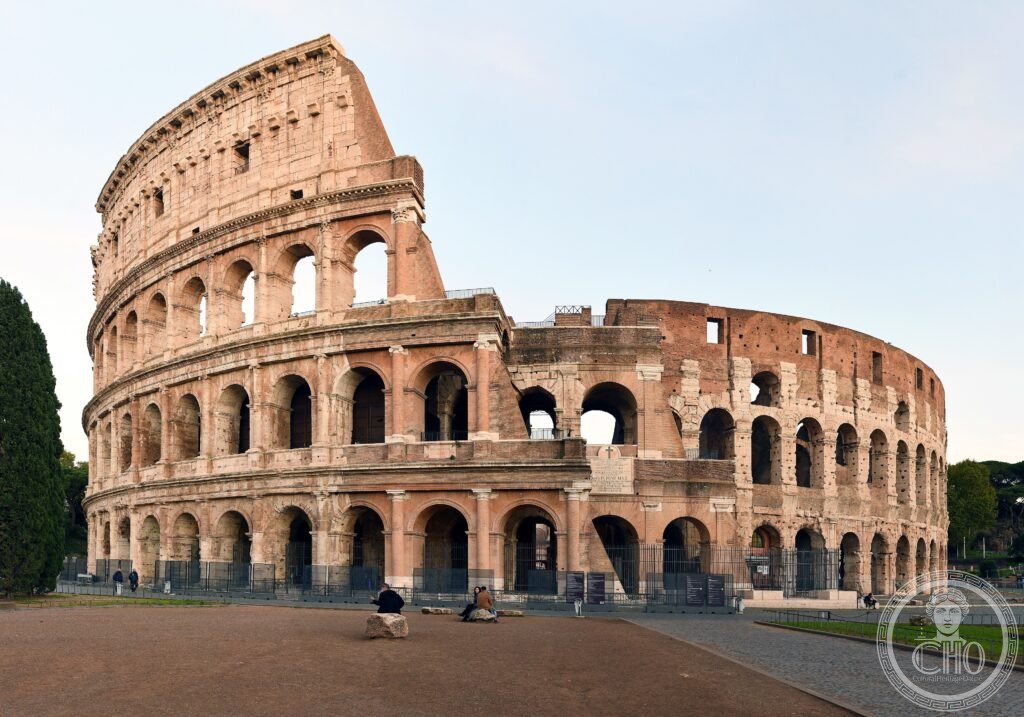
The most visited heritage city in the world and the physical foundation of Western civilisation — Rome, the “Eternal City,” contains within a day’s walk the Colosseum (the largest amphitheatre ever built), the Pantheon (the best-preserved ancient building in the world and the most influential single structure in Western architecture), the Roman Forum, and the Renaissance and Baroque churches, palaces, and fountains of the papal city that shaped two thousand years of European culture.
At a glance
The Historic Centre of Rome (UNESCO WHS 1980; extended 1990 to include Vatican City and the Basilica of San Paolo fuori le Mura; population of Rome approximately 2.87 million (the capital of Italy; the largest city in Italy; the most visited city in Italy)) has been continuously inhabited for approximately 2,800 years (the traditional founding date of Rome is 753 BCE — the date recorded in the Roman tradition; the archaeological evidence suggests an earlier continuous occupation of the Palatine Hill from at least 900 BCE); the city was the capital of the Roman Republic (509–27 BCE), the Roman Empire (27 BCE–476 CE Western Empire; 476–1453 CE Eastern (Byzantine) Empire), the Papal States (754–1870), and modern Italy (from 1871); the physical extent of the historical city (Rome within the Aurelian Walls (3rd century CE; approximately 19 km of walls; the largest walled city in Roman history; still largely intact and walkable) contains the densest concentration of archaeological remains, medieval churches, Renaissance palaces, and Baroque fountains in any city in the world; the archaeological layers of Rome (the most complex urban stratigraphy in Europe: at many locations in the city, 5–10 archaeological layers from different centuries are stacked on top of each other; the building of one era’s Rome required the destruction of the previous era’s Rome — this process of layering created the unique character of the city and the most complex archaeological site in Europe).
Key facts
- The Colosseum: the most recognisable ancient structure in the world — the Colosseum (the Flavian Amphitheatre; Amphitheatrum Flavium; the full construction history described in the figcaption; the spectacles (the munera gladiatoria (gladiatorial combat; the most famous element of Roman public entertainment; the gladiatorial games at the Colosseum (the games were presented by wealthy patrons or emperors as public benefactions — the political tool of “bread and circuses” (panem et circenses; the phrase from Juvenal; the most famous summary of Roman populist politics)); the gladiatorial categories (the most important combat types: the Retiarius (net and trident; the lightest-armed gladiator; the most mobile); the Secutor (helmet with small eye-holes; the heaviest-armed gladiator specifically designed to fight the Retiarius; the most logical paired opponent); the Murmillo (large fish-shaped crest on helmet; rectangular scutum shield; paired with the Thraex); the venatio (animal hunts; caged exotic animals (lions, tigers, elephants, crocodiles, hippopotamuses, rhinoceroses) were brought from across the empire and fought by bestiari (beast hunters)); the underground (the hypogeum; the subterranean network of tunnels and cages below the arena floor; hidden from the spectators; animals and gladiators were hoisted to arena level via 36 lifts (trap doors in the arena floor)); the modern threats (the Colosseum was stripped of its travertine stone during the medieval period for building material (the Colonna, Farnese, and other Roman families literally quarried the Colosseum for stone; the most famous example of archaeological spoliation in European history); currently threatened by exhaust pollution (the vibration of traffic and the chemical erosion of the travertine); the restoration and consolidation work (ongoing since the 1990s; the most expensive ongoing archaeological restoration project in Italy))
- The Pantheon: the best-preserved ancient building in the world and the most influential structure in Western architecture — the Pantheon (Πάνθεον; “All Gods”; the current building: completed approximately 125 CE under Emperor Hadrian (r. 117–138 CE); the dedication on the portico (M·AGRIPPA·L·F·COSTERTIVMFECIT — “Marcus Agrippa, son of Lucius, consul for the third time, built this” — the dedication to Agrippa (who built the first Pantheon on the site in 27 BCE, destroyed by fire) was deliberately retained by Hadrian on the rebuilt temple as an act of historical piety); the dome (the most influential single element of the building; the unreinforced concrete dome (the largest unreinforced concrete dome in the world at 43.3 m diameter; the same diameter as the distance from the floor to the apex of the dome — the dome fits a perfect sphere; the thickness of the dome decreases from 6.4 m at the base to 1.2 m at the oculus (the 9-m opening at the crown); the concrete aggregate (the heaviest aggregate (travertine) at the base; progressively lighter aggregates (tuff, brick, pumice) toward the oculus — the most sophisticated concrete mix design in any ancient structure)); the oculus (the circular opening at the crown of the dome; the only light source in the building (the Pantheon has no windows); the beam of light that enters through the oculus traces a path across the walls and floor as the sun moves (the oculus functions as a sundial; on the summer solstice noon, the beam falls on the entrance portico); the rain (rain enters through the oculus; the floor slopes slightly toward the centre where 22 drainage holes remove the water); the conversion to a Christian church (the Pantheon was consecrated as the church of Santa Maria ad Martyres by Pope Boniface IV in 609 CE — the most important single act of preservation in the history of ancient Rome; the preservation of the Pantheon (almost perfectly intact after 1,900 years) is directly due to its continuous use as a place of worship; the tombs (Raphael (1483–1520; the High Renaissance painter; buried in the Pantheon since 1520 by his own request; the most visited individual tomb in the Pantheon); King Victor Emmanuel II (1820–1878; the first King of unified Italy; buried in the Pantheon since 1878))
- The Roman Forum and Palatine Hill: the birthplace of Western law, governance, and urban civilisation — the Roman Forum (the Foro Romano; the central gathering place of ancient Rome; the most historically significant single open space in the world; the functions (the Forum was simultaneously the religious centre (the temples of Saturn, Castor and Pollux, Vesta, Julius Caesar), the civic centre (the Curia Julia — the meeting house of the Roman Senate — where some of the most consequential decisions in Western political history were made), the commercial centre (the Basilica Aemilia; the Basilica Julia — the law courts), the triumphal route (the Via Sacra — the “Sacred Way” — ran through the Forum from the Arch of Titus to the base of the Capitoline Hill; every Roman triumph (the ceremony in which a victorious general paraded his spoils and prisoners through Rome) passed through the Forum along the Via Sacra)); the most important single structure in the Forum: the Temple of Julius Caesar (Divus Julius; the first temple built by the Romans for a deified human (Augustus built the temple on the spot where Caesar’s body was cremated in 44 BCE; the oldest Roman cult of a deified human; the most politically significant temple in the Forum); the Palatine Hill (Collis Palatinus; the most prestigious address in ancient Rome and the origin of the word “palace” (palatium); the hill where Rome was traditionally founded by Romulus; the hill where the emperors built their private palaces from Augustus onwards; the remains of the House of Augustus (Casa di Augusto; the most important domestic structure on the Palatine; the bedroom with the original fresco decoration (the best-preserved painted interior of any Roman structure in the world); the Domus Flavia (the imperial palace of Emperor Domitian; 81–96 CE; the architectural model for every European royal palace for 1,500 years))
- Heritage: UNESCO World Heritage Site, Historic Centre of Rome, the Properties of the Holy See in that City Enjoying Extraterritorial Rights and San Paolo Fuori le Mura, inscribed 1980
- GPS: 41.8902° N, 12.4922° E
History
The founding mythology and the archaeological reality (Romulus and Remus; the date 753 BCE; the Palatine Hill settlements from at least 900 BCE; the Latin peoples; the Etruscan influence (the Etruscans civilised early Rome; the most important contribution: the arch (the corbelled arch of the Etruscans became the true arch of the Romans — the key structural element of Roman engineering); the last three kings of Rome (Tarquinius Superbus; expelled 509 BCE; the founding of the Republic)); the Roman Republic (509–27 BCE; the most politically inventive period; the SPQR (Senatus Populusque Romanus — the Senate and People of Rome) as the locus of legitimate authority; the expansion from the Tiber valley to domination of the Mediterranean in approximately 500 years; the Social War, the Gracchi, the Civil Wars (Caesar vs. Pompey; Antony and Octavian vs. the Liberators)); the Empire (27 BCE–476 CE; Augustus; the Pax Romana (27 BCE–180 CE; the most peaceful and prosperous period in Mediterranean history); the construction of the major monuments: the Pantheon (Agrippa/Hadrian); the Colosseum (Vespasian/Titus); the Trajan’s Column; the Baths; the fall of the Western Empire (476 CE; Odoacer deposes Romulus Augustulus; the most debated “end” in history)); the Papal Rome (590 CE onwards; Gregory I; the transformation of the ancient city into the capital of the Catholic Church; the Middle Ages and Renaissance; the sack of Rome (1527; Charles V’s troops; the most destructive event in Rome since the Visigoth sack of 410 CE; ended the High Renaissance in Rome)); the Baroque Rome (Bernini, Borromini; the Trevi Fountain; the great churches and fountains); the Italian capital (from 1871); UNESCO WHS 1980.
What you see
The Ancient Rome circuit (the Colosseum (book in advance; the underground or arena floor visits are the best experiences; allow 2h); the Roman Forum and Palatine Hill (combined ticket with the Colosseum; allow 3h; the House of Augustus frescoes require a separate timed booking)); the Pantheon (free entry since 2023 requires advance booking; arrive before 9am or after 5pm to avoid crowds; the interior is the experience — the dome, the oculus, the side niches, the tombs); the Baroque fountains (the Trevi Fountain (evening; the most atmospheric time); the Four Rivers Fountain in Piazza Navona (Bernini, 1651; the finest single fountain in Rome; the central obelisk (an Egyptian obelisk but not actually from Egypt — Domitian had it made in Rome using Egyptian models for the Circus of Maxentius)); the Borghese Gallery (the most important collection of Baroque sculpture in the world; the Bernini sculptures (Apollo and Daphne; The Rape of Proserpina; David) are the most important works; requires advance booking; maximum 360 visitors per 2h slot; the most booking-critical attraction in Rome).
Practical information
- Getting there: Leonardo da Vinci International Airport (FCO; Fiumicino; 30 km west of Rome; the Leonardo Express train (non-stop; 32 min; EUR 14; from Fiumicino Airport directly to Roma Termini) or the FL1 regional train (45 min; EUR 8; stops at Trastevere and Tiburtina before Termini)); Ciampino Airport (CIA; 15 km south-east; budget airlines; Terravision/SIT bus to Termini (45 min; EUR 6)); Roma Termini (the main rail station; the most important transport hub in Italy; high-speed Frecciarossa/Frecciargento trains: Florence (1h 30min); Naples (1h 10min); Venice (3h 25min); Milan (2h 55min); Bologna (2h); the Termini complex (the largest railway station in Italy; the most confusing; the pickpocket hotspot — the most important security warning in Rome)); the Roma Pass (48h or 72h card; unlimited public transport + skip-the-line access to 2 museums; the most economical approach for multi-day visitors)
- The Vatican Museums and Sistine Chapel: the single most important art collection in the world — the Vatican Museums (Musei Vaticani; the world’s largest art museum by some measures; the collection (assembled over 500 years by successive popes; the most important single collection in Western art history); the Sistine Chapel (the most visited single room in the world (approximately 5 million visitors per year; the Papal chapel; the most important paintings in the Western tradition: the ceiling (1508–1512; Michelangelo; approximately 520 m²; the nine central scenes from Genesis (the Creation of Adam; God dividing light from darkness; the Fall and Expulsion from Paradise); the 12 figures of Prophets and Sibyls on the curved walls; painted while lying on scaffolding (the common image of Michelangelo painting flat on his back is incorrect — he stood on a curved scaffold and worked upright with his head tilted backward)); the Last Judgement (the altar wall; 1534–1541; Michelangelo (aged 59–66); the most ambitious single-wall fresco in the Western tradition; 300+ figures; the figure of Christ as the implacable judge — the most Christ-as-judge image in Christian art; the self-portrait (Michelangelo painted his own face on the flayed skin of St. Bartholomew in the right-centre of the composition — the most famous artist’s self-portrait hidden in a religious painting))); the Raphael Rooms (Stanze di Raffaello; the four rooms painted by Raphael for Pope Julius II; the School of Athens (the philosophical fresco; all the great philosophers of antiquity gathered in a Greek architectural setting; Plato depicted with the face of Leonardo da Vinci; Heraclitus depicted as a solitary figure sitting on a step with the face of Michelangelo — painted after Raphael saw the Sistine ceiling scaffolding))
- Eating in Rome: the simplest great cuisine in Italy — the four Roman pasta dishes (cacio e pepe (Pecorino Romano cheese + black pepper + pasta water; the simplest; the most technically demanding; the emulsification of cheese and pepper into a sauce with no cream or butter is the most precise pasta technique in Roman cooking); carbonara (guanciale + egg yolk + Pecorino Romano + black pepper; the post-war Roman dish (the most disputed origin story in Italian food; possibly created by Roman cooks using American military rations (eggs + bacon) after the liberation of Rome in 1944; possibly derived from an older tradition of cacio e uova)); amatriciana (guanciale + Pecorino Romano + tomato + black pepper; the tomato version of the gricia; from Amatrice (the town largely destroyed by earthquake in 2016); the sugo all’amatriciana alla matriciana (the Roman restaurant version is slightly different from the Amatrice version; the Roman version uses a little white wine)); gricia (guanciale + Pecorino Romano + black pepper; the same as amatriciana without the tomato; the oldest of the four; the most underrated)))
Getting there
Fiumicino Airport (FCO; Leonardo Express 32min to Termini EUR 14). High-speed trains: Florence 1h30, Naples 1h10, Milan 2h55. GPS: 41.8902, 12.4922.
Nearby
- Pompeii and Herculaneum (UNESCO WHS 1997) — 230 km south of Rome (1h 10min by Frecciarossa to Naples, then 40min by Circumvesuviana regional train to Pompeii Scavi station); the most important archaeological sites in the world for understanding daily Roman life — described in a separate CHO place card; the combination (Rome + Pompeii) is the single most important ancient heritage itinerary in the world
- Tivoli (Hadrian’s Villa and Villa d’Este, UNESCO WHS) — 30 km east of Rome (1h by COTRAL bus from Ponte Mammolo Metro B station); the most important ancient suburban complex in Italy and the finest Renaissance garden in the world — Hadrian’s Villa (Villa Adriana; UNESCO WHS 1999; built 118–134 CE by Emperor Hadrian as his private retreat; the largest imperial estate in the Roman world (approximately 120 ha of gardens, buildings, pools, and libraries; the most architecturally inventive complex of the Roman imperial period; Hadrian designed the buildings himself (he was the most architecturally gifted Roman emperor — the Pantheon in Rome is attributed to his direct design input; the buildings at Tivoli are more architecturally experimental than anything in Rome: the Maritime Theatre (a circular island villa surrounded by a moat; the emperor’s private room accessible only by a retractable bridge; the most private space in the entire Roman world)); Villa d’Este (UNESCO WHS 2001; the 16th-century Cardinal Ippolito d’Este’s villa above Tivoli town; the most important Italian Renaissance garden; 500 fountains; the Hundred Fountains (a long terrace with 100 individual spouting jets); the Organ Fountain (the water-powered organ — the most technologically ambitious fountain of the Renaissance; plays music powered entirely by the weight and flow of the water))
- Naples (UNESCO WHS 1995) — 225 km south of Rome (1h 10min by Frecciarossa); the most intense, authentic, and overwhelming city in Italy — Naples (Napoli; population approximately 3 million metropolitan; the third-largest city in Italy; the largest city in southern Italy; the Archaeological Museum of Naples (the Museo Archeologico Nazionale; the finest collection of ancient Roman art in the world; the Pompeii and Herculaneum collections (the most important because the art of these cities survived intact through volcanic burial; the most important individual objects: the Alexander Mosaic (the largest ancient mosaic in existence; from the House of the Faun in Pompeii; 5.82 × 3.13 m; depicting the Battle of Issus (333 BCE); Alexander the Great on his horse Bucephalus charging at Darius III on his chariot; the most important ancient mosaic in the world); the Farnese Hercules (a 3rd-century CE Roman marble copy of a Greek bronze original by Lysippos; 3.17 m; the most famous single ancient sculpture in the Naples museum); the Secret Cabinet (the “Gabinetto Segreto”; the collection of erotic art from Pompeii and Herculaneum (previously kept locked from public view; now openly displayed; the most important single collection for understanding Roman erotic culture)))
Sources
- Wikipedia, Colosseum; Pantheon, Rome; Roman Forum; History of Rome, accessed June 2026
- UNESCO, Historic Centre of Rome, WHS reference 91rev, inscribed 1980
- Mary Beard, SPQR: A History of Ancient Rome, Profile Books, 2015
Find it on the map
See this place and what’s around it →
📷 Become a Cultural Heritage Online photographer
Share your photos of places: they stay published under your name as the author. The more they're seen, the more you get noticed — and soon a contest will reward the most appreciated photos.
Log in or sign up free to add a photo