

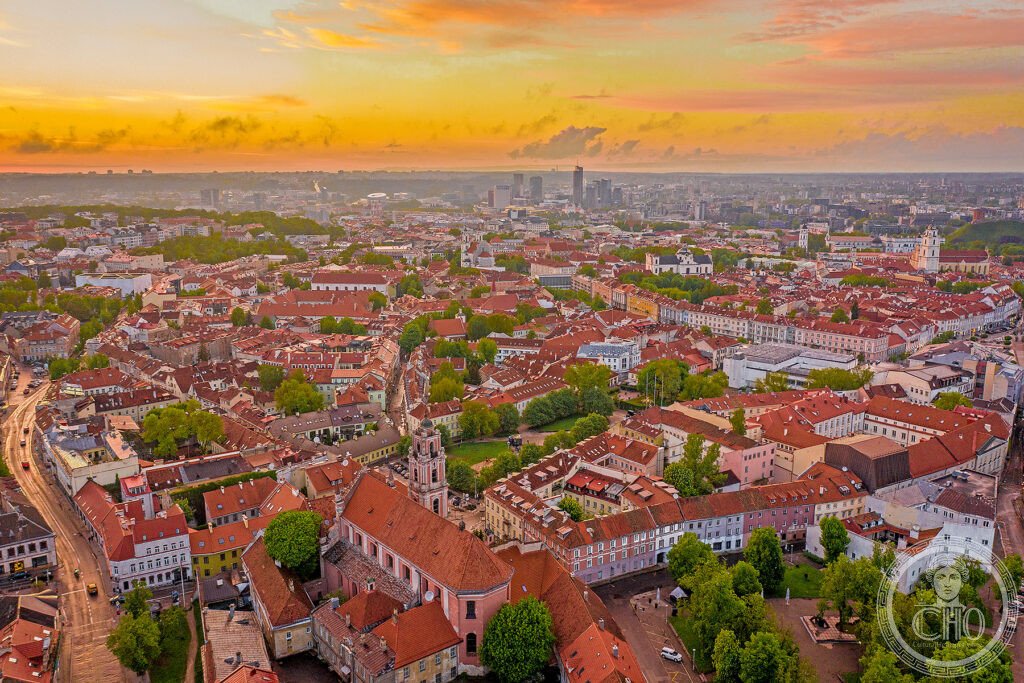
The largest medieval city centre in northern Europe and the most thoroughly Baroque capital in the Baltic states. Vilnius, the capital of Lithuania, preserves in 3.6 square kilometres a layered city of extraordinary density: 65 churches, the most famous Gothic church in the Baltic (St. Anne’s, which Napoleon declared he wished to carry in his palm to Paris), the greatest concentration of Baroque architecture in northern Europe, and the legacy of one of the most distinguished Jewish communities in the history of the Diaspora.
At a glance
The Historic Centre of Vilnius (UNESCO WHS 1994; approximately 3.6 km²; the largest medieval old town in the Baltic region and northern Europe; population of the city of Vilnius approximately 590,000 (the largest city in Lithuania)) is the capital of Lithuania, located at the confluence of the Vilnia and Neris Rivers in south-eastern Lithuania (approximately 30 km from the borders of both Belarus and the Kaliningrad exclave of Russia). The city was founded by Grand Duke Gediminas in 1323 (Gediminas wrote letters to the Hanseatic cities and to the Pope inviting merchants and craftsmen to settle in his city; the letters, written in 1323, are the oldest surviving documents referencing Vilnius by name) and became the capital of the Grand Duchy of Lithuania. Which at its greatest extent (14th–15th century) was the largest state in Europe, stretching from the Baltic Sea to the Black Sea. The Polish-Lithuanian Commonwealth (the union of Poland and Lithuania in 1569; the most powerful state in eastern Europe for the next century; Vilnius was the second capital of the Commonwealth alongside Kraków and Warsaw). The character of the Vilnius historic centre is defined above all by Baroque architecture. The Jesuits arrived in 1569 and transformed the city over the next 150 years into a showcase of Counter-Reformation Baroque. The Vilnius University (founded 1579 by the Jesuits; one of the oldest universities in the region; the University Church of St. John the Apostle and Evangelist; the 13 inter-linked courtyards of the university complex).
Key facts
- St. Anne’s Church: the finest Gothic church facade in the Baltic and Napoleon’s favourite building. St. Anne’s Church (Šv. Onos bažnyčia; a late Gothic Flamboyant church built approximately 1495–1501; the architect is unknown (the church is “attributed to” Benedikt Rejt, the Czech architect who worked for the Jagiellonian kings, but there is no documentary proof)). The facade (the most celebrated single architectural facade in Lithuania; 22 different types of red brick arranged in a complex pattern of Gothic tracery, pinnacles, and blind arches; the facade has no flat or plain surfaces — every centimetre is articulated with Gothic ornament; the visual effect is of extreme delicacy and complexity despite the solidity of the brick construction). Napoleon’s remark (during his 1812 Russian campaign, Napoleon and his Grande Armée passed through Vilnius; the story (reported in multiple 19th-century sources) that Napoleon, seeing St. Anne’s, declared “I would like to carry it in the palm of my hand to Paris” is one of the most famous architectural anecdotes in the Baltic; whether or not Napoleon said this exactly, the story reflects accurately the extraordinary impression the building makes on first sight). The adjacent Bernardine Church (early 16th century; the largest Gothic church in Lithuania; the two churches together — the small exquisite St. Anne’s and the large late-Gothic Bernardine — form the most important Gothic ensemble in Vilnius).
- Vilnius. The “Jerusalem of Lithuania”: the most important Jewish city in northern Europe and the legacy of the Vilna Gaon. The name “Jerusalem of Lithuania” records what Vilnius — Wilno in Polish, Vilne in Yiddish — was as a centre of Jewish scholarship and culture from the 16th to the 20th century. The Great Synagogue of Vilna, built in the 1630s, was the most important in northern Europe for 300 years: the Nazis destroyed it in 1941 and the Soviets demolished what remained. A primary school in Zydu Street now occupies the site, and archaeological excavations between 2015 and 2019, by a joint Israeli-Lithuanian-American team, found the foundations and fragments of the synagogue beneath the school building. The city’s greatest scholar was Elijah ben Solomon Zalman, 1720–1797, the Vilna Gaon, the most celebrated Jewish scholar of the Enlightenment era: he was called the “genius of Vilnius” for the scope of his learning, knew all Talmudic literature by memory and wrote approximately 70 books on Jewish law, mysticism, grammar, mathematics and astronomy. Gaon Elijah Street, formerly Žydų gatvė, Jewish Street, is named for him, as is the Vilna Gaon State Jewish Museum, the most important museum of Lithuanian Jewish history, whose collection follows Litvak culture from the 16th century to the Holocaust.
- Užupis. The bohemian republic within the city: the most unusual urban micro-state in Europe. Užupis means “Beyond the River” in Lithuanian: it is the artists’ quarter across the Vilnia from the historic centre, and it declared itself a “Republic” on 1 April 1997 — April Fool’s Day, the declaration part tongue-in-cheek and part serious statement of identity. Its “Constitution” lists the rights of the citizens on plaques in several languages along the main street. Article 1: “Everyone has the right to live by the River Vilnelė, and the River Vilnelė has the right to flow by everyone”. Article 12: “A dog has the right to be a dog”. Article 41: “Everyone has the right to be happy”. Serious political and social statements and absurdist humour run through it in approximately equal measure. On a tall column in the central square stands the symbol of the republic: a golden angel playing a trumpet.
- Heritage: UNESCO World Heritage Site, Vilnius Historic Centre, inscribed 1994.
- GPS: 54.6872° N, 25.2797° E.
History
Foundation by Grand Duke Gediminas (1323; the letters to western Europe inviting settlement). The Grand Duchy of Lithuania (the largest state in Europe at its 14th–15th century peak; stretching from the Baltic to the Black Sea; the Grand Duke was simultaneously a pagan ruler (Lithuania was the last pagan state in Europe to convert to Christianity; baptism 1387) and the most powerful ruler in eastern Europe). The Polish-Lithuanian Commonwealth (1569–1795; the most powerful state in the region; Vilnius as the second capital; the Jesuit Counter-Reformation transformation of the city (1569–1750; 40 Jesuit-associated buildings including the University)). Russian Empire (1795–1918; partition of Poland-Lithuania by Russia, Prussia, and Austria; Vilnius became Wilno in the Russian province of Lithuania; the 19th-century literary and cultural revival; the Lithuanian National Revival). WWI and the interwar period (1918–1939; briefly the capital of independent Lithuania (1918); then occupied by Poland (1920–1939; the region of Wilno was disputed between Lithuania and Poland; the political dispute between the two countries was so serious that they had no diplomatic relations for 20 years; Vilnius was Polish Wilno, the second city of the Second Polish Republic)). Soviet period, 1940–1991: the Soviet occupation, and the Holocaust. Approximately 95% of Lithuanian Jews, approximately 200,000 people, were murdered, almost all between 1941 and 1943 — the highest percentage of any Jewish community in Europe. At Ponary, Paneriai, the forest site outside Vilnius, approximately 70,000 Jews were murdered by the Einsatzgruppen and Lithuanian collaborators between July 1941 and July 1944: it is the most important Holocaust memorial site in Lithuania. Lithuanian independence restored 1991; UNESCO WHS 1994; European Capital of Culture 2009.
What you see
The Cathedral Square (the main public space; the Cathedral Basilica neoclassical exterior; the bell tower; the Gediminas Avenue (the main boulevard running west from the Cathedral Square; the most important commercial and public street in Vilnius)). The Gediminas Tower (the funicular or path to the top; the view of the old town; the museum inside the tower). Pilies Street (the main pedestrian street of the old town; the street of amber shops, souvenir stalls, and cafes leading south from the Cathedral Square; the most visited street in Vilnius). St. Anne’s Church (at the end of Pilies Street, across a small square; approach from the south for the full facade view; best in late afternoon light). The Vilnius University complex (enter from the main gate on Universiteto Street; walk the 13 courtyards; the Observatory Courtyard (the oldest university observatory in the Baltic; the zodiac signs carved on the wall of the observatory); the Church of St. John; the Sarbievijaus Courtyard (the most intimate courtyard; the view of the bell tower)). Užupis (cross the bridge at the end of Bernardinų Street; the Constitution plaques; the angel; the cafes and galleries).
Practical information
- Getting there: Vilnius International Airport (VNO; 7 km from the city centre; Bus 1 or 88 (20 min; EUR 1) or taxi (approximately EUR 10–15); Ryanair, Wizz Air, LOT, Finnair, Lufthansa, SAS, and airBaltic serve Vilnius; direct flights from London, Berlin, Paris, Amsterdam, Frankfurt, Stockholm, Helsinki, Warsaw, Riga, and Tallinn). The Vilnius train station (adjacent to the old town; Vilnius–Warsaw (9h; PKP/LG; from EUR 20; the most scenic rail route between the Baltic and Poland); Vilnius–Riga (4h; Lux Express or bus; bus is faster than train on this route)). The Tallinn–Riga–Vilnius corridor (the three Baltic capitals; the most logical itinerary for exploring all three; Riga is central to both; Lux Express buses connect all three; the complete circuit (Tallinn–Riga–Vilnius–back) can be done in a week at a relaxed pace with 2 nights in each city).
- The Trakai Castle day trip: the finest lake castle in the Baltic region and the symbol of medieval Lithuanian power. Trakai lies 28 km west of Vilnius, 30 min by train — the most convenient way, with departures every 1–2h from Vilnius station for approximately EUR 1.50. Its Island Castle is the most visited heritage site in Lithuania, a 14th–15th century building that Grand Duke Vytautas the Great raised in the late 14th century as a royal residence and the seat of the Grand Duchy, standing on an island in Lake Galvė and reached by two wooden bridges. The restoration of the 1950s–1980s remains controversial precisely because it was so thorough: the castle was rebuilt from a ruined shell, and the result is the most visually complete medieval castle in Lithuania and more reconstruction than authentic survival. Trakai is also the home of the Karaites, or Karaim, a Turkic-speaking Jewish religious minority who accept only the written Torah, the Hebrew Bible, and not the Oral Torah, the Talmud. Grand Duke Vytautas brought approximately 380 Karaite families from Crimea in the late 14th century to serve as his bodyguard, and the approximately 50–70 Karaites left in Trakai today form one of only 3–4 surviving communities in the world.
- The Hill of Crosses (Kryžių kalnas): the most extraordinary pilgrimage site in the Baltic and one of the most powerful sacred landscapes in Europe. The Hill of Crosses stands 215 km north of Vilnius, 2h 30 min away, reached by train or bus via Šiauliai. It is a low hill outside the town on which Lithuanian Catholics have been placing crosses since approximately the 14th century. Its meaning sharpened after the uprising of 1863 against Russian rule, when Lithuanians began planting crosses in memory of the dead. The Soviet authorities bulldozed them three times, in 1961, 1973 and 1975, and each time the crosses were back within days. After independence their number grew explosively, and the count now exceeds 200,000 of every size: the vast majority small, in wood or metal, the largest approximately 10 m tall. The effect of that mass covering the hill is overwhelming and unlike any other landscape in Europe. Pope John Paul II came in 1993 and placed a cross himself, on what had been the most important symbol of Lithuanian Catholic resistance to Soviet atheism.
Getting there
Vilnius Airport (7 km; bus 20 min). Direct flights from London, Berlin, Warsaw and other European cities. GPS: 54.6872, 25.2797.
Nearby
- Curonian Spit (UNESCO WHS 2000). 330 km north-west of Vilnius (4h by road to Klaipėda + ferry to the Spit). The most beautiful sand dune landscape in the Baltic and the greatest natural spit on the European coast. The Curonian Spit, Kuršių Nerija, is a 98 km bar of sand that separates the Curonian Lagoon from the Baltic Sea, shared between Lithuania — the northern section, from Klaipėda to the Russian border — and the Kaliningrad exclave of Russia; UNESCO WHS 2000. Along the southern part of the Lithuanian section runs the Great Dune Ridge, among the largest moving sand dunes in Europe, which can reach 60–70 m in height. Nida is the most important of the fishing villages and the most visited on the Lithuanian side. The German writer Thomas Mann built a summer house there in 1929–1930, now the Thomas Mann Memorial Museum and the only museum dedicated to him outside Germany; he called the landscape of the Spit “the Lithuanian Sahara”.
- Kernavė (Archaeological Site). 35 km north-west of Vilnius (40 min by road). The most important medieval archaeological site in Lithuania and the former first capital of the Grand Duchy. Kernavė, UNESCO WHS 2004, is the archaeological site of the first capital of the Grand Duchy of Lithuania, before Vilnius took that role in 1323. It holds the 4 mounded hillforts; the medieval town site in the valley of the Neris River; the finds from the archaeological excavations (the Kernavė Museum; the most important collection of Lithuanian prehistoric and medieval artefacts); the Midsummer Night festival (the most important traditional festival in Lithuania; held annually at Kernavė on the weekend of 23–24 June; the Rasos / Jonines festival of the summer solstice; bonfires, folk music, and traditional games).
- Anykščiai and the Aukštaitija National Park. 100 km north of Vilnius (1h 30 min by road). The most beautiful lake landscape in Lithuania and the first national park in the Baltic states. Aukštaitija National Park (established 1974; the first national park in the Baltic; 30,265 hectares; over 100 lakes interconnected by rivers; the most important beekeeping heritage in Lithuania (the tree beehives (drevės; traditional tree-trunk hive boxes used by Lithuanian beekeepers for centuries; the Labanoras Regional Park section of Aukštaitija has the largest concentration of traditional tree beehives remaining in Lithuania)); Anykščiai (the nearby town; the narrow-gauge railway museum (Anykščiai has the last surviving section of the narrow-gauge railway that once connected the market towns of north-eastern Lithuania; the vintage steam trains and the museum of the railway workers))).
Sources
- Wikipedia, Vilnius. Vilnius Old Town. St. Anne’s Church, Vilnius. Gaon of Vilna, accessed June 2026.
- UNESCO, Vilnius Historic Centre, WHS reference 541rev, inscribed 1994.
- Darius Staliunas (ed.), Vilnius: City of Strangers, Central European University Press, 2015.
Find it on the map
See this place and what’s around it →📷 Become a Cultural Heritage Online photographer
Share your photos of places: they stay published under your name as the author. The more they're seen, the more you get noticed — and soon a contest will reward the most appreciated photos.
Log in or sign up free to add a photo