
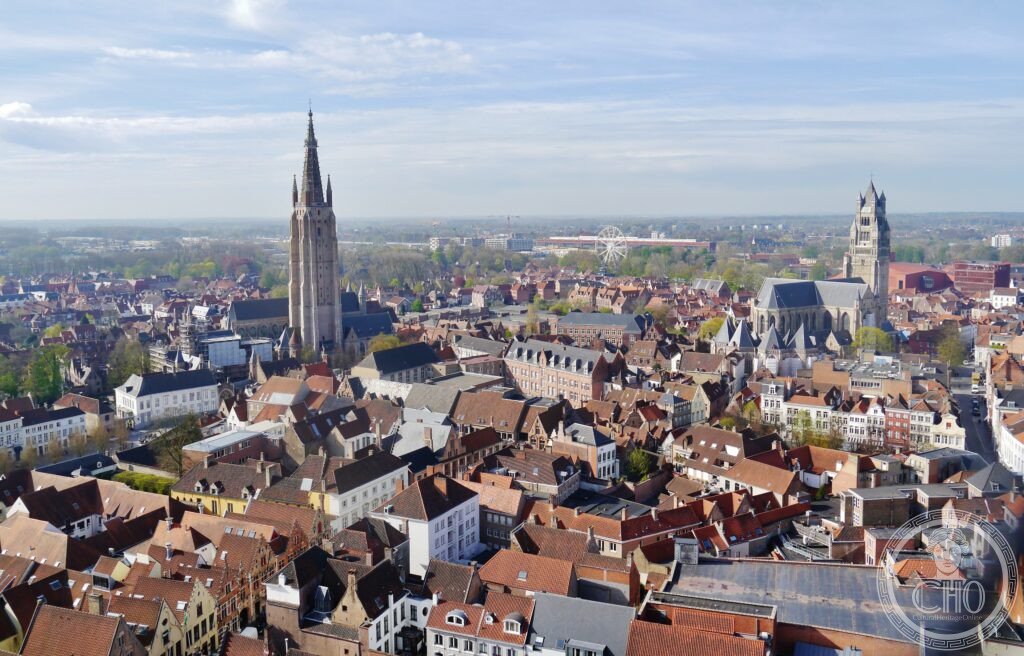
Historic Centre of Bruges
The most perfectly preserved medieval commercial city in northern Europe — Bruges, which dominated North Sea trade from the 12th to the 15th centuries and employed Jan van Eyck as its court painter, was economically frozen in place around 1500 when its sea access silted up, leaving a medieval urban fabric of extraordinary completeness that has survived essentially intact for five centuries.
At a glance
The Historic Centre of Bruges (UNESCO WHS 2000; the historic urban area enclosed within the ring canal (the Coupure and the Minnewater — the “Lake of Love”; approximately 430 hectares; the ring canal follows the line of the original medieval city walls); the historic centre is small enough that everything is accessible on foot or by boat (canal tours run continuously from multiple departure points)) was the most important commercial city in northern Europe from approximately 1150 to approximately 1480; the city’s wealth was based on the trade in Flemish wool cloth (the finest woollen fabric in Europe; woven from English wool; exported via Bruges to Italy, the Mediterranean, and the Hanseatic world); the Flemish cloth trade made Bruges the financial capital of northern Europe — the world’s first commodity futures exchange (the Bruges Bourse, where merchants traded standardised contracts for future delivery of goods) operated here from approximately 1309; the Medici, the Bardi, the Peruzzi, and the Alberti (the great Florentine banking families) all maintained offices in Bruges; the Hanseatic League’s headquarters in the Low Countries (the Oosterlingenhuis, 1478) was in Bruges; the Court of Burgundy was in Bruges in the 15th century (Philip the Good and Charles the Bold, dukes of Burgundy, made Bruges their principal court city); Jan van Eyck was employed as court painter by Philip the Good in Bruges from 1425 until his death in 1441.
Key facts
- Jan van Eyck and the Flemish Primitives: the greatest collection of 15th-century Flemish painting in the world is in Bruges — the Groeningemuseum (the primary art museum in Bruges; contains the two masterpieces of Jan van Eyck that have remained in Bruges: the Madonna with Canon van der Paele (1436; the largest and most complex painting van Eyck ever completed; the Canon Joris van der Paele kneels in prayer before the Virgin in a Romanesque church interior; the detail of the canon’s eyeglasses, the embroidery of the bishop’s vestment, the heraldic shield of St. George, and the reflections in the armour are at the absolute limit of what oil painting can render in terms of optical naturalism; the painting was commissioned to hang in St. Donatian’s church, where it remained until the Revolution) and the Portrait of Margareta van Eyck (1439; the painter’s wife; one of the earliest independent female portraits in European painting; the inscription on the frame states that van Eyck made this portrait from life and that it was made “as faithfully as he knew how”); the museum also contains Hans Memling’s masterwork, the Triptych of the Last Judgment (c. 1467–1471), and paintings by Gerard David and Hugo van der Goes)
- The Belfry of Bruges: the most famous free-standing bell tower in northern Europe and an element separately inscribed on the UNESCO World Heritage list — the Belfry (Belfort; 1240–1297 (the two lower octagonal stages; the upper octagonal Gothic spire added 1482–1486; total height 83 m; the icon of Bruges and of Flemish civil architecture); the belfry is a civic tower, not a church tower (it was built by the town corporation, not by a bishop; this is characteristic of Flemish cities where merchant wealth expressed itself in civic architecture rather than ecclesiastical architecture); 366 steps to the top; the carillon (47 bronze bells; the largest weighing 6 tonnes; the carillon is played by a municipal carillonneur on a keyboard mechanism 3 floors below the bells; concerts on Wednesdays, Saturdays, and Sundays); the octagonal treasury chamber on the first floor was used to store the town’s privileges (the documents of Bruges’ legal rights) under multiple locks; the view from the top is the classic panoramic view of Bruges with the canal network below and the church spires visible above the flat Flemish plain)
- The Rozenhoedkaai and the canal network: the most photographed spot in Belgium — the Rozenhoedkaai (“Rosary Quay”; the bend in the canal where the Dijver meets the Groenerei; the view from the quay (looking east along the Groenerei canal toward the Meebrug bridge, with the Belfry visible in the background framed by medieval brick facades) is the most reproduced view in Belgium; the canal network (approximately 40 km of canals within the city; the canal tours (from the Rozenhoedkaai; 5 boats running in rotation; 30-min circuit; approximately EUR 12 per person; the low-bridge experience at the Boniface Bridge (the smallest and most romantic bridge in Bruges; a footbridge between two garden walls across the Groenerei) is the most popular moment in the boat tour))
- Heritage: UNESCO World Heritage Site, Historic Centre of Bruges (Flemish: Brugge), inscribed 2000
- GPS: 51.2092° N, 3.2247° E
History
First mention as a port c. 865 AD; rise to commercial prominence in the 12th century with the development of the Zwin estuary; the cloth trade peak (12th–15th centuries); the Court of Burgundy in Bruges (Philip the Good and Charles the Bold; 1419–1477; the most brilliant court in northern Europe; the Order of the Golden Fleece (a chivalric order founded by Philip the Good in 1430 in Bruges; still active) was inaugurated in the Church of Saint Basil); Jan van Eyck lived and worked in Bruges (1425–1441); the silting of the Zwin estuary (from approximately 1490 onwards; the gradual loss of deep-water access transferred the North Sea trade to Antwerp; Bruges entered a long economic decline from approximately 1500 and the population fell from approximately 200,000 at the peak to approximately 30,000 by 1600); the economic decline preserved the medieval city (no 17th–19th century development to replace the medieval fabric); the 19th-century Romantic rediscovery of Bruges (Georges Rodenbach’s symbolist novel Bruges-la-Morte (1892) established the image of the city as a melancholy, perfectly preserved medieval ghost town; the novel was enormously influential in establishing Bruges as a tourist destination and a symbol of medieval beauty); UNESCO WHS 2000.
What you see
The Market Square (Markt; the central square; the Belfry on the south side; the Provincial Court on the north; the statue of Jan Breydel and Pieter de Coninck (the leaders of the 1302 Bruges Matins — the massacre of the French garrison that preceded the Battle of the Golden Spurs, the most important victory in Flemish history) in the centre; horse-drawn carriages and canal tour boats from the Markt); the Burg (the second square; the more historically important of the two; the Town Hall (one of the oldest in the Low Countries; 1376–1421; the Gothic Council Chamber (Gotische Zaal) has a spectacular wooden vaulted ceiling with polychrome keystone bosses); the Basilica of the Holy Blood (a two-storey structure; the lower chapel (12th century Romanesque; one of the finest Romanesque interiors in Belgium) and the upper chapel (Neo-Gothic; 15th century; housing the relic of the Holy Blood — a phial of blood believed to have been brought from Jerusalem by the Count of Flanders in 1150)); the Church of Our Lady (Our-Lieve-Vrouwekerk; one of the tallest brick structures in the world at 122 m; the Michelangelo Madonna (1505; Michelangelo’s only sculpture outside Italy in his lifetime; sold to a Bruges merchant; in the north choir aisle; in white Carrara marble; the only Michelangelo in Belgium)).
Practical information
- Getting there: Bruges railway station (Brugge; the station is 15 min walk south of the historic centre; bus connections from the station to the Markt take 5 min; alternatively, walk through the 1000-year-old park (the Minnewater; the Lake of Love) connecting the station to the city); direct trains from Brussels (55 min; approximately EUR 15; runs every 30 min; the Brussels Bruges day trip is the most popular excursion from Brussels for tourists); from London by Eurostar (2h to Brussels, then 55 min to Bruges; one of the most used sustainable travel routes to Belgium); from Ghent (24 min; EUR 10; running hourly); from Amsterdam (3h by Intercity or Thalys; change in Antwerp or Brussels)
- When to go: Bruges is visited year-round; the Christmas market (Markt and Burg; late November to early January; the most atmospheric Christmas market in Belgium; illuminations, hot chocolate, and the Belfry lit against the night sky) is the peak romantic season; February–March has the fewest tourists and the clearest winter light (ideal for photography); summer (July–August) is very crowded (1,000+ tourists in the Markt at noon) but the canal tour and the evening (after 7pm when the day-trippers have left) are always worth it; the Holy Blood Procession (Heilig-Bloedprocessie; the Thursday after Ascension Day, in May or June; a religious procession bringing the Holy Blood relic through the town; the most important civic and religious celebration in Bruges; dating to 1291 (possibly earlier); approximately 1,700 participants in medieval costumes; a UNESCO Intangible Heritage element)
- The Groeningemuseum: small but world-class — the Groeningemuseum (Dijver 12; open Tuesday–Sunday; approximately EUR 12; one of the most rewarding small museums in Europe — the Jan van Eyck collection alone (the Madonna with Canon van der Paele and the Portrait of Margareta van Eyck) justifies the visit; the museum also contains the major works of Hans Memling (the Triptych of Moreel (1484) and the Portrait of a Man (c. 1470)), a room of 19th-century Belgian Symbolist and Expressionist painting, and the magnificent Flemish Primitives collection from the 15th and 16th centuries; the museum takes approximately 1h 30 min for a comprehensive visit; it is never as crowded as the major museums in Florence or Amsterdam)
Getting there
Direct train from Brussels (55 min). Eurostar London to Brussels (2h) then train to Bruges (55 min). Ghent 24 min. GPS: 51.2092, 3.2247.
Nearby
- Ghent — 55 km east of Bruges (30 min by train; EUR 10); the most important art-historical city in Belgium and home of the Ghent Altarpiece — Ghent (Gent; a medieval industrial city of 250,000; the canal network; the Gravensteen castle (the Count of Flanders’ moated castle; 1180; the best-preserved medieval castle in Belgium; the view from the top over the Graslei and Korenlei quays is the finest single view in Ghent); the Ghent Altarpiece (the Adoration of the Mystic Lamb; Jan van Eyck and Hubert van Eyck; begun c. 1420, completed 1432; in the Chapel of the Lamb of God in St. Bavo Cathedral; the most important painting in the world, according to many art historians (in terms of its influence on Western painting and its technical revolutionary impact); the altarpiece consists of 12 panels (6 when folded; the Virgin Mary, John the Baptist, the Donor portraits, and the central vision of the Lamb of God on the altar — a polyphonic masterpiece of allegory and optical naturalism); the panels were stolen, sold, destroyed, and recovered multiple times over 500 years (including a kidnapping and ransom in 1934 and the confiscation by the Nazis in 1942; the last missing panel (the Just Judges; stolen 1934) has never been recovered))
- Ypres (Ieper) and the Flanders Fields — 65 km south of Bruges (1h by road; 1h 30 min by train via Kortrijk); the most important World War I memorial landscape in Europe — Ypres (Ieper; the city was almost entirely destroyed in World War I (1914–1918) and entirely rebuilt in the exact Gothic and Renaissance style of the original medieval city; the reconstruction of the Cloth Hall (the largest Gothic secular building in the world; 133 m long; rebuilt in exact replica by 1967) is the most ambitious post-war urban reconstruction in European history; the In Flanders Fields Museum (in the Cloth Hall; the best World War I museum in Europe; opened 1998; covering the entire history of the Ypres Salient from 1914 to 1918; the interactive exhibitions and the individual experience of the rotating visitor identification tag — the visitor is assigned the identity of a real soldier, nurse, or civilian and their fate is revealed at the end); the Menin Gate (the triumphal arch at the east exit of the town; 54,896 names of Commonwealth soldiers killed in the Ypres Salient who have no known grave are inscribed on the walls; a Last Post ceremony has been sounded at the Gate by the Ypres fire brigade every evening at 8pm since 1928 (with the exception of the years of German occupation 1940–1944)); the Tyne Cot cemetery (10 km north-east of Ypres; the largest Commonwealth war graves cemetery in the world; 11,954 graves; the most moving single place in Flanders))
- Antwerp — 100 km east of Bruges (1h 15 min by train; EUR 20); the diamond capital of the world and home to the greatest collection of Rubens in existence — Antwerp (Antwerpen; the port city that replaced Bruges as the commercial capital of northern Europe after 1500; the city where Peter Paul Rubens lived, worked, and died; the Rubenshuis (Rubens’ home and studio; Wapper 9; open Tuesday–Sunday; approximately EUR 12; the most important artist’s house museum in northern Europe; the collection includes original Rubens paintings, the Baroque garden pavilion, and the scale model of the house as it appeared in Rubens’ lifetime); the Cathedral of Our Lady (the largest Gothic church in the Benelux; the Rubens Triptychs — The Descent from the Cross (1614; the most important altarpiece in Belgium) and The Elevation of the Cross (1610) are in the north and south transepts); the diamond quarter (the Antwerp Diamond District; 80% of the world’s rough diamonds and 50% of cut diamonds pass through Antwerp every year))
Sources
- Wikipedia, Bruges; Jan van Eyck; Belfry of Bruges, accessed June 2026
- UNESCO, Historic Centre of Bruges, WHS reference 996, inscribed 2000
- Maryan W. Ainsworth, From Van Eyck to Bruegel, The Metropolitan Museum of Art, 1998
Find it on the map
See this place and what’s around it →📷 Diventa un fotografo di Cultural Heritage Online
Condividi le tue foto dei luoghi: restano pubblicate con la tua firma come autore. Più vengono viste, più ti fai conoscere — e presto un concorso premierà le foto più apprezzate.
Accedi o registrati gratis per aggiungere una foto