

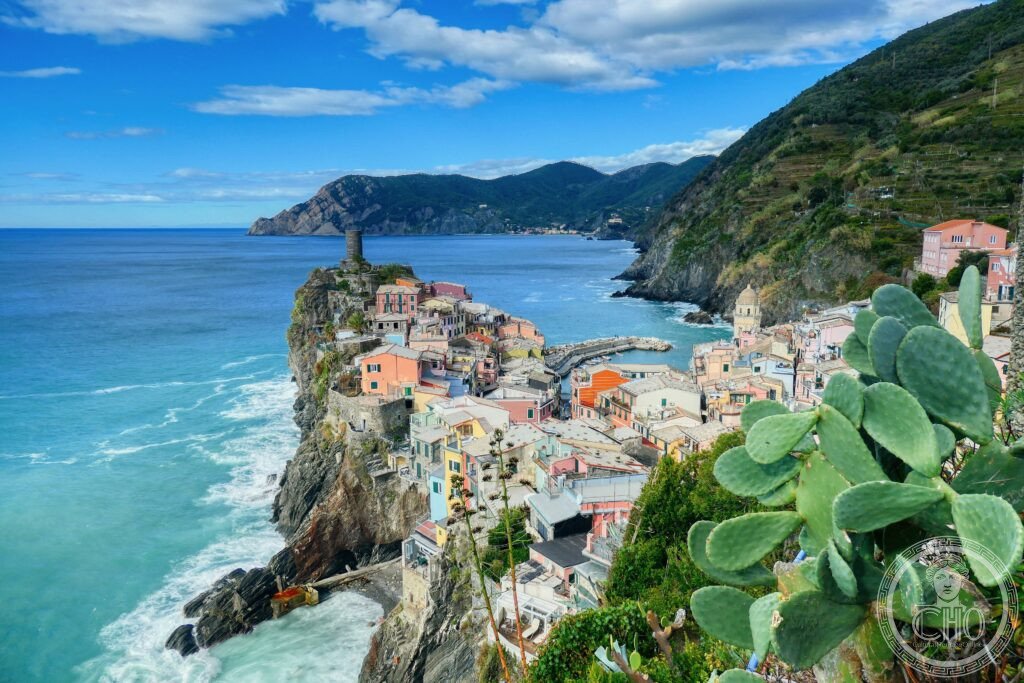
Five cliff villages hanging above the Ligurian Sea, linked by 3,000 kilometres of dry-stone terrace walls built over a millennium. The Cinque Terre (Five Lands) in Liguria is a UNESCO World Heritage Site not for a single building but for the entirety of a cultural landscape in which cliff-face agriculture, colourful stone architecture, and one of the most dramatically sited coastal paths in Europe have coexisted for a thousand years.
At a glance
The Cinque Terre (UNESCO WHS 1997; Cinque Terre National Park, 3,319 hectares — Italy’s smallest national park) consists of five villages along 12 km of Ligurian coastline between Levanto (north) and La Spezia (south). The villages run from north to south. Monterosso al Mare is the largest and the only one with a proper beach, sandy and divided between a free public stretch and a fee-paying beach club, which makes it the most comfortable base for families. Vernazza is the most photographed, built into a small rocky bay with a defensive tower, a little harbour full of coloured boats and the best-preserved historic core. Corniglia is the only one not directly on the sea: it sits on a 100-metre clifftop, reached from the rail station in the bay below by a staircase of 382 steps, the Lardarina, and it is the smallest and quietest. Manarola is the most compact, a single main street running from the harbour to the top of the cliff, and its Christmas crib display on the hillside is the largest in the world. Riomaggiore is the southernmost and the easiest to reach by rail, historically an important fishing village, with its harbour set in a narrow gorge. A network of coastal and hillside trails connects all five. The most famous is the Sentiero Azzurro, the Blue Trail, the seaside path that links the villages for approximately 11 km in total: the Manarola–Corniglia section of 2.5 km and the Corniglia–Vernazza section of 4 km are currently open, and the Via dell’Amore between Manarola and Riomaggiore partially reopened in 2023, after being closed since the landslide of 2012.
Key facts
- The dry-stone terrace walls: the most extensive dry-stone agricultural terracing in Europe. The approximately 3,000 km of dry-stone retaining walls (ciàn in the local Ligurian dialect; a word that describes both the terrace wall and the terrace itself) were built progressively from the 11th to the 19th centuries. The walls hold the thin soil on the near-vertical cliff faces (gradients up to 70°) against erosion by gravity and by the intense rainfall events that characterise the Ligurian climate. The total area of terraced land is approximately 5 km² (approximately 1,500 football pitches). The individual terraces are small. A typical terrace is 2–4 metres wide and 5–15 metres long. Planting and harvesting must be done by hand (no machine access). The weight of grapes from a single terrace has to be carried to the winery on the farmer’s back or by the characteristic Cinque Terre monorail (a small single-rail trolley, suspended from cables, that carries loads up the cliff face at approximately 45°). The maintenance of the walls is a constant work against gravity and weather. Each heavy rain washes small amounts of soil from the terraces, each severe storm may displace stones. The 2011 flash flood in Vernazza and Monterosso (4 October 2011; the worst flooding in Liguria in 60 years; a wall of mud up to 4 metres deep flowed through Vernazza’s main street; 9 people died in the area; damage was estimated at EUR 200 million) was partially caused by the abandonment of terrace maintenance by younger generations who moved to the cities.
- Sciacchetrà: the rarest wine in Italy and the defining product of the Cinque Terre. Sciacchetrà is a DOC sweet passito wine made only in the Cinque Terre, from Bosco, Albarola and Vermentino grapes. They are harvested late, between late September and October, from the terraced vineyards, then dried on wooden racks in the producers’ own homes for 2–3 months: the process is called appassimento, and water evaporation concentrates the sugars and the flavours. The dried grapes are pressed and fermented, and the wine that comes out is amber, sweet but not cloying, with aromas of dried apricot, honey and almond. Production is tiny, approximately 3,000–5,000 bottles a year in the best vintages, because the terraces are small and much of the growing has been abandoned as the labour-intensive farming is given up. Bottles retail for EUR 20–60, at the Cantina Cinque Terre co-operative in Riomaggiore and from individual producers.
- Vernazza harbour: the most beautiful natural harbour on the Ligurian Riviera. Vernazza (the name derives from the Latin word for wine; a prosperous fishing and trading village from the 11th to the 18th centuries; now entirely tourism-based) is built into a narrow rocky inlet at the base of a hill. The breakwater (built in the 19th century) creates a small harbour where colourful fishing boats are moored. The Doria Castle (a round tower on the promontory above the harbour; 12th century; the best view of Vernazza is from the castle terrace) and the Gothic Church of Santa Margherita d’Antiochia (14th century; the bell tower is the dominant vertical element of the Vernazza silhouette) frame the harbour. The main piazza (Piazza Marconi; a few tables of restaurants spilling onto the stone pavement; the sound of the sea from three sides; a gathering place in the evening) is the most lived-in public space in the Cinque Terre.
- Heritage: UNESCO World Heritage Site (Cinque Terre, Portovenere and the Islands), inscribed 1997.
- GPS: 44.1244° N, 9.7041° E.
History
The five villages were founded in the 11th century, primarily by Genoese and Pisan families seeking defensible clifftop positions. The terrace agriculture was established progressively from the 11th century onward. The villages were controlled by the Genoese Republic from the 13th century until its dissolution. The railway was constructed in 1874 (the most important modern development; the railway made the villages accessible for the first time without boat or mountain path; it brought tourists from the early 20th century onward). UNESCO WHS 1997. The Cinque Terre National Park was established in 1999. The 2011 Vernazza flood was the most destructive natural event in the area in living memory. Reconstruction was largely complete by 2014. The Via dell’Amore connecting Manarola and Riomaggiore was partially reopened in 2023 after an 11-year closure.
What you see
The Sentiero Azzurro, the coastal path, is the most iconic experience in the area. Three sections are open as of 2026. Manarola–Corniglia is the first. Corniglia–Vernazza is the most dramatic, 4 km in 2h, with views of the cliffs and the villages both from above and at sea level. Vernazza–Monterosso comes second for drama, 3.5 km in 1h 30 min, climbing to 200 m above the sea before dropping into Monterosso: from its highest point you see the full 12 km arc of the coast. The most famous stretch of all, the Via dell’Amore from Manarola to Riomaggiore, is 1.2 km of flat paved path with a tunnel section, partially open since 2023 — check the current status before going. Vernazza harbour is the single most photographed view in the Cinque Terre, reached on foot from every direction or by rail. Manarola harbour is the second: the reflection of the coloured houses in the harbour pool at sunset and at dawn is the most famous photographic view in Italy after the Colosseum.
Practical information
- Cinque Terre Card and the daily quota: the Cinque Terre National Park charges a fee (the Cinque Terre Card; approximately EUR 7.50 per day in 2026; required for access to the Sentiero Azzurro (Blue Trail) coastal path; the card also provides unlimited use of the local bus and park services; available at the park visitor offices at each rail station; the park has implemented a daily maximum visitor quota on the trail sections that are most heavily visited (particularly the Via dell’Amore and the Vernazza–Monterosso section) in peak season; in July–August, trail access on the most popular sections may require booking by QR code at recreation.gov or via the national park website). The Cinque Terre Express (the regional train; Trenitalia; runs every 30–60 min between La Spezia, Riomaggiore, Manarola, Corniglia, Vernazza, Monterosso, and Levanto; approximately 4 min between villages; the most efficient way to move between the five villages).
- Getting there: La Spezia is the main rail hub (from Genoa: 1h by Intercity; from Florence: 2h by regional train via Pisa; from Rome: 4h by Frecciarossa to La Spezia; from Milan: 3h by Intercity; from Pisa: 1h 30 min by regional train). From La Spezia Centrale, the Cinque Terre Express reaches Riomaggiore in 7 min, Manarola in 10 min, Corniglia in 14 min, Vernazza in 17 min, Monterosso in 22 min. Accommodation should be booked at least 2–3 months in advance for July–August.
- When to go: May–June and September–October are the best months (the terraced vineyards are green; the sea is warm enough to swim; the trails are open; fewer people than July–August; accommodation is easier to find and cheaper). The grape harvest (the vendemmia; September–October) is the most authentically agricultural moment in the Cinque Terre. The monorails running up the cliffs to collect the harvest baskets are visible from the trail and from the stations. July–August is extremely crowded (the trail sections are literally queued; the small villages feel overwhelmed; Corniglia is significantly less crowded than the others as it has no direct seafront access).
Getting there
La Spezia hub: Genoa 1h, Florence 2h, Rome 4h. Cinque Terre Express between villages (4 min). GPS: 44.1244, 9.7041.
Nearby
- Portovenere and the Islands (Palmaria, Tino, Tinetto). 15 km south of Riomaggiore (30 min by boat from Riomaggiore or La Spezia in summer; 20 min by road to Portovenere from La Spezia; inscribed together with the Cinque Terre on the same UNESCO WHS 1997). The most atmospheric small town on the Gulf of La Spezia. Portovenere is a narrow medieval village on the extreme tip of the Gulf of La Spezia, built along a single main street, Via Capellini, lined with tall painted stone houses. The Church of San Lorenzo is of the 12th century, with a striped black and white marble façade in the Genoese style. The Church of San Pietro stands on the very point of the promontory, over the site of a pagan temple: its nave is Romanesque, 13th century, its exterior banded in black and white, and the view from its terrace — the open Ligurian Sea to the west, the Gulf to the east, the island of Palmaria immediately offshore — is one of the most beautiful coastal views in Italy. Below it opens Byron’s Grotto, the sea cave where Lord Byron reportedly swam, marked today by a plaque.
- The Gulf of La Spezia (Gulf of Poets). The bay immediately south of the Cinque Terre. Named the “Gulf of Poets” by the Italian nationalist writer D’Annunzio for its association with Percy Bysshe Shelley (who drowned here in 1822; his body was found on the beach at Viareggio; Byron cremated him on the beach and kept his skull), Lord Byron, and Mary Shelley (who wrote parts of Frankenstein at nearby San Terenzo). The naval arsenal of La Spezia (the largest naval base in Italy; not open to visitors) and the ferry to Portovenere (departs from the La Spezia ferry terminal; 30 min) are the main practical uses of the Gulf.
- Carrara marble quarries. 60 km south of La Spezia (1h by road; the town of Carrara, Tuscany, just south of the Ligurian border). Where Michelangelo chose the marble for the David. The Apuan Alps above Carrara have been quarried for white Statuario marble (the finest sculptural marble in the world; used by Michelangelo for the David, the Pietà, and virtually all his major sculptures; by Canova for his Venuses and Graces; by the great Renaissance and Baroque sculptors as the default material for the highest quality figurative sculpture) since the Roman period. The quarries are still active (approximately 160 working quarry sites). The white dust from the quarrying gives the mountain summits a snow-like appearance year-round. Tours of the Fantiscritti quarry and the Museo del Marmo are available.
Sources
- Wikipedia, Cinque Terre. Vernazza. Sciacchetrà, accessed June 2026.
- UNESCO, Portovenere, Cinque Terre, and the Islands, WHS reference 826, inscribed 1997.
- Giorgio Bergami, Cinque Terre: Landscape and Human Presence, Sagep Editrice, Genoa, 2004.
Find it on the map
See this place and what’s around it →📷 Become a Cultural Heritage Online photographer
Share your photos of places: they stay published under your name as the author. The more they're seen, the more you get noticed — and soon a contest will reward the most appreciated photos.
Log in or sign up free to add a photo