
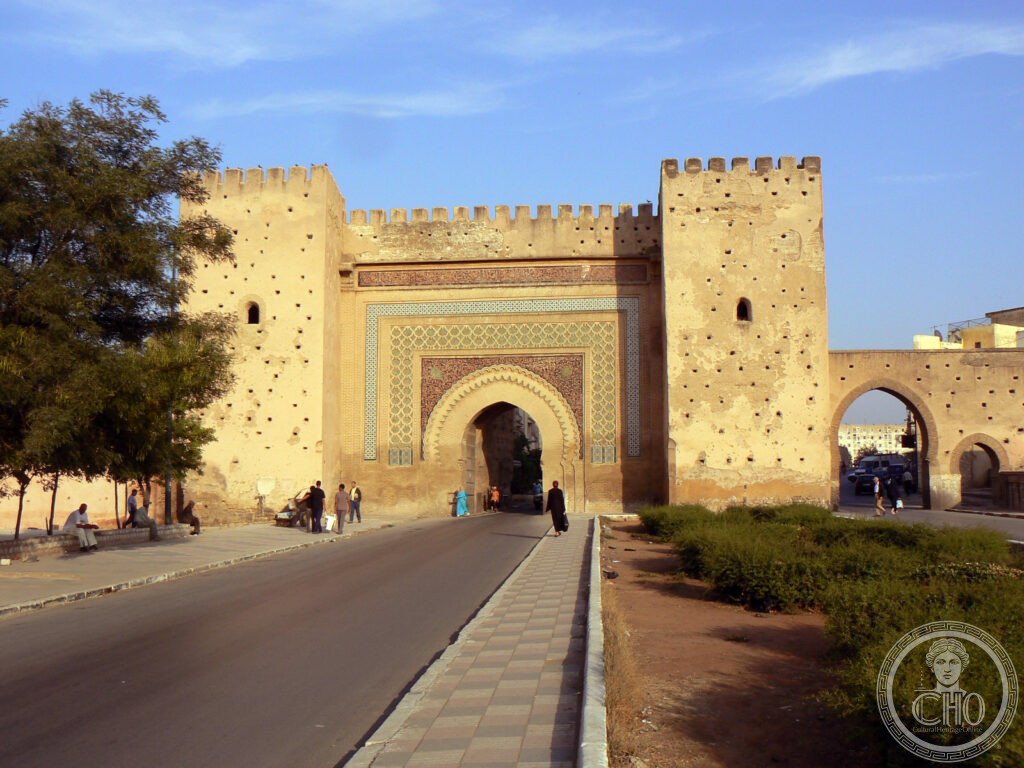
The most ambitious single royal building programme in Moroccan history — Moulay Ismail (r. 1672–1727), the most powerful Alawite sultan of the 17th century and a self-declared rival of Louis XIV, chose the small town of Meknes as his new imperial capital and spent 55 years transforming it into a monumental city of palace enclosures, monumental gates, royal stables, granaries, and gardens enclosed within 40 kilometres of walls, a scale of construction unmatched in the Islamic world of his time.
At a glance
Meknes (population approximately 800,000) is 60 km west of Fez and 140 km east of Rabat on the fertile Saïss plain. The city has two main zones for visitors: the Imperial City (the palatial area built by Moulay Ismail, south of the medina), focused on the Dar al-Makhzen, the Heri es-Souani stables, the Mausoleum of Moulay Ismail, and the Bab al-Mansour gate; and the Medina (the traditional urban fabric of Meknes, smaller and less chaotic than Fez but retaining most of the same urban forms: souks, fondouks, mosques, madrasas, and residential quarters). The essential visit focuses on the Imperial City, which can be covered in half a day; the medina adds another half day.
Key facts
- Moulay Ismail (r. 1672–1727) and the imperial programme: Moulay Ismail ibn Sharif was the second sultan of the Alawite dynasty (the dynasty that rules Morocco to this day as the House of Alaoui, represented by the current King Mohammed VI); he was by temperament, ambition, and practical accomplishment the most powerful Moroccan ruler of the early modern period — he unified Morocco after decades of civil war, expelled the English from Tangier (1684) and the Spanish from Larache and Asilah, organized a professional army of approximately 150,000 (the most powerful in the Mediterranean basin), established diplomatic relations with Louis XIV (their exchanges of ambassadors are one of the most documented diplomatic episodes of the late 17th century, producing detailed accounts of both courts by European observers), and created the new imperial capital of Meknes from approximately 1677 onward; the construction workforce included approximately 25,000 European Christian slaves (captured by Moroccan corsairs in the Mediterranean and Atlantic), vast numbers of Moroccan labourers and artisans, and military units performing corvée labour; the building programme continued for 50+ years (roughly 1677–1727, the entire reign)
- Bab al-Mansour al-Aleuj (Gate of Mansour the Renegade, completed 1732): the largest and most ornate ceremonial gate in Morocco and the defining image of imperial Meknes — the gate was begun by Moulay Ismail and completed in 1732 (5 years after his death) by his son Moulay Abdallah; the architect was a formerly Christian slave who had converted to Islam (hence “al-Aleuj” = the renegade); the gate takes the form of a massive horseshoe arch flanked by pavilions, faced in polychrome zellij tilework (the geometric mosaic tile work that is the definitive ornamental medium of Moroccan architecture) and capped with a cornice of green-glazed tiles; the two columns flanking the central horseshoe arch were taken from the ruins of the Roman city of Volubilis (30 km to the north), which had been a Roman colony and later a Byzantine city and had columns standing from the ruins of its major buildings; the appropriation of Roman columns from Volubilis for the Meknes gate is a deliberate act of symbolic appropriation (Moulay Ismail presenting himself as heir to both the Roman and the Islamic imperial traditions in Morocco)
- The Heri es-Souani (Royal Stables and Granaries): the most awe-inspiring single structure in Moulay Ismail’s imperial city — the Heri es-Souani was the stables and granary complex built to maintain and feed 12,000 horses (the cavalry was the backbone of Moulay Ismail’s military power); the structure consists of two adjacent elements: the stables (a vast vaulted structure of approximately 300 metres long and 120 metres wide, divided into stall corridors by enormous stone piers supporting pointed barrel vaults; the horses were stabled in parallel rows in the corridor spaces between the piers; the scale is overwhelming); and the granaries (a series of sunken underground storage chambers that used the insulating properties of the earth to maintain stable low temperatures for grain storage); the entire complex covers approximately 4 hectares; the stables are ruined (the roof partly collapsed in the 1755 earthquake) but the scale remains legible and the surviving arches have a grandeur comparable to Roman aqueduct engineering
- The Mausoleum of Moulay Ismail: one of only two mausoleums in Morocco open to non-Muslim visitors — the Mausoleum was built by Moulay Ismail himself (he expected to die during his reign and made explicit provision for his burial place) and expanded by subsequent rulers; the exterior of the mausoleum is the finest surviving example of 17th-century Moroccan funerary architecture; the interior (accessible to non-Muslims, an unusual and generous policy for a Moroccan royal mausoleum) consists of a sequence of antechambers with zellij tilework, carved stucco walls, and cedar wood ceilings leading to the burial chamber (where the tomb of Moulay Ismail is in a separate enclosure off the main hall; visitors can look into the burial chamber but not enter); the mausoleum is still an active site of popular devotion (Moroccan pilgrims visit daily)
- Heritage: UNESCO World Heritage Site, Historic City of Meknes, inscribed 1996
- GPS: 33.8935° N, -5.5473° W
History
Meknes was founded in the 10th century by the Miknasa Berber tribe (hence the name); it was occupied by the Almoravids in the 11th century and by the Almohads in the 12th; it became a significant city under the Marinid dynasty (13th–15th centuries) but was largely overshadowed by Fez; Moulay Ismail chose it as his new capital in 1672, presumably because Fez was associated with the previous Saadian dynasty and its aristocratic factions (who would resist his authority), while Meknes gave him a relatively clean slate on which to build a new imperial identity; the building programme ran approximately 1677–1727; Moulay Ismail died in 1727 and subsequent sultans preferred Fez, Marrakesh, or Rabat; the imperial city fell into disrepair after the 1755 earthquake (which damaged North Africa as well as Portugal and Spain); the medina continued to function as a normal Moroccan city; UNESCO inscription 1996.
What you see
Begin at the Place el-Hedim (the central square in front of the Bab al-Mansour; the square was created by Moulay Ismail by demolishing the old medina houses; it functions as the main public gathering space of Meknes); the Bab al-Mansour (view from the Place el-Hedim; the gate is now used as an art gallery — you can enter the interior and look at the ceiling vaulting); the Mausoleum of Moulay Ismail (entrance on the left side of the Place el-Hedim; remove shoes; the sequence of courtyards and antechambers is architecturally impressive and emotionally resonant); walk through the Bab al-Mansour area into the Imperial City enclosure (the vast empty space of the Dar al-Makhzen palace enclosure is now largely inaccessible — occupied by the royal family, still in occasional use — but the perimeter walls are impressive from the exterior); the Heri es-Souani (20 min walk from the Bab al-Mansour or taxi; the most impressive single structure; allow 30 minutes to walk through the stables and granaries); the Bassin de l’Aguedal (the vast artificial reservoir adjacent to the stables, still filled with water, used originally for irrigation and for leisure boating; the scale — 400 x 150 metres — gives a sense of the ambition of the imperial programme).
Practical information
- Admission: the Mausoleum of Moulay Ismail is free (remove shoes, dress modestly); the Heri es-Souani approximately 70 MAD; the medina is freely walkable; the Place el-Hedim and the Bab al-Mansour exterior are free to enjoy at any time; Meknes is less heavily touristed than Fez or Marrakesh, which makes it a more relaxed experience; the medina souks are less aggressive than in Fez
- Getting there: from Fez by train or CTM bus: 1h (by train approximately 45 min; Meknes is on the main Casablanca-Fez rail line with frequent services from both cities); by car from Fez: 60 km (45 min via A2 motorway); from Casablanca: 300 km (2h 30 min via A1/A2); from Rabat: 140 km (1h 30 min via A1/A2); Meknes is one of the easiest Moroccan imperial cities to reach by rail
- The Moroccan Imperial Cities circuit: Meknes is one of the four imperial cities of Morocco (along with Rabat, Fez, and Marrakesh); a circuit of all four (by train via Rabat-Casablanca-Marrakesh, or by hired car) is the quintessential Moroccan cultural itinerary; from Meknes, the Roman ruins of Volubilis (30 km north; UNESCO WHS 1997; the most important Roman site in Morocco, with a complete street plan, the Capitol temple, the arch of Caracalla, and extraordinary in-situ floor mosaics including the famous mosaic of Bacchus and Ariadne) and the hillside holy city of Moulay Idriss (near Volubilis; the most important pilgrimage site in Morocco, burial place of Moulay Idriss I, the founder of the Idrisid dynasty and the ancestor of the present Moroccan royal family) are essential half-day excursions
Getting there
From Fez by train (45min) or bus (1h). From Rabat by train (1h 30min). From Casablanca (2h 30min). GPS: 33.8935, -5.5473.
Nearby
- Volubilis — 30 km north of Meknes (35 min by car or taxi); the largest and best-preserved Roman city in Morocco and the most important archaeological site in North Africa west of Libya — Volubilis (known in antiquity as Volubilis Municipium Aelium Hadriani) was a prosperous Roman city of approximately 20,000 inhabitants, primarily producing olive oil for export to Rome; the current visible remains date mainly from the 2nd–3rd centuries AD (the Severan period, when Volubilis was at its peak); the site is UNESCO WHS 1997; the essential monuments are the Capitol temple (2nd century, partially reconstructed, with three surviving cella walls), the Basilica (the civic judicial building, 37 metres long, with two apse ends), the triumphal arch of Caracalla (217 AD, partially reconstructed), and approximately 40 in-situ mosaic floors visible in the excavated private houses (the Bacchus and Ariadne mosaic in the House of Orpheus, the Diana and Actaeon mosaic, and the Labours of Hercules mosaics are the most spectacular); the setting (on a plateau above the plain, with views to the Rif Mountains) is exceptional
- Fez (Fès) — 60 km east of Meknes (45 min by train or 45 min by car); the most important medieval city in North Africa and the oldest continuously inhabited city in Morocco — the Medina of Fez (Fès el-Bali; UNESCO WHS 1981) is the largest intact medieval Islamic urban fabric in the world, with approximately 350,000 inhabitants living in a street pattern and building fabric dating from the 9th to the 18th centuries; the Kairouyine Mosque (859 AD; the oldest and most important mosque in Morocco, founded by Fatima al-Fihri; claims to house the oldest continuously operating university in the world, the University of al-Qarawiyyin, 859 AD — though the university’s unbroken continuity is disputed by scholars), the Bou Inania Madrasa (14th century; the finest Marinid madrasa in Fez, with exceptional carved stucco and carved cedar wood above blue-and-white zellij tile dados), and the tanneries (the Chouara tannery, visible from the leather shops above; the most photographed traditional craft operation in Morocco, with its circular stone vats of natural dyes) are the essential stops; see separate CHO place card
- Moulay Idriss Zerhoun — 25 km north of Meknes (30 min by car); the most important pilgrimage city in Morocco and one of the oldest Islamic cities in the Maghreb — the hilltop city of Moulay Idriss (also called “Zerhoun” for the mountain it stands on) is built around the mausoleum of Moulay Idriss I (c. 745–828 AD), the great-grandson of the Prophet Muhammad who fled Abbasid persecution from Baghdad, arrived in Morocco, converted the Berber tribes to Islam, founded the Idrisid dynasty (the first Arab dynasty in Morocco), and is the ancestor (via his son Moulay Idriss II, who founded Fez in 809) of the present Moroccan royal family; the city is semi-closed to non-Muslims (non-Muslims may visit the exterior of the mausoleum and the town’s streets but not enter the mausoleum itself); the annual Moussem (pilgrimage festival, September) is the largest in Morocco
Sources
- Wikipedia, Meknes; Moulay Ismail ibn Sharif; Bab Mansour; Heri es-Souani, accessed June 2026
- UNESCO, Historic City of Meknes, WHS reference 793, inscribed 1996
- Jamil Abun-Nasr, A History of the Maghrib in the Islamic Period, Cambridge University Press, 1987
- Jeffrey Spurr, Islamic Architecture and Urbanism: The Moroccan City, MIT Press, 2003
Find it on the map
See this place and what’s around it →📷 Become a Cultural Heritage Online photographer
Share your photos of places: they stay published under your name as the author. The more they're seen, the more you get noticed — and soon a contest will reward the most appreciated photos.
Log in or sign up free to add a photo