

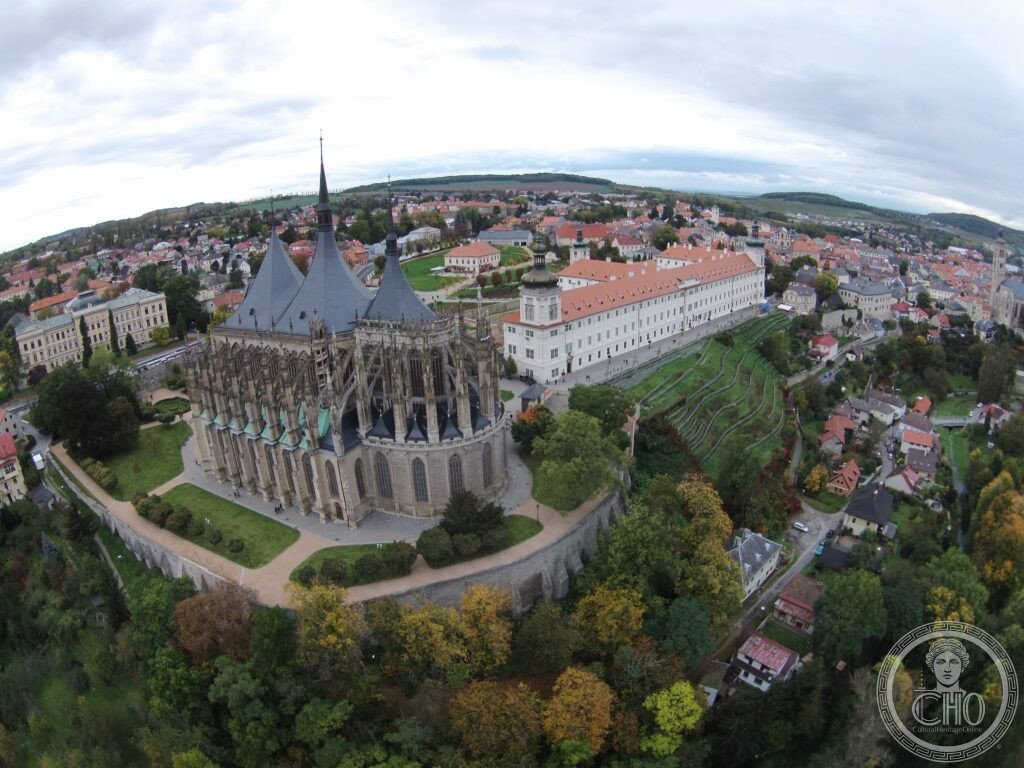
The silver-rush city that bankrolled the Holy Roman Empire and built one of Central Europe’s most original Gothic cathedrals. Kutná Hora (Bohemian German: Kuttenberg, “mine hill”) grew explosively from the 1280s when a rich vein of silver was struck at Kaňk hill, producing wealth that made the town the second largest in Bohemia after Prague and the site of the royal mint (the Italian Court, Vlašský dvůr) that struck the Prague Groschen (Pražský groš), the most widely-used silver coin of medieval Central Europe. The town also contains the most extraordinary ossuary in the world.
At a glance
Kutná Hora (population approximately 22,000) lies in the Central Bohemian hills 70 km south-east of Prague, on the main railway line from Prague to Brno, and can be reached in approximately 1 hour by direct train. UNESCO inscribed the Historic Centre of Kutná Hora with the Church of Our Lady at Sedlec in 1995, covering both the Gothic cathedral of St Barbara and the Baroque-Gothic Cistercian church at Sedlec (1.5 km north of the town centre), which contains the most visited charnel house in the world. The majority of visitors come for the Sedlec Ossuary (Kostnice u Sedlec), but the Cathedral of St Barbara and the Italian Court (the royal mint) are architecturally more significant and much less crowded.
Key facts
- Sedlec Ossuary (Bone Church, c.1400; decorated 1870): the most visited attraction in the Czech Republic outside Prague and the most extraordinary funerary space in the world. The Cistercian monastery at Sedlec (2 km north of Kutná Hora centre) was established in 1142. The Black Death and the Hussite Wars left the monastery cemetery overflowing with corpses, and around 1400 the bones of approximately 40,000–70,000 people were stacked in the lower chapel of the All Saints Church (Kostel Všech Svatých) above the Sedlec Ossuary. In 1870 the wood-carver František Rint was commissioned by the Schwarzenberg family (landowners of the area) to arrange the bones into artistic compositions. Rint created a chandelier of bones (using every bone in the human body at least once), four pyramid-shaped towers of skulls and femurs stacked to the ceiling in the corners of the chapel, garlands of skulls festooning the arches, and. Most remarkably. The coat of arms of the Schwarzenberg family rendered entirely in bone (a femur raven pecking at a skull). The effect is simultaneously macabre, devotional, and extraordinarily aesthetic. The Ossuary is heavily visited (book tickets online to avoid queues) and requires approximately 45 minutes.
- Cathedral of St Barbara (Chrám svaté Barbory, begun 1388): the most ambitious and original Gothic cathedral in Bohemia after St Vitus in Prague and the culminating monument of Bohemian Gothic architecture. Begun in 1388 by Jan Parler (son of Peter Parler, the architect who built St Vitus Cathedral in Prague) on the commission of the silver-mining burgher class of Kutná Hora (who dedicated it to St Barbara, the patron of miners) as a deliberate architectural rival to the royal cathedral. The building was interrupted by the Hussite Wars and the depletion of the silver mines and not completed until 1905. The most striking features: the tent-roofed flying buttresses (each buttress is capped with a small tent roof — a detail unique in Gothic architecture) and the three tent-roofed chapel projections on the north side of the nave that give the cathedral its distinctive silhouette when seen from the south across the valley. The interior contains late-Gothic frescoes of miners and their tools (15th century, in the choir ambulatory) that are among the most important documentary images of medieval mining technology. The Jesuit College (1667–1700, immediately adjacent to the cathedral on the promontory above the valley, the longest Baroque building façade in Bohemia) frames the approach from the south.
- Italian Court (Vlašský dvůr, 1300–1400): the royal palace of the Bohemian kings and the mint of the Prague Groschen. The “Italian Court” was so named for the Italian craftsmen (florentine financiers and mint-masters) who operated the silver mint beginning in 1300. The Prague Groschen (a thick silver coin, 3.7 g, minted at the Italian Court from 1300 to 1547) was the most widely circulated silver coin in Central Europe for 200 years, used from Poland to France. King Wenceslas IV of Bohemia (1378–1419) used the Italian Court as his royal residence in preference to Prague. The building was reconstructed in Neo-Gothic style in the 1890s but retains two original late-Gothic spaces: the Chapel of St Wenceslas (with 15th-century wall paintings of the passion of St Wenceslas) and the Royal Audience Hall (used for the election of the Bohemian diet).
- Church of Our Lady at Sedlec (1290–1320; rebuilt 1702–1707): the first Gothic church in Bohemia and a masterwork of Jan Blažej Santini-Aichel’s extraordinary “Bohemian Gothic Baroque” (also known as Santini’s Baroque or Baroque Gothic). The original Cistercian church (1290–1320, the first Gothic church built in Bohemia, which served as the model for the Gothic churches of the Premonstratensian Order throughout Bohemia) was severely damaged in the Hussite Wars. Santini-Aichel (Giovanni Blasius Santini-Aichel, 1677–1723, the most original architect of Bohemia’s Baroque period) rebuilt it between 1702 and 1707 by overlaying the medieval Gothic structure with Baroque spatial geometry and plaster ornament, creating a haunting fusion of pointed Gothic ribs and Baroque oval chapels that has no parallel in European architecture. Santini used the same Gothic-Baroque synthesis in several Bohemian monasteries (Kladruby, Zelená Hora near Žďár nad Sázavou — the latter UNESCO WHS 1994) but nowhere so strikingly as at Sedlec.
- Silver mining heritage: the Kutná Hora silver mines (in the hills between the town and Kaňk, 2 km north-east) were the richest silver deposits in Europe in the 14th century and the primary source of the Bohemian kings’ wealth. The “Hrádek” (the former castle of the Smíšek family, now the Czech Silver Museum) includes access to a real medieval mine shaft: visitors don miner’s suits and descend with a guide approximately 12 metres underground to walk through the original 14th-century mining galleries (the single most interesting museum experience in Kutná Hora, approximately 1.5 hours; book ahead).
- Heritage: UNESCO World Heritage Site, Historic Centre of Kutná Hora with the Church of Our Lady at Sedlec, inscribed 1995.
- GPS: 49.9481° N, 15.2680° E.
History
The Cistercian monastery at Sedlec (founded 1142) was the first Cistercian house in Bohemia and controlled the agricultural estates of the area when silver was discovered at Kaňk hill in the 1280s. The King of Bohemia claimed the silver deposits as royal property and the Italian Court was established in Kutná Hora in 1300 to mint the silver into Prague Groschen. The town grew extraordinarily rapidly (from a mining camp to a city of approximately 20,000 within a generation, comparable to Prague in population) and became one of the most important economic centres of the Holy Roman Empire. The Hussite Wars (1420–1434). The conflict that arose from the trial and execution of the Czech reformer Jan Hus at the Council of Constance in 1415. Devastated Kutná Hora. The town was a strongly Catholic royal city, opposed to the Hussite movement, and suffered several sieges and sacks. The silver mines were also eventually depleted (silver production dropped dramatically from the 16th century as richer deposits were found in the Americas), reducing the town to a provincial centre from which it never fully recovered economically.
What you see
The standard Kutná Hora circuit is a full day from Prague: arrive by train (approximately 1h). Walk or take the shuttle bus to the Sedlec Ossuary first (1.5 km from the train station; allow 45 min). Walk or bus back through the Sedlec Church. Walk into the town centre along the historic Baroque street. Italian Court museum. Cathedral of St Barbara (the most architecturally rewarding site; allow 1 hour for interior and the promenade along the south fortification with views of the buttresses). Czech Silver Museum and mine descend tour (allow 1.5–2h if doing this; must book in advance). Train back to Prague.
The essential sensory experience of Kutná Hora is the progression from the Ossuary (the most extreme funerary experience in Europe, simultaneously overwhelming and carefully composed) to the Cathedral (austere Gothic rationality against the hillside backdrop) with the Silver Museum underground tour connecting the two through the economic history that made both possible. Each site speaks to a different register of the same medieval Bohemian ambition.
Practical information
- Admission: Sedlec Ossuary approximately 90 CZK (approximately €3.50, book online at kostnice.cz to skip the queue, which forms before opening; combined ticket with the Sedlec Church approximately 130 CZK). Cathedral of St Barbara approximately 100 CZK. Italian Court guided tour approximately 140 CZK. Czech Silver Museum + mine tour approximately 200 CZK (must pre-book at strednicechy.cz; capacity is limited and tours sell out days in advance at peak season). Stone Fountain (a free medieval landmark on the central Palackého square) free. Most of the streets and the promenade around the Cathedral are freely accessible.
- Getting there: direct regional trains from Praha hlavní nádraží (Prague main station) approximately every hour (1h 10 min, approximately 130 CZK). The Kutná Hora Hlavní Nádraží (main station) is at Sedlec, 2 km north of the old town. The Sedlec Ossuary is 100m from the main station. A second station (Kutná Hora Město) is in the town centre (not all trains stop there; check times). By car from Prague 70 km east on the D1 motorway then D11, approximately 1h. From Brno 130 km north-west via D1, approximately 1h 30 min. The town has adequate parking adjacent to the Cathedral and the Italian Court.
- Day trip from Prague: Kutná Hora is the single best day-trip destination from Prague for heritage visitors. Better than Karlštejn Castle (which has a magnificent exterior but an interior destroyed by over-enthusiastic 19th-century restoration) and better than the Konopiště Castle (which is more impressive as a royal residence but less architecturally significant). The UNESCO inscription was specifically designed as a rival to Prague’s own UNESCO inscription (the Historic Centre of Prague, 1992), proposing Kutná Hora as the “second city” of Bohemia that Prague overshadows. The comparison is apt.
Getting there
Train from Prague (1h 10min, hourly, ~130 CZK). Main station is next to Sedlec Ossuary. By car from Prague (1h, D1/D11). GPS: 49.9481, 15.2680.
Nearby
- Český Krumlov. 200 km south of Kutná Hora (2.5h by car; direct bus from Prague 3h). The most visited town in the Czech Republic after Prague and one of the most beautiful small towns in Central Europe. A medieval castle town on a meander of the Vltava River in South Bohemia, with a Gothic-Renaissance castle complex (one of the largest in Central Europe, with 40 buildings and 5 courtyards; UNESCO WHS 1992) that towers above the red-roofed old town on the rock spur of the river bend. The castle houses the only intact Baroque theatre in the world with its original stage machinery (1,700 individual elements, including wave machines, flying rigs, and wind machines, all from the 1680s and 1690s — fully operational and used for annual performances of Baroque opera).
- Žďár nad Sázavou (Pilgrimage Church of Zelená Hora). 90 km south-west of Kutná Hora (1h by car). The most extreme example of Santini’s Gothic-Baroque synthesis and one of the most original buildings in Europe. The Pilgrimage Church of St John of Nepomuk on the Green Hill (Zelená Hora) was designed by Jan Blažej Santini-Aichel in 1719–1722 as a funerary chapel for the cult of St John of Nepomuk (the Czech martyr thrown from Prague’s Charles Bridge in 1393 by King Wenceslas IV, canonised 1729). The church plan is based on the number 5 (the symbol of the five stars that appeared on the Vltava River when John’s body was recovered). A five-pointed star plan within a ten-pointed star cloister, with 10 chapels and 5 entrance gates. UNESCO WHS 1994.
- Prague. 70 km north-west of Kutná Hora (1h by train). The Historic Centre of Prague (UNESCO WHS 1992) is the natural complement to Kutná Hora. The Peter Parler workshop that designed the Gothic choir of St Vitus Cathedral (1344–1399) also designed the Cathedral of St Barbara (Jan Parler was Peter’s son). The Charles Bridge (1357, also Peter Parler’s design, with the same Kutná Hora stone used as facing) connects the two Prague banks. Prague Castle contains the complete history of Bohemia from Romanesque to Baroque in a single complex.
Sources
- Wikipedia, Kutná Hora. Sedlec Ossuary. Cathedral of Saint Barbara, Kutná Hora. Church of the Assumption of Our Lady and Saint John the Baptist, accessed June 2026.
- UNESCO, Historic Centre of Kutná Hora with the Church of Our Lady at Sedlec, WHS reference 732, inscribed 1995.
- Pavel Vlček (ed.), Umělecké památky Čech, vol. 2, Academia Praha, 1978.
- Mojmír Horyna, Jan Blažej Santini-Aichel, Karolinum Press, 1998.
Find it on the map
See this place and what’s around it →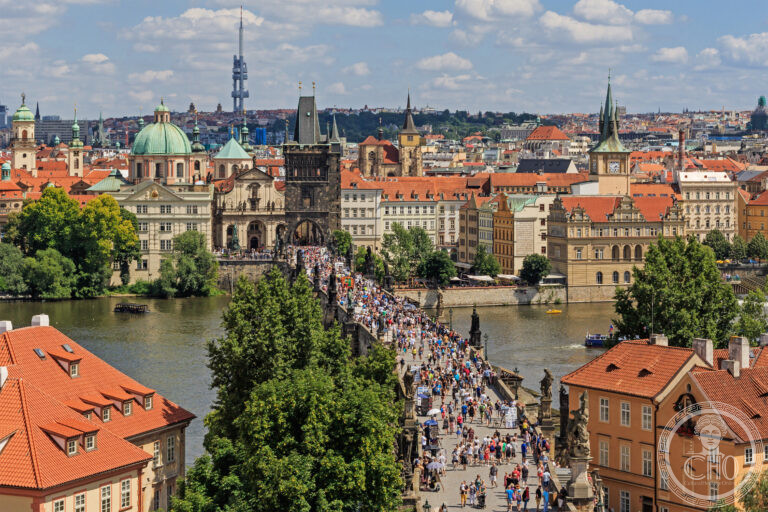
📷 Become a Cultural Heritage Online photographer
Share your photos of places: they stay published under your name as the author. The more they're seen, the more you get noticed — and soon a contest will reward the most appreciated photos.
Log in or sign up free to add a photo