
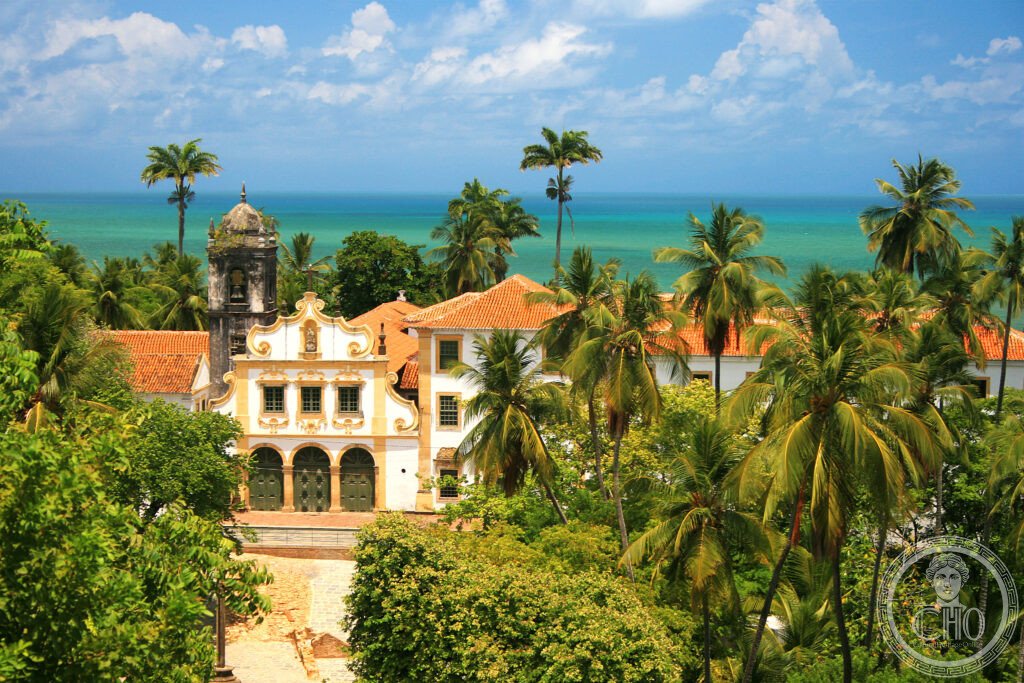
Historic Town of Olinda
The most complete colonial hilltop town in Brazil and one of the most intact examples of Portuguese Baroque urban architecture in the world — Olinda was founded in 1535 on a series of hills above the Atlantic coast in Pernambuco (north-east Brazil), served as the first capital of Pernambuco, was sacked and burned by the Dutch in 1631 and rebuilt with extraordinary consistency in the Luso-Baroque style between 1654 and the early 18th century; the result is a remarkably homogeneous historic centre of colourful colonial mansions, Baroque churches and convents, and cobbled streets cascading down hillsides above the former Dutch-controlled city of Recife.
At a glance
Olinda (population approximately 390,000) is a municipality in Pernambuco State, north-eastern Brazil, immediately north of the city of Recife (which had become the capital of Pernambuco after the Dutch occupation, 1630–1654) at the Atlantic coast. The historic centre of Olinda (approximately 5.2 km²) is built on three interconnected hills, giving it a dramatically stepped urban silhouette visible from Recife below. UNESCO inscribed the Historic Town of Olinda in 1982 — one of the first Brazilian UNESCO inscriptions. Olinda is most famous internationally for its Carnival, considered one of the most participatory and authentic in Brazil (unlike the Rio de Janeiro Carnival, which is an increasingly spectator-oriented festival dominated by the samba school parades, Olinda’s Carnival has a street-level participatory character in which the entire town becomes a stage).
Key facts
- Convento de São Francisco (1585): the first Franciscan convent established in Brazil and one of the finest examples of colonial religious architecture in the Americas — founded in 1585 on the Cruzeiro hill by the Spanish Franciscan Friar Melchior de Santa Catarina, the convent complex includes the church of Nossa Senhora das Neves (with its Baroque façade of pale yellow stucco and an interior of 18th-century azulejo tiles from Portugal depicting the life of Saint Francis — the finest azulejo cycle in Brazil outside Salvador da Bahia), the cloister (an 18th-century arcaded courtyard with its original Portuguese paving), and the third-floor chapel of São Roque (with a view over the roofscape of Olinda to the Atlantic and to Recife); the Franciscan Museum within the convent has a collection of colonial religious art including 17th-century Flemish paintings brought during the Dutch occupation
- Se Cathedral (1537, rebuilt 18th century): the oldest cathedral in Brazil — the first church was built on the Se hill in 1537, two years after the town’s founding; it was burned by the Dutch in 1631 and rebuilt multiple times; the current structure (largely 18th century) is the most architecturally austere of Olinda’s churches, which has been read as a deliberate reaction to the ornate Baroque decoration of the town’s other churches; the Se hill gives the most panoramic view of the historic centre (the classic postcard view of Olinda — church towers and coloured façades cascading down to the sea), particularly at sunset; adjacent to the cathedral are the remains of the palace of the Bishops of Pernambuco (now the Palácio do Bispo, used for cultural events)
- Dutch occupation and the Blaeu Atlas: the 24-year Dutch West India Company occupation of Pernambuco (1630–1654) was the most sustained European challenge to Portuguese American empire and profoundly shaped north-eastern Brazil — the Dutch governor Johan Maurits van Nassau-Siegen (1637–1644) turned Recife into the most sophisticated European city in the Americas, commissioning the first systematic natural history of the Americas (by Willem Piso and Georg Marcgraf, 1648), the first portrait paintings by a European artist in the Americas (Franz Post’s Brazilian landscapes, now in major European museums), and cartographic surveys that produced the most accurate maps of the Brazilian coast; Olinda was burned by the Dutch in 1631 (they saw it as a strategic threat to their control of Recife below) and rebuilt by the Portuguese after the Dutch were expelled in 1654; the rebuilt Olinda (1654–1720) is what the UNESCO inscription protects
- Olinda Carnival — the street Carnival: the most participatory Carnival in Brazil and one of the largest street festivals in the world, drawing approximately 2 million people over the 5-day Carnival period (the Saturday before Ash Wednesday through Fat Tuesday) — unlike Rio’s Carnival (focused on the samba school parades in the Sambódromo) or Salvador’s Carnival (dominated by axé music and trio eléctrico sound trucks), Olinda’s Carnival is centred on the historic streets of the old town; the characteristic figures are the giant puppet carriers (bonecos gigantes — papier-mâché figures 3–5 metres tall, carried through the streets and representing local politicians, artists, and cultural figures since the 1930s) and the frevo — the distinctive Pernambuco musical-dance tradition (a syncopated brass band music derived from European march and Caribbean maxixe, with acrobatic dance movements using small umbrellas as balance props; UNESCO inscribed frevo as Intangible Cultural Heritage in 2012)
- Oficina Cerâmica Francisco Brennand (outside Olinda): 15 km from Olinda in Recife’s western Várzea neighbourhood, the ceramic workshop and museum of Francisco Brennand (1927–2019 — the most important Brazilian artist of the 20th century after Cândido Portinari) occupies a former tile factory site on approximately 50 hectares of tropical forest planted with Brennand’s ceramic sculptures (thousands of them, ranging from intimate vessels to monumental erotic phallic columns); the ceramic works in the atelier and surrounding garden, drawing on both the azulejo tile tradition of Portugal and Brennand’s own symbolic universe, constitute one of the most extraordinary artist’s environments in the world; free admission to the grounds (appointment required)
- Heritage: UNESCO World Heritage Site, Historic Town of Olinda, inscribed 1982
- GPS: 8.0089° S, 34.8553° W
History
The Portuguese navigator Duarte Coelho received the captaincy of Pernambuco from the Portuguese Crown in 1534 and founded Olinda in 1535 on the same hilltop above the coast where he had built a small fort; the name of the town (“Oh, beautiful!” — “Ó linda!” in Portuguese) is traditionally attributed to Coelho’s exclamation on seeing the site; Olinda grew rapidly as the centre of the sugar economy of Pernambuco (the most productive sugar-growing region in the world in the 16th century, producing approximately 60% of the world’s sugar supply at its peak), with the sugar mills (engenhos) of the surrounding coast and river valleys feeding their product through Olinda’s port. The Dutch conquest of Pernambuco (Dutch West India Company, 1630) proceeded with the capture of Recife below and the burning of Olinda above; the Dutch rebuilt Recife as their headquarters but left Olinda in ruins as a deliberate strategic measure; after the Portuguese restoration (1654), Olinda was rebuilt on its ruins, giving the colonial architecture a single period of construction (1654–1720) and a remarkable stylistic unity.
What you see
The historic centre is compact and best explored on foot (the hills are steep — wear comfortable shoes; the cobbled streets are uneven); the standard circuit: Praça do Carmo (the lowest and largest square, with the Baroque Church of Our Lady of Mount Carmel, 1581 — the largest Baroque church in Olinda) → Rua 13 de Maio (the main commercial street of the old town, with craft galleries, atelier workshops, and the Museum of Contemporary Art of Pernambuco) → Convento de São Francisco (on the Cruzeiro hill, including the azulejo cycle and cloister) → Monastery of São Bento (on the São Bento hill, the most ornate Baroque interior in Olinda, with gilded altarpieces and a 17th-century painted ceiling in the church nave) → Se Cathedral (on the Se hill, best at sunset for the panoramic view).
The Mercado Eufrásio Barbosa (at the base of the historic centre, near the main bus terminal) is the best place for regional craft shopping — the terracotta figures (figurinhas de barro) of the local sculptor Master Vitalino’s tradition (ceramic naive folk art depicting North-Eastern Brazilian rural life), the painted leather work of the São João artisans, and Pernambuco lacework are the characteristic crafts. The woodcut print tradition of the northeastern Brazilian cordel literature (small illustrated pamphlets with rhymed popular narratives of saints, bandits, and supernatural events, printed on cheap paper with dramatic woodcut images) is centred in the Caruaru region (120 km west) but sold throughout Pernambuco.
Practical information
- Admission: all streets and church exteriors free; Convento de São Francisco approximately BRL 15 (about €2.70); Monastério de São Bento approximately BRL 10; Museu de Arte Contemporânea de Pernambuco (MAC PE, in the 18th-century former jail) approximately BRL 10; the Oficina Francisco Brennand (in Recife, 15 km) free admission to the garden on weekdays (appointment required via the Fundação Brennand); most churches have free admission to the nave during services
- Getting there: Recife-Guararapes International Airport (REC) — direct flights from São Paulo (2.5h, LATAM/GOL/Azul, multiple daily), Rio de Janeiro (3h), Lisbon (8.5h, TAP Air Portugal, the only direct transatlantic flight to Recife), Madrid (9h, Iberia seasonal); the airport is 17 km south of Olinda; taxi from airport to Olinda approximately BRL 70–90 (about €13–16, 30–40 min); the Metrô do Recife rapid transit system (Line 1) connects the airport to the central Recife bus terminal from which Olinda-bound buses run every 10–15 minutes; total trip approximately 45 min from airport to Olinda by public transport, approximately BRL 5
- The sertão: the interior of Pernambuco, Paraíba, and Ceará — the semi-arid backland of north-eastern Brazil known as the sertão — is one of the most culturally distinctive regions in Brazil; the Caruaru fair (Feira de Caruaru, 130 km west of Recife — the largest artisan fair in Latin America, with thousands of stalls selling regional crafts, food, and music; UNESCO Intangible Heritage of Humanity 2006) and the mystical village of Nova Jerusalém in Serra Talhada (the world’s largest outdoor theatre, site of an annual Passion Play performed in a full-scale replica of ancient Jerusalem) are the most remarkable heritage experiences in the north-eastern interior reachable from Olinda on a day trip or overnight
Getting there
Recife Airport (REC): 17 km south. Flights from São Paulo (2.5h), Lisbon (8.5h direct, TAP). Taxi to Olinda approx. 30 min. GPS: -8.0089, -34.8553.
Nearby
- Recife — immediately south of Olinda (15–20 min by bus); the capital of Pernambuco State and the largest city in north-eastern Brazil (population 1.7 million, metropolitan 4.1 million); the historic centre of Recife includes the Bairro do Recife (the original island district, now largely abandoned as an administrative quarter but with the Kahal Zur Israel Synagogue — the oldest synagogue in the Americas, founded by Sephardic Jews during the Dutch occupation in 1636); the Marco Zero (the zero kilometre marker on the waterfront of the Bairro do Recife, centre of the Recife Antigo renovation project); and the Instituto Ricardo Brennand (a private museum in a mock-medieval castle in the western Várzea neighbourhood, with the world’s most important collection of Dutch-Brazilian paintings by Frans Post and a major collection of arms and armour)
- Porto de Galinhas — 60 km south of Recife (1h by bus); consistently voted one of the most beautiful beaches in Brazil, with its natural pool reefs (jangadas, traditional flat-bottomed fishing rafts, carry visitors from the beach to the natural pools in the reef at low tide for snorkelling with tropical fish — the definitive Porto de Galinhas experience); the beach town has grown into a major resort but retains its fishing village character outside the main beach area; the name (“Port of Chickens”) derives from the code used by slave traders in the 19th century to communicate the arrival of enslaved Africans (calling them “poultry” to evade customs inspection after the official abolition of the slave trade)
- Fernando de Noronha — 545 km off the Pernambuco coast (1.5h by propeller aircraft from Recife, daily flights by GOL and Azul); the most important marine protected area in the South Atlantic (UNESCO Biosphere Reserve and Brazilian National Marine Park) — an archipelago of 21 volcanic islands at the most biodiverse marine environment in the western South Atlantic, with endemic spinner dolphins, hawksbill turtles, green turtles, humpback whales, and some of the most pristine coral reefs and clear water in Brazil; visitor numbers are controlled by a daily fee (starting at approximately BRL 133 per day, increasing with length of stay) and a maximum of approximately 420 visitors per day; the island is self-described as Brazil’s greatest ecological monument
Sources
- Wikipedia, Olinda; Convento de São Francisco (Olinda); Dutch conquest of Brazil, accessed June 2026
- UNESCO, Historic Town of Olinda, WHS reference 189, inscribed 1982
- José Antônio Gonsalves de Mello, Tempo dos Flamengos: Influência da ocupação holandesa na vida e na cultura do norte do Brasil, Topbooks, 2001
- João Maurício de Nassau-Siegen, Descrição geral da captania de Pernambuco, primary source, 1643 (modern edition FIOCRUZ, 2011)
Find it on the map
See this place and what’s around it →📷 Diventa un fotografo di Cultural Heritage Online
Condividi le tue foto dei luoghi: restano pubblicate con la tua firma come autore. Più vengono viste, più ti fai conoscere — e presto un concorso premierà le foto più apprezzate.
Accedi o registrati gratis per aggiungere una foto