
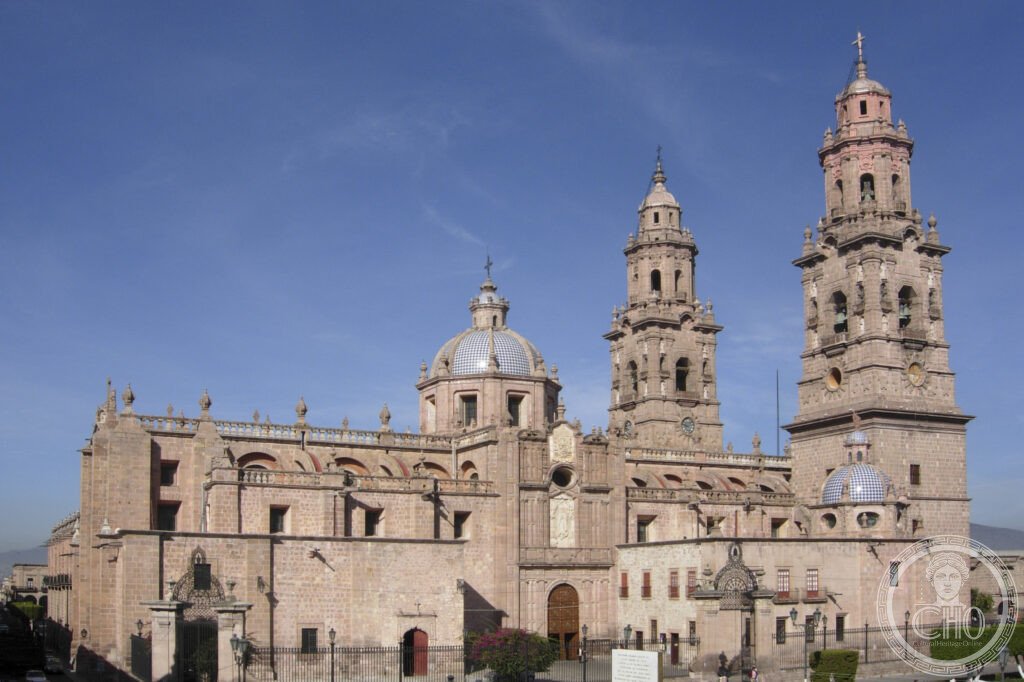
Morelia has the most complete Baroque colonial streetscape in western Mexico. The city, originally Valladolid, renamed 1828 in honour of native son José María Morelos, was built between 1541 and the early 19th century in the distinctively warm rose-pink cantera stone of Michoacán. This produced a unified architectural ensemble of over 200 historic monuments — churches, convents, palaces, aqueduct, and the finest Baroque cathedral in western Mexico — whose consistency of scale, material, and colour is unique among the colonial cities of the Americas.
At a glance
Morelia (population approximately 900,000) is the capital of Michoacán State, western Mexico, at an altitude of approximately 1,920 m, approximately 300 km west of Mexico City. The city was founded in 1541 as Valladolid de Michoacán by the Spanish viceroy Antonio de Mendoza on a site previously occupied by the Purépecha indigenous people. Their state, the Tarascan Empire, had successfully resisted Aztec conquest and was the most powerful indigenous polity in western Mexico at the time of the Spanish arrival. UNESCO inscribed the Historic Centre of Morelia in 1991.
Key facts
- The Catedral Metropolitana: the defining landmark of Morelia, built between 1660 and 1744 in a combination of Baroque and Herreran-Neoclassical styles. The cathedral is famous for its extraordinary organ, the largest and finest pipe organ in Latin America, built by the German firm Walcker in 1902 with 4,600 pipes, which is played in the annual International Organ Festival held in the Cathedral plaza in August. The twin towers, 75 metres tall, are the tallest in Mexico. The rose-pink cantera stone of the façade glows particularly in the late afternoon light. The cathedral is the spiritual centre of the Michoacán Diocese and the Plaza de Armas in front of it is the social heart of the city.
- The Morelia Aqueduct (1785): the most visually dramatic monument in the city after the Cathedral. A 1.63-kilometre stone aqueduct of 253 arches, each approximately 9 metres tall, was built between 1785 and 1789 to supply the city with water from a spring 2.2 km to the east. The aqueduct terminates at the Plaza Villalongin at the eastern edge of the historic centre, where the arches march through the historic streetscape in a way directly recalling the Roman aqueducts of Segovia and Tarragona. The aqueduct is illuminated nightly, as Morelia has an outstanding night-time illumination programme for its monuments. Walking the length of the aqueduct at dusk is one of the best experiences in the city.
- José María Morelos y Pavón (1765–1815): the most important leader of the Mexican independence movement and Morelia’s most famous native son. Born in Valladolid, the city’s colonial name, in 1765, Morelos was a mestizo priest who took up the independence cause after the execution of Miguel Hidalgo y Costilla in 1811 and led the insurgent forces for the next four years. He drafted the Solemn Act of the Declaration of Independence of Northern America (1813), the first formal independence declaration for Mexico, and convened the Congress of Chilpancingo. He was captured by royalist forces and executed by firing squad in Ecatepec on 22 December 1815. His birthplace, Casa de Morelos (1750, now the Morelos Museum), and the house where he grew up, Casa Natal de Morelos, are both open to visitors.
- The Colegio de San Nicolás (1540): the oldest continuously operating educational institution in the Americas at university level. It was founded by Bishop Vasco de Quiroga in 1540, one year before the city’s official foundation. The institution is now part of the Universidad Michoacana de San Nicolás de Hidalgo, the state university of Michoacán. The original Colegio building, on the Calle de Madrigal de las Altas Torres, is still part of the university campus. Miguel Hidalgo, the “Father of Mexican Independence” who rang the Grito de Independencia bell in Dolores on 16 September 1810, studied here. Morelos himself was a student and later a teacher here before joining the independence movement.
- Día de Muertos and Purépecha culture: Michoacán State is the original home of the most internationally recognised Día de Muertos (Day of the Dead) celebrations in Mexico. The villages around Lake Pátzcuaro (50 km west of Morelia), particularly Janitzio Island, the most photographed Día de Muertos site in the world, and the lakeside villages of Tzurumútaro, Ihuatzio, and Erongarícuaro, maintain the pre-Columbian Purépecha funeral tradition of spending the night (1–2 November) in the cemetery with their deceased ancestors, lighting candles and marigolds (cempasúchil, the traditional flower of the dead) on every tomb. UNESCO inscribed the Michoacán Día de Muertos as Intangible Cultural Heritage in 2008.
- Heritage: UNESCO World Heritage Site, Historic Centre of Morelia, inscribed 1991.
- GPS: 19.7060° N, 101.1950° W.
History
The Purépecha (Tarasco) people of Michoacán were the only major indigenous civilisation in Mesoamerica that successfully resisted Aztec military expansion; the Aztec-Tarascan War of 1478–79 ended in Aztec defeat. The Spanish exploited this rivalry by allying with the Purépecha against the Aztec. After the fall of Tenochtitlan (1521), the Spanish turned on their former allies and conquered Michoacán (1522). The first Bishop of Michoacán, Vasco de Quiroga (1482–1565), one of the most extraordinary figures of the colonial period, established a network of craft-producing indigenous communities around Lake Pátzcuaro, each village specialising in a different craft, such as copper working in Santa Clara del Cobre, lacquerwork in Uruapan, and wooden furniture in Tocuaro, a system still in operation today. He also founded the Colegio de San Nicolás in Pátzcuaro (1540) before moving the bishopric to Valladolid. The city was renamed Morelia in 1828, three years after the execution of Morelos, the independence movement hero who was born here.
What you see
The historic centre is compact, with most monuments within 1 km of the Cathedral plaza. The standard circuit runs: Plaza de Armas (Cathedral and Government Palace, with its Diego Rivera murals depicting Michoacán history), then the Palacio Clavijero, a 17th-century Jesuit college, now a government building and library, with the finest cloister in Morelia, then the Casa de la Cultura, a 17th-century Augustinian convent, then the Aqueduct, best seen at sunset or evening illumination, and finally the Bosque Cuauhtémoc, the main city park, with the Michoacán Regional Museum in the adjacent Palacio Montejo. The Tarascan Fountain (Fuente Tarasca, 1960), a modernist bronze sculpture of three Purépecha women supporting a large fruit platter, at the intersection of Avenida Madero and the Calzada Fray Antonio de San Miguel, is the de facto symbol of modern Morelia.
On the Pátzcuaro day trip (50 km west, 1h by bus), the lakeside colonial city of Pátzcuaro, itself a remarkably intact colonial town, is usually combined with a boat ride to Janitzio Island (15 min by motorised launch) and a visit to the Basilica de Nuestra Señora de la Salud (early 17th century). On 1–2 November, the Día de Muertos cemetery visits at the lakeside villages are one of the most profound cultural experiences in Mexico.
Practical information
- Admission: all historic streets and the Cathedral free. Regional Museum of Michoacán approximately MXN 80 (about €4). Casa Natal de Morelos approximately MXN 30. Palacio Clavijero (exterior and courtyard) free. The historic centre is walkable; guided walking tours are available from the Tourism Office on the east side of the Cathedral plaza (approximately MXN 250 per person).
- Getting there: General Francisco J. Mújica International Airport (MLM) has direct domestic flights from Mexico City (Aeroméxico, VivaAerobus, 1h, multiple daily) and Tijuana (2h, VivaAerobus). The airport is 25 km north of the city centre (taxi approximately MXN 300, 30 min). By direct bus from Mexico City (ETN or Primera Plus, 4–4.5 hours, approximately MXN 400) is the most comfortable option. There is also bus service from Guadalajara (3h) or Guanajuato (2.5h).
- Monarch Butterfly Biosphere Reserve: from mid-November to February, the Oyamel fir forests of the Sierra Chincua and El Rosario butterfly sanctuaries (100 km north-east of Morelia) host the overwintering of approximately 1 billion Eastern Monarch butterflies. The entire Eastern North American Monarch population migrates to these specific mountains annually, returning in spring to their summer breeding grounds in the northern United States and Canada. The sanctuaries are accessible by a combination of shuttle bus and horse or walking, approximately 30 min uphill to the butterfly concentration. UNESCO biosphere reserve; one of the most extraordinary natural spectacles in the world.
Getting there
Morelia Airport (MLM): 25 km from centre, flights from Mexico City (1h). Bus from Mexico City (4h), Guadalajara (3h). Altitude 1,920m. GPS: 19.7060, -101.1950.
Nearby
- Pátzcuaro — 50 km west (1h by bus). This colonial lakeside city is the spiritual capital of the Purépecha people. The Plaza Vasco de Quiroga, the largest colonial plaza in Mexico, flanked by 16th-century arcaded buildings, and the Basílica de Nuestra Señora de la Salud, containing the statue of the Virgin of Health, fashioned by Purépecha craftsmen from a paste made of corn cobs and honey, a pre-Columbian technique adapted for Christian use, are the main historic sites. Janitzio Island, 15 min by boat launch from the pier at Lago de Pátzcuaro, has a panoramic view of the lake and the most commercially visible Día de Muertos cemetery of the Michoacán tradition.
- Guanajuato — 180 km north-east of Morelia (2.5h by bus). This is the other great colonial mining city of central Mexico. While Morelia is associated with independence politics and religious Baroque, Guanajuato (UNESCO WHS 1988) is the most picturesque and most visited colonial city in Mexico, with its warren of coloured staircase alleys, the underground road system, the former riverbed routed underground in the 1960s to solve traffic, and the Mummy Museum (El Museo de las Momias), natural mummies exhumed from the municipal cemetery in the 19th century, now Guanajuato’s most visited attraction. Diego Rivera was born here in 1886.
- Uruapan — 120 km west of Morelia (2h by bus). This is the avocado capital of Mexico: Michoacán produces approximately 80% of Mexican avocados, and approximately 40% of global supply, and the Uruapan area alone produces more avocados than any other single region in the world. The Paricutín volcano (27 km north of Uruapan), a cinder cone that erupted from a cornfield on 20 February 1943, grew to 424 metres in one year, and buried the village of San Juan Parangaricutiro to its church towers in lava before going extinct in 1952, is one of the geologically youngest features in the world and one of the most accessible active lava fields. It is accessible by horse from the village of Angahuan.
Sources
- Wikipedia, Morelia; Catedral de Morelia; José María Morelos, accessed June 2026.
- UNESCO, Historic Centre of Morelia, WHS reference 585, inscribed 1991.
- Michael Mathes, Las misiones de Michoacán, Instituto Nacional de Antropología e Historia, 1990.
- Vasco de Quiroga, Información en Derecho, 1535 (primary source on the colonial foundation of Michoacán).
Find it on the map
See this place and what’s around it →📷 Become a Cultural Heritage Online photographer
Share your photos of places: they stay published under your name as the author. The more they're seen, the more you get noticed — and soon a contest will reward the most appreciated photos.
Log in or sign up free to add a photo