

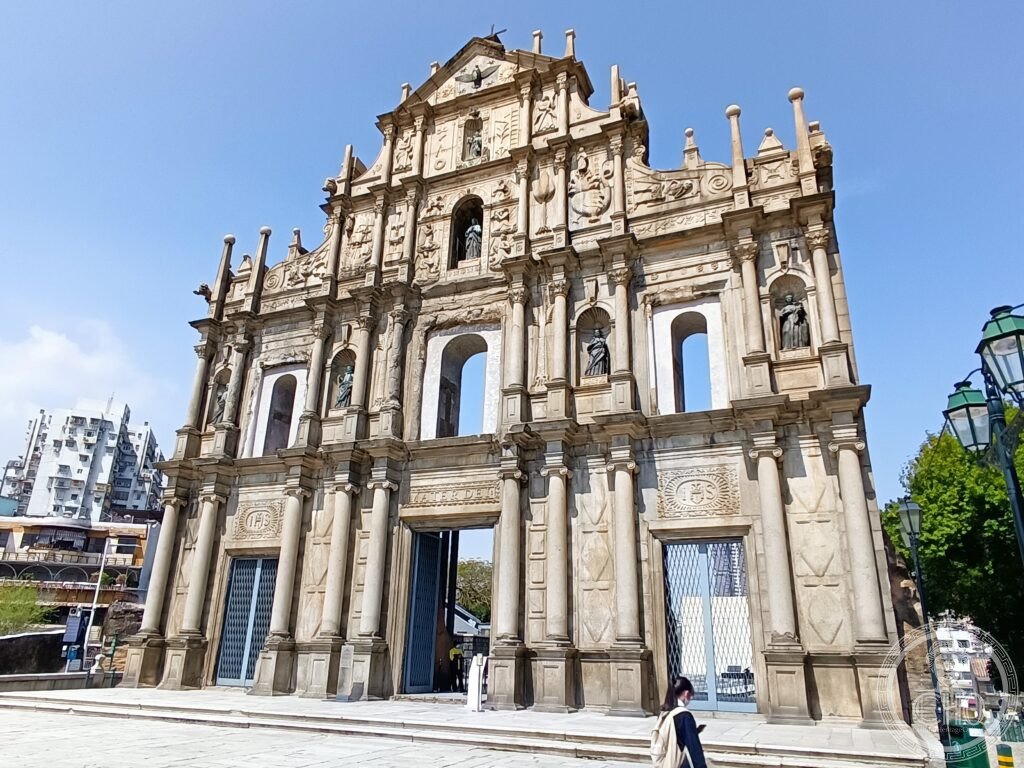
The longest-surviving European settlement in Asia, and the most complete surviving example of a colonial city where Portuguese and Chinese architectural traditions, religious practices, languages, and cuisines merged over four centuries into a unique synthesis that exists nowhere else on Earth. The same street in the Historic Centre of Macau will contain a baroque Portuguese church and a Taoist temple facing each other across a granite-paved mosaic square, with incense from both drifting together.
At a glance
Macau (population approximately 700,000) is a Special Administrative Region (SAR) of the People’s Republic of China on the western side of the Pearl River Delta, 65 km south-west of Hong Kong and 145 km south-east of Guangzhou. Portugal established a trading post at Macau in 1557 (making it the first permanent European settlement in China and the last to be returned — the handover occurred on 20 December 1999, two years after Hong Kong). Portuguese sovereignty, Catholic mission influence, and the China trade produced an architectural heritage of remarkable richness across a very small territory (the historic centre covers approximately 30 hectares). UNESCO inscribed the Historic Centre of Macau in 2005.
Key facts
- Ruins of St Paul’s (Ruins of the Church of Mater Dei): the most visited heritage site in China (approximately 4 million visitors annually). The College of the Mother of God (built 1594–1640 by Jesuit missionaries, designed by Carlo Spinola and built partly by Japanese Christian exiles who had fled Japan’s anti-Christian persecutions) was the first Western-style university in East Asia. The church (attached to the college) had a five-tier carved stone façade of extraordinary iconographic sophistication, combining Jesuit symbols (the IHS monogram, the flaming heart, the angels), Portuguese maritime imagery (a Portuguese carrack sailing ship, a hydra), and Chinese and Japanese Buddhist imagery (the Japanese chrysanthemum, Chinese phoenix, lotus flowers) into a single theological programme in stone. The body of the church burned in 1835 (typhoon fire that started in a military barracks kitchen nearby) and only the façade and the crypt (the crypt of the Japanese martyrs, where the bones of the 26 Japanese Christian martyrs of Nagasaki 1597 are kept) survived. The façade is now the symbol of Macau.
- A-Ma Temple (Temple of the Goddess of the Sea): the oldest temple in Macau, and the origin of the city’s name. Built in 1488 (approximately 70 years before Portuguese arrival) by Fujian fishermen on a rocky promontory at the southern tip of the Macau peninsula. Dedicated to A-Ma (or Mazu), the Taoist goddess of the sea worshipped by fishermen and sailors throughout southern China. When the Portuguese asked the local fishermen what the place was called, they reportedly replied “A-Ma-Gao” (Bay of A-Ma), which the Portuguese transcribed as Macau. The temple (a complex of pavilions and shrines set into the cliff face) is still active and provides the most atmospheric experience of the pre-Portuguese Chinese heritage. Pilgrims burn giant joss sticks at the main entrance and navigate the shrine precinct along narrow paths between boulders.
- The Macanese culture and cuisine: the synthesis of Portuguese and Chinese cultures produced the Macanese culture (a distinct ethnic community of mixed Portuguese-Chinese descent) and the Macanese cuisine (one of the world’s great fusion cuisines). Dishes like minchi (minced pork or beef with potatoes, soy sauce, and bay leaf), bacalhau à Gomes de Sá (salt cod, adapted from the Portuguese national dish), tacho (a pork and vegetable stew), caldo verde (Portuguese kale soup adapted with Chinese ingredients), African chicken (frango à africana, grilled with chilli sauce — reflecting Macau’s role as a transit point between Portugal’s African and Asian colonies), and the famous pastel de nata de Macau (egg tarts, a Macau-adapted version of the Portuguese pastel de Belém that has become the most exported pastry in Asia). The original egg tart recipe from the Lord Stow’s Bakery in Coloane Village (1989) is the direct ancestor of the Hong Kong and mainland Chinese egg tart tradition.
- Guia Fortress and Lighthouse: the highest point of the Macau Peninsula (92 m) and the first modern lighthouse built on the Chinese coast (1865). The Guia Fortress (1637) with its chapel of Our Lady of Guia (containing the only surviving example of Chinese Baroque fresco painting in Macau, rediscovered under layers of whitewash in 1996) and the lighthouse (the oldest lighthouse on the Chinese coast, operating since 1865) give the best panoramic view over Macau, the Pearl River Delta, and, on clear days, Guangdong province. Accessible by cable car from the Flora Garden or by foot via the Guia Hill Municipal Park.
- Macau’s casino economy: Macau is the world’s largest gambling market (revenue approximately six times that of Las Vegas in the peak years before 2020). Gambling was legalised by the Portuguese colonial government in 1850 and expanded with the liberalisation of the casino concession system in 2002. The casino strip on the Cotai (reclaimed land between Taipa and Coloane islands) is physically separate from the UNESCO historic centre and does not overlap with the heritage zone. The contrast between the UNESCO-protected old city and the Cotai Strip of giant casino-hotels (modelled on individual world cities and cultures: the Paris casino, the Venetian casino, the Wynn casino) is Macau’s central paradox.
- Heritage: UNESCO World Heritage Site, Historic Centre of Macau, inscribed 2005.
- GPS: 22.1937° N, 113.5390° E.
History
Portuguese traders established themselves at Macau in 1557 with the permission of the Ming dynasty (in exchange for services policing the Pearl River Delta against pirates). The formal lease agreement was not ratified until 1887. Macau was the most important Portuguese base in East Asia for three centuries, serving as the transit point for the China trade (silk, porcelain, and tea from China; silver from Japan and the Americas) and as the primary Christian mission base for the Jesuits working throughout East Asia (the Jesuits — Matteo Ricci, Francis Xavier, Michele Ruggieri — used Macau as their staging point and language school for missions to China, Japan, Vietnam, and the Philippines).
The city’s decline began with the collapse of the Japan trade (1639, when Japan expelled all Portuguese and closed the country) and the rise of Hong Kong (ceded to Britain 1842). The Portuguese retained Macau but as an increasingly marginal economic backwater until the gambling concession revived it in the 20th century. The 1966 12-3 Incident (anti-colonial riots by pro-communist groups) effectively ended Portuguese authority, and the 1974 Carnation Revolution in Portugal led to Lisbon offering Macau back to China in 1975 (China declined to accept it at that point, preferring to maintain the gambling revenue). The handover finally occurred 20 December 1999. The UNESCO inscription (2005) followed the handover and confirmed the commitment to heritage preservation under the “one country, two systems” framework.
What you see
The UNESCO heritage route connects 25 monuments and squares in the historic city (a circular walk of approximately 3 km, requiring 4–5 hours to visit properly). The key sequence: Ruins of St Paul’s façade (with the crypt of the Japanese martyrs). Monte Fort (immediately above the ruins, with Macau Museum inside — the best single introduction to Macau history). St Dominic’s Church (1587, now a museum of religious art, most beautiful Baroque church interior in Macau). Senado Square (the granite-mosaic cobbled square with Portuguese wave pattern, flanked by the Leal Senado and the General Post Office — the civic heart of the city). The Mandarin’s House (Zheng Guanying residence, 1869 — the most important Chinese vernacular historic house open to visitors; the contrast with the European buildings nearby is instructive). A-Ma Temple (the oldest building in Macau, at the southern tip of the peninsula).
The egg tart walk: after completing the heritage circuit, the Lord Stow’s Bakery (in Coloane Village, 20 min from the historic centre by taxi) sells the original recipe Macanese egg tarts (Portuguese-style pastel de nata with flaky pastry, not the local Hong Kong caramelised custard variant). The queue is typically 15–30 minutes and the tarts are eaten warm at the outdoor tables facing the small square of Coloane Village. The most atmospheric place to eat in Macau.
Practical information
- Admission: Ruins of St Paul’s and façade free. Macau Museum (Monte Fort) MOP 15 (about €1.65). Mandarin’s House free. All Catholic churches free. A-Ma Temple free. Guia Fortress and lighthouse free. The entire UNESCO heritage route can be done on foot for no admission cost (museums and churches optional).
- Getting there: Macau International Airport (MFM). Flights from mainland China cities, Southeast Asia. The primary access route for international visitors is by ferry from Hong Kong (Turbojet, Cotai Jet, or HKMacau Ferry, approximately 1 hour from Hong Kong Macau Ferry Terminal on Hong Kong Island or Tuen Mun Ferry Terminal in the New Territories; MOP 170–240/approximately €19–27 one-way; ferries run approximately every 30 minutes from 7 am to midnight; the Cotai Strip ferry terminals for direct access to the casino hotels are served by dedicated ferries from Hong Kong Airport). By road via the Hong Kong-Zhuhai-Macau Bridge (opened 2018, the world’s longest sea-crossing fixed link at 55 km; shuttle buses run between Hong Kong and Macau border crossing).
- Day trip from Hong Kong: Macau is easily done as a day trip from Hong Kong (1 hour each way by ferry). The recommended sequence: arrive morning ferry, Ruins of St Paul’s and Monte Fort museum (morning), Senado Square lunch, heritage walk afternoon (A-Ma Temple, Mandarin’s House), late afternoon ferry back. If extending to a night stay, the Coloane egg tarts and the Cotai Strip casino observation (even without gambling) are worth the extra time.
Getting there
Ferry from Hong Kong (1h, MOP 170–240). Hong Kong-Zhuhai-Macau Bridge by shuttle bus. Macau Airport (MFM): regional flights. GPS: 22.1937, 113.5390.
Nearby
- Hong Kong. 65 km east (1h by ferry). The former British colony (returned 1997) and now Hong Kong SAR combines the densest urban heritage of the British colonial period in Asia (Government House, the Court of Final Appeal in the old Supreme Court Building, the Hong Kong and Shanghai Banking Corporation headquarters by Norman Foster, the Exchange Square by Remo Riva) with the world’s most concentrated urban-nature interface (the 70% of Hong Kong’s territory that is country parks — including the MacLehose Trail, Tai Long Wan beach, and the Pink Dolphin habitat in Lantau’s western waters). The Star Ferry crossing (6 minutes, HK$2.70, the best value transportation experience in any world city) and the Peak Tram (to Victoria Peak, 1888, the oldest cable railway in Asia) are the defining Hong Kong heritage experiences.
- Zhuhai and the Pearl River Delta. Immediately across the border from Macau (5 min drive to the Lotus Bridge border crossing). The city of Zhuhai (population approximately 2.5 million) is part of the Greater Bay Area development zone. The Dr Sun Yat-sen Memorial Hall in Cuiheng Village (30 km north of the Macau border) is the birthplace house of Sun Yat-sen (1866–1925), the founder of the Republic of China and the “Father of the Nation” for both the PRC and the ROC (Taiwan). Open daily. Admission CNY 20.
- Guangzhou (Canton). 145 km north-west of Macau (2h by high-speed rail from the Guangzhou South station, accessible from Zhuhai by train). The capital of Guangdong Province and the southern China commercial capital. The Chen Clan Ancestral Hall (1888–1894, one of the finest examples of Lingnan traditional architecture, with carved stonework, wood, brick, and ceramic decorative elements across 19 courtyards and 6 main halls) and the Shamian Island (the former European concession island, with its French and British colonial buildings well preserved on a tree-lined island in the Pearl River, now a café and gallery district) are the best heritage experiences in Guangzhou accessible from Macau.
Sources
- Wikipedia, Historic Centre of Macau. Ruins of St Paul’s. Macanese people, accessed June 2026.
- UNESCO, Historic Centre of Macau, WHS reference 1110, inscribed 2005.
- Rogério Beltrão Coelho, Macau, A Herança Histórica, Fundação Oriente, 2008.
- Luís Filipe Barreto (ed.), Macau: Mitos e Realidades, Centro Científico e Cultural de Macau, 2010.
Find it on the map
See this place and what’s around it →📷 Become a Cultural Heritage Online photographer
Share your photos of places: they stay published under your name as the author. The more they're seen, the more you get noticed — and soon a contest will reward the most appreciated photos.
Log in or sign up free to add a photo