
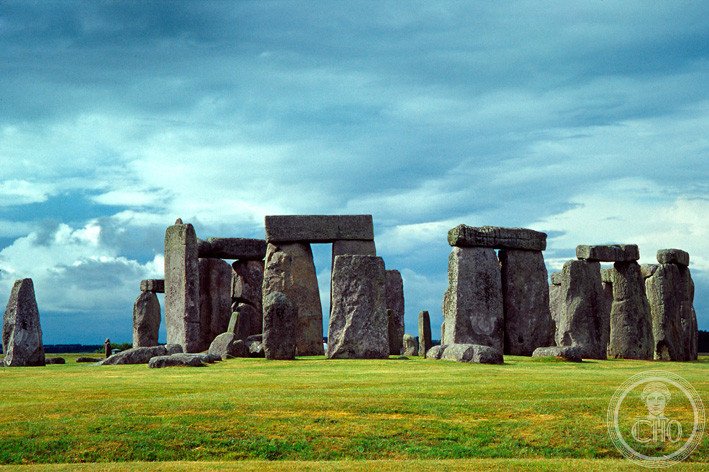
Stonehenge
A ring of standing stones on the Wiltshire plain whose builders moved 25-tonne sarsen blocks from Marlborough Downs 25 km away and 4-tonne bluestones from the Preseli Hills in Wales 240 km away — a logistical effort on a scale comparable to the Egyptian pyramids — and oriented the whole structure so precisely to the midsummer sunrise and midwinter sunset that modern astronomical instruments cannot improve on it.
At a glance
Stonehenge is a prehistoric megalithic monument on Salisbury Plain in Wiltshire, England, 13 km north of Salisbury. It is the most architecturally sophisticated prehistoric stone circle in the world, built in several phases between approximately 3000 and 1500 BC. The monument consists of a circular earthwork (the earliest phase) containing a ring of sarsen standing stones (each up to 9 metres tall and 25 tonnes), many still capped by horizontal lintels, forming an outer circle and an inner horseshoe of trilithons (pairs of uprights supporting a lintel); within these, a smaller circle and horseshoe of bluestones. The monument is precisely oriented to the midsummer sunrise and midwinter sunset and is believed to have served as a ceremonial and astronomical site throughout its long history of use. Stonehenge is a UNESCO World Heritage Site inscribed in 1986 (as part of “Stonehenge, Avebury and Associated Sites”).
Key facts
- Construction phases: Phase 1 (c. 3000 BC): circular earthwork ditch and bank, 56 Aubrey Holes (possibly for a timber circle or posts); Phase 2 (c. 2500 BC): arrival of the bluestones from Wales; Phase 3 (c. 2500–1500 BC): erection of the sarsen circle and trilithons; the monument was modified and added to repeatedly over 1,500 years
- The sarsen stones: the outer circle consists of 30 sarsen standing stones (17 still upright), each 4 metres above ground and 25 tonnes, capped by 30 curved lintels (6 surviving); the inner horseshoe has 5 trilithons (3 complete), the tallest 7.3 metres; the sarsens were quarried at Marlborough Downs 25 km north and transported using sledges, rollers, and possibly rafts on the Avon River
- The bluestones: approximately 80 smaller stones (each 2–4 tonnes, blue-grey igneous rock) brought from the Preseli Hills in Pembrokeshire, Wales, 240 km distant; the source quarries (at Carn Goedog and Craig Rhos-y-felin) were identified in 2015; how they were transported (overland, coastal sea, Salisbury Avon?) remains debated; the effort was equivalent to a modern engineering project
- Solar alignment: the monument is aligned so that on midsummer sunrise (summer solstice, c. 21 June), the sun rises directly over the Heel Stone and the first light illuminates the central altar stone; on midwinter sunset (c. 21 December), the sun sets directly through the trilithon horseshoe to the south-west; the alignment has been astronomically verified to within 0.1°
- Burials: the site contains at least 64 cremation burials in the Aubrey Holes and around the monument, dating from the earliest phase (c. 3000 BC) to the Bronze Age; the cremated remains include individuals with varied origins (some from Wales, suggesting the monument attracted people from distant regions); Stonehenge was also a burial ground
- Heritage: UNESCO World Heritage Site, Stonehenge, Avebury and Associated Sites, inscribed 1986
- GPS: 51.1789° N, 1.8262° W
History
The Stonehenge landscape was sacred before the stones were erected: the earliest features in the area date from the Mesolithic period (c. 8000 BC) and include timber posts whose purpose is unknown. The circular earthwork of Phase 1 (c. 3000 BC) was dug with antler picks and shoulder-blade shovels, producing a circular bank and inner ditch approximately 100 metres in diameter. The 56 Aubrey Holes — shallow pits around the interior — may have held timber posts, bluestones, or simply cremation deposits; all three theories have current adherents. The wooden buildings inside the earthwork (evidenced by post holes) suggest the site was actively used before the stones arrived.
The arrival of the bluestones from Wales c. 2500 BC is the most debated episode in Stonehenge’s construction history. The source quarries in the Preseli Hills were identified by geologist H.H. Thomas in 1923; why these particular stones from these particular quarries (rather than local sarsen) were used is unknown. One hypothesis suggests the bluestones had healing properties attributed to them and were already a site of pilgrimage in Wales before being moved; another suggests the monument at Stonehenge was itself the destination of a migration, incorporating sacred stones from a Welsh sanctuary. The erection of the sarsen circle and trilithons (c. 2500 BC) required the organisation of a major regional workforce — the scale of effort has been estimated at 20 million person-hours.
Stonehenge was in use for approximately 1,500 years after its completion. Bronze Age burial mounds (barrows) cluster thickly around the monument; the Amesbury Archer, buried 5 km from the monument c. 2300 BC, had the richest known Bronze Age burial in Britain and his isotopic analysis shows he was born in the Alps — evidence that Stonehenge attracted people from across Europe. Use of the site appears to have declined by c. 1500 BC, possibly as religious practice shifted to the new Bronze Age barrow burial tradition. The monument became known to medieval chroniclers as the work of giants or of Merlin (Geoffrey of Monmouth, c. 1136 AD); the astronomer John Aubrey made the first systematic survey in 1666; archaeological excavations have been continuous since the 19th century.
What you see
The monument is approached from the visitor centre via a 1.5 km path or shuttle bus across the plain; the stones appear on the horizon as a compact, low mass that rapidly increases in scale as you approach. The standard visitor path circles the stones at a distance of approximately 10 metres (closer access is available on special solstice tours and for pre-booked inner circle visits). From the outer ring, the scale of the sarsen lintels — each weighing 6 tonnes and fitted with precision mortice-and-tenon joints to their uprights — is the most striking detail; the precision of the fitting is visible from close range.
The solstice celebrations (midsummer sunrise, midwinter sunset) at Stonehenge are free, open to all, and attended by thousands of people; they are managed by English Heritage and police; the inner circle is accessible for these events. The experience — the plain, the mist before dawn, the crowd in the dark, the first light appearing precisely where it was expected — has an emotional charge that the standard daytime visit cannot replicate. The Avebury stone circle (40 km north, the largest in the world by area) and Silbury Hill (the largest prehistoric earthwork in Europe) are part of the same World Heritage Site and make a natural two-day visit.
Practical information
- Admission: £22.00 adult (English Heritage members free); the ticket includes shuttle bus from the visitor centre; pre-booking recommended in summer; solstice events are free and do not require a ticket
- Special access: inner circle visits (walking among the stones) require a separate booking (approximately £45); stone Circle Experience tours run at dawn and dusk outside public hours; book months in advance
- Getting there: from London Waterloo to Salisbury by train (1.5 hours, every 30 minutes); from Salisbury station, Stonehenge Tour bus (35 minutes, hourly); by car from London via A303, approximately 2 hours; the nearest major airport is Heathrow (130 km, 1.5–2 hours by car)
- Visitor centre: opened 2013, 2.7 km from the stones; the Neolithic house reconstructions, the display of excavated finds (including the Amesbury Archer’s grave goods), and the virtual inner circle tour are all worth the time before walking to the monument
Getting there
Train from London Waterloo to Salisbury (1.5 hours), then Stonehenge Tour bus (35 minutes). By car from London (A303, 2 hours). Heathrow Airport (LHR) is 130 km east. GPS: 51.1789, -1.8262.
Nearby
- Avebury — the largest prehistoric stone circle in the world by area (about 400 metres diameter), encompassing the village of Avebury within its banks and ditches; less visited and more experiential than Stonehenge; the West Kennet long barrow (burial mound, c. 3650 BC) and Silbury Hill (the largest prehistoric mound in Europe, 40 metres tall, purpose unknown) are nearby; 40 km north; UNESCO WHS (same inscription as Stonehenge)
- Salisbury Cathedral — the finest Gothic cathedral in England (1220–1320), with the tallest spire in Britain (123 metres); the best-preserved original Magna Carta (1215) is displayed in the Chapter House; 13 km south of Stonehenge
- Bath — the Roman spa city with the best-preserved Roman baths in northern Europe (1st–4th century AD); the Georgian Bath cityscape (Royal Crescent, Circus, Pulteney Bridge) is intact and UNESCO WHS; 45 km north-west of Stonehenge
Sources
- Wikipedia, Stonehenge, accessed June 2026
- UNESCO, Stonehenge, Avebury and Associated Sites, WHS reference 373, inscribed 1986
- Mike Parker Pearson, Stonehenge: A New Understanding, The Experiment Publishing, 2012 — the Stonehenge Riverside Project synthesis by the leading active excavator
- Timothy Darvill and Geoffrey Wainwright, “Stonehenge Excavations 2008,” Antiquaries Journal, 2009
Find it on the map
See this place and what’s around it →📷 Diventa un fotografo di Cultural Heritage Online
Condividi le tue foto dei luoghi: restano pubblicate con la tua firma come autore. Più vengono viste, più ti fai conoscere — e presto un concorso premierà le foto più apprezzate.
Accedi o registrati gratis per aggiungere una foto