
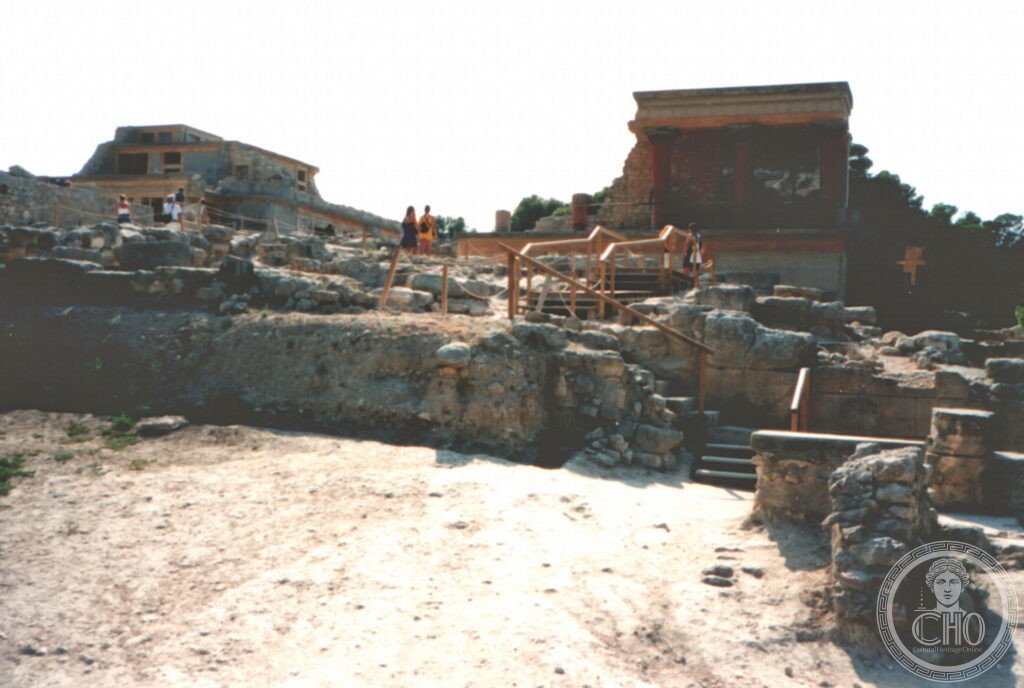
Knossos
The largest Bronze Age palace on Crete and the administrative centre of the Minoan civilisation — the first advanced civilisation of the European continent — whose frescoes of acrobats vaulting over bulls, marine life in blue plaster, and processional figures have an elegant naturalism that was not seen again in European art for 3,000 years, and whose labyrinthine multi-storey plan is the probable origin of the Theseus and the Minotaur myth.
At a glance
Knossos (Greek: Κνωσός) is a Bronze Age archaeological site near Heraklion on the island of Crete, Greece. It is the largest Bronze Age palace on Crete, with approximately 1,300 rooms at its peak (c. 1600–1375 BC), and is believed to have been the political and ceremonial centre of the Minoan civilisation — the first advanced civilisation of the European continent, which dominated the Aegean Sea trade from approximately 2700 to 1100 BC. The palace was excavated by the British archaeologist Arthur Evans from 1900, who partially reconstructed several areas (a decision that remains controversial among archaeologists). The site includes the partially restored palace complex, a large bronze age town extending around the palace, and the Minoan road network connecting Knossos to the coastal towns of Crete. Knossos is on the UNESCO Tentative List for World Heritage nomination.
Key facts
- Scale: the palace complex covers approximately 20,000 sq metres (5 acres) over multiple storeys; the main building had at least 4 storeys; the complex included storerooms (magazines) with large storage jars (pithoi) still in place, ceremonial rooms, the Throne Room with the oldest throne in Europe (still in situ), workshops, and frescoed ceremonial halls
- The Throne Room: the oldest throne in situ in Europe (c. 1350 BC); carved limestone; flanked by painted griffins; the anteroom has a ritual basin (lustral basin or adyton); the throne room was probably used for religious ceremonies; the configuration — throne against the wall with a basin opposite — is unlike the throne rooms of later royal palaces
- The frescoes: the Minoan frescoes are among the most dynamic and naturalistic paintings of the ancient world; the Bull Leaper fresco (young acrobats vaulting over a charging bull) shows aerial body positions that require extraordinary athletic ability; the Prince of the Lilies fresco shows a processional figure in a lily crown; the Dolphin fresco from the Queen’s Megaron shows playful marine life; the originals are in the Heraklion Archaeological Museum; Evans’s reconstructions at the palace are based on these originals
- Linear A and Linear B: Linear B tablets found at Knossos (after the Mycenaean takeover of the palace c. 1450 BC) were deciphered by Michael Ventris in 1952 and proved to be an early form of Greek; the earlier Linear A script (used at Knossos and other Minoan sites) has not been deciphered; the two scripts demonstrate the transition from Minoan to Mycenaean administration at the palace
- The Labyrinth hypothesis: the complex multi-directional layout of the palace — the largest and most complex building in the Bronze Age Aegean — and the bull iconography throughout it are the most likely inspiration for the Greek myth of King Minos’s labyrinth (the maze that housed the Minotaur); Arthur Evans named the civilisation “Minoan” after this connection
- GPS: 35.2980° N, 25.1632° E
History
Knossos was inhabited from the Neolithic period (c. 7000 BC), making it one of the oldest continuously occupied sites in Europe. The first palace was built c. 1900 BC; it was destroyed (probably by earthquake) c. 1700 BC and rebuilt on a larger scale as the “New Palace” (c. 1700–1375 BC). The Minoan civilisation at its peak (c. 1700–1450 BC) was the most advanced in the Aegean: its trading network extended from Egypt to the Levant, from Cyprus to the Adriatic; Minoan art (frescoes, pottery, seal stones) shows a sophisticated and cosmopolitan culture that influenced the Mycenaean civilisation of mainland Greece.
Around 1450 BC, the other major Minoan palaces (Phaistos, Malia, Zakros, Akrotiri) were destroyed in a catastrophe whose cause remains debated — the volcanic eruption of Santorini (Thera, c. 1600 BC) has been proposed but its date is not securely aligned with the palace destructions; earthquake and/or Mycenaean invasion are also proposed. Knossos itself survived and was occupied by Mycenaean Greeks who used Linear B to administer the palace — the only Minoan palace to continue under Greek administration. The palace was finally destroyed c. 1375 BC, probably by fire, and not rebuilt.
Arthur Evans purchased the site in 1894 and began excavations in 1900; he spent 35 years and his own fortune (inherited from his father) excavating and partially reconstructing the palace. His reconstructions — reinforced concrete columns painted in the Minoan red-and-black colour scheme, reconstructed upper storeys, fresco reproductions in situ — are visually striking but have been criticised as too speculative; they remain a fundamental part of the visitor experience and cannot now be easily removed without damaging the original structures they protect.
What you see
The site is entered from the south; the South Propylaeum (ceremonial gateway) with its reconstructed fresco reproductions of processional figures marks the entry to the main palace complex. The Central Court — 60 × 29 metres — is the organisational heart of the palace; all the major rooms are accessible from this court. The Throne Room on the west side is the most atmospherically complete room: the stone throne against the north wall, the flanking griffin frescoes, and the lustral basin opposite create a spatial composition whose ritual logic is still legible. The Grand Staircase on the east side — five flights of steps with a light well, the most impressive Minoan architectural feature still standing — gives access to the upper floor East Wing.
The Heraklion Archaeological Museum (2 km north, 20 minutes by bus) is essential context: the original frescoes, the Minoan jewellery (the Chrysolakkos gold bee pendant), the Linear A and B tablets, and the collection of seal stones — including the famous Minoan ring of Minos — are all there. Do Knossos in the morning (less crowded, better light), the museum in the afternoon.
Practical information
- Admission: €15 adult (€20 combined ticket with Heraklion Archaeological Museum, strongly recommended); May–October 8 am–8 pm; November–April 8 am–3 pm
- Getting there: from Heraklion city centre, bus 2 (every 15 minutes, 20 minutes, €1.70) or taxi (10 minutes, €10–12); from Heraklion airport (HER), taxi to Knossos 15 minutes (€20)
- Guided tours: the site is easier to understand with a guide; authorised guides are available at the entrance; alternatively, the Heraklion Archaeological Museum audio guide provides context that makes the palace visit much more coherent
- Combined itinerary: Knossos morning (2–3 hours) + Heraklion Old Town lunch + Heraklion Archaeological Museum afternoon (2–3 hours) = an excellent full day
Getting there
Heraklion Nikos Kazantzakis Airport (HER) is 5 km from Heraklion city centre; direct flights from Athens (45 minutes), major European hubs, and summer charters. Knossos is 5 km south of Heraklion city centre; bus 2 from the port (20 minutes). GPS: 35.2980, 25.1632.
Nearby
- Heraklion Archaeological Museum — the finest collection of Minoan art in the world; the original Knossos frescoes, the Phaistos Disc (an undeciphered inscribed clay disc), the Minoan gold jewellery; reorganised in 2023; allow 2–3 hours; 5 km north of Knossos; included in the combined ticket
- Phaistos — the second-largest Minoan palace on Crete, 62 km south-west of Heraklion; unrestored (all original ruins, no Evans-style reconstruction); the panoramic view over the Messara plain and Mount Ida is exceptional; the Phaistos Disc was found here; 1.5 hours from Heraklion by bus or car
- Akrotiri (Santorini/Thera) — the Minoan settlement buried by the c. 1600 BC eruption of Santorini; the best-preserved Bronze Age town in the Aegean (sometimes called the “Pompeii of the prehistoric Aegean”); frescoes in the National Archaeological Museum Athens; accessible by ferry from Heraklion (2 hours) or by air
Sources
- Wikipedia, Knossos, accessed June 2026
- Cathy Gere, Knossos and the Prophets of Modernism, University of Chicago Press, 2009 — on Arthur Evans and the intellectual history of the Minoan “reconstruction”
- J. Alexander MacGillivray, Minotaur: Sir Arthur Evans and the Archaeology of the Minoan Myth, Hill and Wang, 2000
- Yannis Hamilakis, The Nation and Its Ruins: Antiquity, Archaeology, and National Imagination in Greece, Oxford University Press, 2007
Find it on the map
See this place and what’s around it →📷 Diventa un fotografo di Cultural Heritage Online
Condividi le tue foto dei luoghi: restano pubblicate con la tua firma come autore. Più vengono viste, più ti fai conoscere — e presto un concorso premierà le foto più apprezzate.
Accedi o registrati gratis per aggiungere una foto