
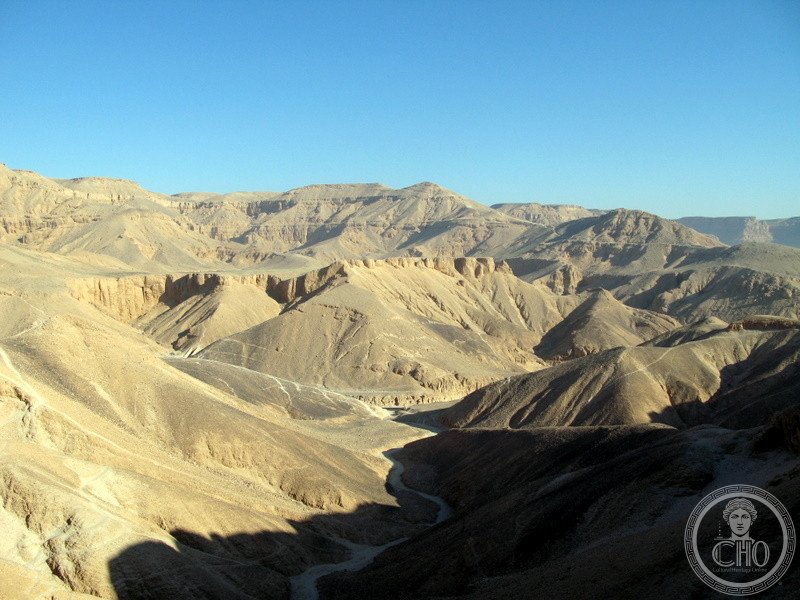
A limestone valley on the west bank of the Nile opposite ancient Thebes where, for five centuries, the pharaohs of the New Kingdom cut their tombs into the bedrock and filled them with everything they believed they would need to continue existing after death — the paintings on the walls are a theology of the afterlife so detailed and coherent that modern scholars have used them to reconstruct an entire cosmology.
At a glance
The Valley of the Kings (ancient Egyptian: Ta Bikhet or “Place of Truth”) is a limestone valley on the west bank of the Nile opposite the ancient city of Thebes (modern Luxor) in Upper Egypt. It served as the royal burial ground of the New Kingdom pharaohs from approximately 1539 to 1078 BC, encompassing the 18th, 19th, and 20th Dynasties. The valley contains 64 known tombs (numbered KV1 through KV64), of which approximately 20 are open to visitors; the tombs range from small pits to elaborate complexes with hundreds of metres of corridors and chambers, all cut into the limestone bedrock and decorated with painted scenes from the Books of the Dead and the Amduat (the Book of What is in the Underworld). The valley is part of the UNESCO World Heritage Site “Ancient Thebes with its Necropolis,” inscribed 1979.
Key facts
- Scale: 64 confirmed tombs (KV1–KV64); the largest is KV2 (Ramesses IV), with 160 metres of corridors; the deepest descent (KV9, Ramesses V/VI) is 95 metres; combined, the tombs represent millions of person-years of cutting, plastering, and painting in narrow underground galleries by artificial torchlight
- KV62 — Tomb of Tutankhamun: the only royal tomb discovered largely intact (1922, Howard Carter); the burial chamber, antechamber, treasury, and annex contained approximately 5,000 objects; the gold funerary mask of Tutankhamun is in the Egyptian Museum Cairo; the mummy of Tutankhamun remains in the burial chamber in KV62; the tomb is small compared to other royal tombs (Tutankhamun died young) but its completeness is unique in the archaeological record
- KV9 — Ramesses V/VI: the largest decorated tomb open to visitors; 160 metres of painted corridors descending to the burial chamber; the ceiling paintings (astronomical charts, divine figures) are among the most extensive in the valley; Ramesses V was buried here, then Ramesses VI usurped the tomb and sealed it; the debris of Ramesses VI’s construction concealed the entrance to Tutankhamun’s tomb KV62 until 1922
- Robbing: virtually all the tombs were robbed in antiquity, most within decades of the burial; the mummies and portable valuables were removed; the New Kingdom administration attempted to combat tomb robbery with a series of trials documented in surviving papyri (the “tomb robbery papyri”); the royal mummies were eventually collected and hidden in two caches (at Deir el-Bahari and KV35) by the priests of Amun, where they were found in 1881 and 1898
- Valley of the Queens: a second valley 2 km south-west contains the tombs of queens and princes; the most elaborate is QV66, the tomb of Nefertari (wife of Ramesses II), with the finest painting in any Egyptian tomb (reopened 2016 after restoration)
- Heritage: UNESCO World Heritage Site, Ancient Thebes with its Necropolis, inscribed 1979
- GPS: 25.7402° N, 32.6014° E
History
The decision to move the royal burial ground from the pyramid fields of the north (used by the Old and Middle Kingdom pharaohs) to a hidden limestone valley in the south was the defining architectural and religious decision of the New Kingdom (c. 1549–1069 BC). The pyramid had announced the burial too obviously; by the Middle Kingdom, every pyramid had been robbed. The new solution was concealment and depth: tombs cut into the bedrock in a remote valley, covered by a natural pyramid-shaped peak (the al-Qurn, “the Horn”), guarded by a permanent settlement of craftsmen and necropolis workers (Deir el-Medina, a community whose members kept extraordinary records of their daily lives, now among the most valuable social-historical documents from ancient Egypt).
The earliest royal burial in the valley was Thutmose I (c. 1504 BC); the last was Ramesses XI (c. 1077 BC). The 18th Dynasty pharaohs (Thutmose III, Amenhotep III, Akhenaten’s successors including Tutankhamun, Ramesses I) used the West Valley and the East Valley; the 19th and 20th Dynasties (the Ramessides) concentrated in the main East Valley and built the largest tombs. Ramesses II (KV7), the most powerful pharaoh of the 19th Dynasty, is believed to be in one of the worst-damaged tombs in the valley; flooding has destroyed most of its decoration. Ramesses III (KV11) had his tomb cut so deep into the hill that workers broke through into a neighbouring tomb and had to dog-leg the corridor — the break is still visible.
Systematic Egyptological exploration of the valley began in 1799 (Napoleon’s expedition) and continued through the 19th century; the majority of the known tombs were found by 1902. Howard Carter’s discovery of KV62 in November 1922 was the last major discovery in the valley until 2005, when KV63 (a cache of embalming materials, not a royal tomb) was found; KV64 (a shaft tomb of the 18th Dynasty) was found in 2011. Current work by several international missions continues to map unexplored portions of the bedrock.
What you see
The valley is entered by a shuttle bus from the main ticket area (a short walk or minibus from the west bank ferry landing). A standard ticket admits to three tombs from the main selection; additional tickets are required for KV62 (Tutankhamun), KV17 (Seti I — the largest and most decorated, recently reopened), and KV55 (a chamber with objects from the Amarna period). The recommended visits for a first-time visitor are KV9 (Ramesses V/VI, the most extensive decoration accessible), KV11 (Ramesses III, the longest corridors), and KV35 (Amenhotep II, where the royal mummy cache was found in 1898, with some mummies still in place).
The paintings: the dominant theme throughout the valley is the journey of the royal soul through the underworld (Duat) from death to resurrection. The twelve hours of the night are depicted hour by hour in the Amduat; the sun god Ra-Horakhty travels his solar barque through the underworld, confronting obstacles and enemies (including the serpent Apophis, who threatens to swallow the sun at the fifth hour); the pharaoh’s soul is assimilated with Ra and participates in the nightly drama of death and resurrection. The colours — intense ultramarine, yellow ochre, red, white, and black on a cream gesso ground — remain vivid in the deeper chambers where humidity and visitors have not degraded them.
Practical information
- Standard ticket: EGP 360 (foreigners); admits to 3 of the main tombs; choose based on current conditions as some tombs close periodically for conservation
- Tutankhamun ticket: additional EGP 300; the mummy is in the burial chamber; the four golden shrines that enclosed the sarcophagus are in the Egyptian Museum Cairo; the tomb is small but unique
- Getting there: cross the Nile from Luxor by local ferry (5 minutes, EGP 5) to the west bank; taxi or shuttle to the valley (10–15 minutes); the valley is 5 km from the west bank ferry landing
- Time needed: plan 3 hours minimum; 5–6 hours for a thorough visit including Deir el-Bahari (Hatshepsut’s Temple) and the Colossi of Memnon on the return
- Photography: permitted (no flash) in most tombs but banned in KV62 (Tutankhamun) and some newly restored chambers
Getting there
Luxor International Airport (LXR) has direct flights from Cairo (1 hour), Hurghada (30 minutes), and European charters (London, Frankfurt, Milan). The west bank ferry from Luxor crosses in 5 minutes; the valley is 5 km from the ferry landing. GPS: 25.7402, 32.6014.
Nearby
- Deir el-Bahari — Temple of Hatshepsut — the mortuary temple of the female pharaoh Hatshepsut (c. 1479–1458 BC), built against the cliffs of the west bank; three colonnaded terraces rise to the cliff face; the reliefs showing the expedition to Punt (the first known documentary record of an overseas trading expedition) are the most historically significant; 15 minutes from the valley by taxi
- Medinet Habu — the mortuary temple of Ramesses III, the best-preserved on the west bank; the great pylon has the most extensive battle reliefs in Egypt (the Sea Peoples invasion); the painted hypostyle hall is intact; 25 minutes south of the valley
- Karnak Temple Complex — on the east bank of Luxor; the largest ancient religious complex in the world (33 hectares); the Temple of Amun-Ra accumulated additions from 20 dynasties (c. 2055 BC–AD 396); the Great Hypostyle Hall (134 columns, 23 metres tall) is the largest room in any religious building ever built; 30 minutes from the valley
Sources
- Wikipedia, Valley of the Kings, accessed June 2026
- UNESCO, Ancient Thebes with its Necropolis, WHS reference 87, inscribed 1979
- Erik Hornung, The Valley of the Kings: Horizon of Eternity, Timken Publishers, 1990
- Nicholas Reeves and Richard Wilkinson, The Complete Valley of the Kings, Thames and Hudson, 1996 — the standard reference with plans and descriptions of all 64 tombs
Find it on the map
See this place and what’s around it →📷 Become a Cultural Heritage Online photographer
Share your photos of places: they stay published under your name as the author. The more they're seen, the more you get noticed — and soon a contest will reward the most appreciated photos.
Log in or sign up free to add a photo