
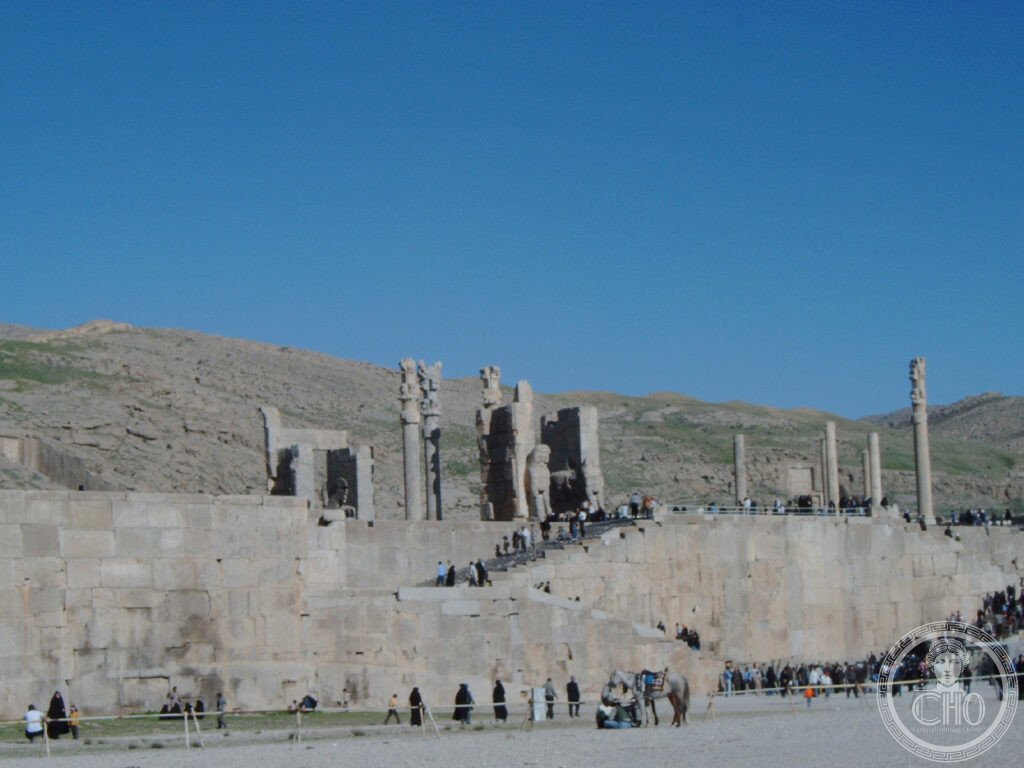
Persepolis
The ceremonial capital of the Achaemenid Empire — the largest political entity the ancient world had yet seen — where the carved staircases show the delegations of 28 nations bringing tribute to the King of Kings, each figure in the distinctive dress of their country, each face individually characterised, the whole an encyclopaedia of the ancient world executed in limestone that Alexander the Great deliberately burned in 330 BC.
At a glance
Persepolis (Greek: “City of the Persians”; Old Persian: Pārsa) is the ceremonial capital of the Achaemenid Empire, located on a natural rock terrace in the Marvdasht plain of Fars Province, 60 km north-east of Shiraz, Iran. Construction was begun by Darius I (r. 522–486 BC) around 518 BC; the main structures were completed by his son Xerxes I (r. 486–465 BC) and continued under Artaxerxes I (r. 465–424 BC). The city served as the administrative and symbolic heart of the empire — the largest empire the world had yet seen, stretching from Egypt to the Indus — and was the site of the Nowruz (Persian New Year) celebrations at which delegations from all the satrapies of the empire delivered tribute. Persepolis was burned and looted by Alexander the Great in 330 BC (the burning was either a drunken accident or a deliberate symbolic act of revenge for Xerxes’ burning of Athens in 480 BC); it was never rebuilt. The site was inscribed as a UNESCO World Heritage Site in 1979.
Key facts
- The Apadana: the great audience hall of Darius I; supported by 72 columns 20 metres tall (13 still standing); the Apadana Staircase reliefs — the most celebrated carvings of the ancient Near East — show 23 delegations of subject nations in procession, 2.5 metres wide and 20 metres long on each face; each delegation is identified by their distinctive dress, gifts, and hairstyle; the Medes and Persians are depicted in alternating panels at the front; the total composition shows approximately 1,000 carved figures
- Gate of All Nations: the monumental gateway built by Xerxes I; guarded by four human-headed bull colossi (lamassu) of which two survive; inscriptions in Old Persian, Elamite, and Babylonian declare Xerxes’ kingship over all the peoples of the earth; the gate was the formal entrance to the terrace through which all delegations passed
- The Treasury: the building where tribute and gifts brought by the delegations were stored; relief carvings on the staircase show a parallel version of the Apadana procession; a large cache of clay tablets found here (the Persepolis Fortification Tablets, now divided between Tehran and Chicago) document the administrative operations of the empire in extraordinary detail
- The Throne Hall (Hundred-Column Hall): begun by Xerxes I, completed by Artaxerxes I; larger than the Apadana (70 × 70 metres, 100 columns); the facade reliefs show the king on his throne, supported by representatives of the subject nations; believed to have served military or administrative rather than ceremonial functions
- Burning 330 BC: the fire that destroyed Persepolis was catastrophic and well-documented; the collapse of the wooden roof structures buried the relief carvings under rubble, which paradoxically preserved them; most scholars believe the burning was deliberate; Alexander is reported by Diodorus Siculus to have distributed torches to his companions and female companions in a drunken celebration
- Heritage: UNESCO World Heritage Site, inscribed 1979
- GPS: 29.9350° N, 52.8912° E
History
The Achaemenid Empire (550–330 BC) was the world’s first true superpower: at its maximum extent under Darius I and Xerxes I, it controlled territory from the Aegean coast of Anatolia to the Indus Valley, from Egypt to Central Asia — approximately 5.5 million square kilometres, governing an estimated 44% of the world’s population. The empire’s capital cities (Persepolis, Pasargadae, Susa, Ecbatana) were distributed across the empire’s core territories; Persepolis was the newest and most lavishly built of these, intended by Darius as the supreme symbol of Achaemenid power.
The Nowruz celebrations — the Persian New Year, at the spring equinox — were the primary occasion for which Persepolis was designed. Delegations from the 28 satrapies (provinces) of the empire arrived with tribute: gold, silver, horses, camels, cloth, luxury goods. The procession depicted on the Apadana Staircase is a representation of this event: the stone is both a record and a programme, showing the delegations in the order of their approach through the Gate of All Nations. The care with which each delegation is distinguished — the Scythians in their pointed caps, the Ethiopians with giraffe and antelope, the Lydians with precious metalwork, the Indians with skins and gold dust — reflects an Achaemenid ideology that emphasised the diversity of the empire’s peoples as a source of imperial strength rather than a problem to be assimilated.
Alexander’s conquest of the empire culminated in the burning of Persepolis in 330 BC. The city’s wealth (approximately 120,000 talents of silver, according to ancient sources) was looted; the wooden structures were burned; the stone reliefs were buried under the collapsed debris. The site was largely forgotten by Western scholarship until the first European travellers (Garcia de Silva Figueroa, Pietro della Valle) visited in the early 17th century; systematic excavation began under Ernst Herzfeld for the Oriental Institute of the University of Chicago in 1931–1939.
What you see
The approach to Persepolis follows the ancient processional route: the Great Staircase (110 steps, wide enough for horses to climb without bending their legs) rises to the terrace level. The Gate of All Nations directly ahead is still guarded by its lamassu; the surviving columns of the Apadana rise 20 metres to the east. The Apadana Staircase reliefs — the primary reason to visit Persepolis — are at ground level along the north and east faces of the audience hall platform; the delegations are carved at human scale (approximately 1:1.2) with extraordinary specificity of costume and gift.
The museum on the terrace (the former harem of Xerxes) displays some of the finest surviving architectural fragments; the Persepolis Museum at the bottom of the site has an excellent orientation to the site’s history. The nearby Naqsh-e Rostam cliff necropolis (5 km north) has the rock-cut royal tombs of Darius I, Xerxes I, Artaxerxes I, and Darius II, each with a cross-shaped facade and a carved scene of fire altar worship; these are essential context for Persepolis.
Practical information
- Location: 60 km north-east of Shiraz; 5 km from Marvdasht town
- Hours: daily 7 am–7 pm (summer); 7 am–5 pm (winter)
- Admission: IRR 1,500,000 (approximately USD 3.50 at unofficial rates)
- Getting there: from Shiraz, shared taxi (1.5 hours, IRR 200,000 per seat) or private taxi (IRR 1,000,000–1,500,000 round trip with waiting); no direct public bus; many tour operators in Shiraz offer half-day or full-day Persepolis + Naqsh-e Rostam + Pasargadae circuits
- Combined visit: Naqsh-e Rostam is 5 km before Persepolis on the road from Shiraz; Pasargadae (the earlier Achaemenid capital with the tomb of Cyrus the Great) is 87 km from Shiraz; a full circuit takes a full day from Shiraz
Getting there
Shiraz International Airport (SYZ) has flights from Tehran (1.5 hours), Dubai, Istanbul, and other regional hubs. From Shiraz city centre to Persepolis: 60 km north-east, 1.5 hours by shared taxi. GPS: 29.9350, 52.8912.
Nearby
- Naqsh-e Rostam — the cliff necropolis with the rock-cut tombs of four Achaemenid kings (Darius I, Xerxes I, Artaxerxes I, Darius II); Sassanid relief carvings below the tombs; 5 km north of Persepolis on the road from Shiraz; UNESCO WHS (as part of Persepolis)
- Pasargadae — the earlier Achaemenid capital founded by Cyrus the Great (r. 559–530 BC); the Tomb of Cyrus (a stepped platform supporting a gabled chamber, 11 metres tall) is one of the most moving monuments of the ancient world; 87 km from Shiraz; UNESCO WHS inscribed 2004
- Shiraz — the “city of poets, wine, and roses” (the first and third metaphorical in the Islamic period); the Shah Cheragh mosque and its mirror-mosaic interior; the Nasir-ol-Molk mosque (the “Pink Mosque,” famous for its stained-glass windows); the tombs of the poets Hafez and Sa’di; 60 km south-west of Persepolis
Sources
- Wikipedia, Persepolis, accessed June 2026
- UNESCO, Persepolis, WHS reference 114, inscribed 1979
- John Curtis and Nigel Tallis (eds.), Forgotten Empire: The World of Ancient Persia, British Museum Press, 2005 — the British Museum exhibition catalogue, comprehensive overview of Achaemenid art and archaeology
- Pierre Briant, From Cyrus to Alexander: A History of the Persian Empire, Eisenbrauns, 2002 — the definitive modern historical study of the Achaemenid Empire
Find it on the map
See this place and what’s around it →📷 Diventa un fotografo di Cultural Heritage Online
Condividi le tue foto dei luoghi: restano pubblicate con la tua firma come autore. Più vengono viste, più ti fai conoscere — e presto un concorso premierà le foto più apprezzate.
Accedi o registrati gratis per aggiungere una foto