
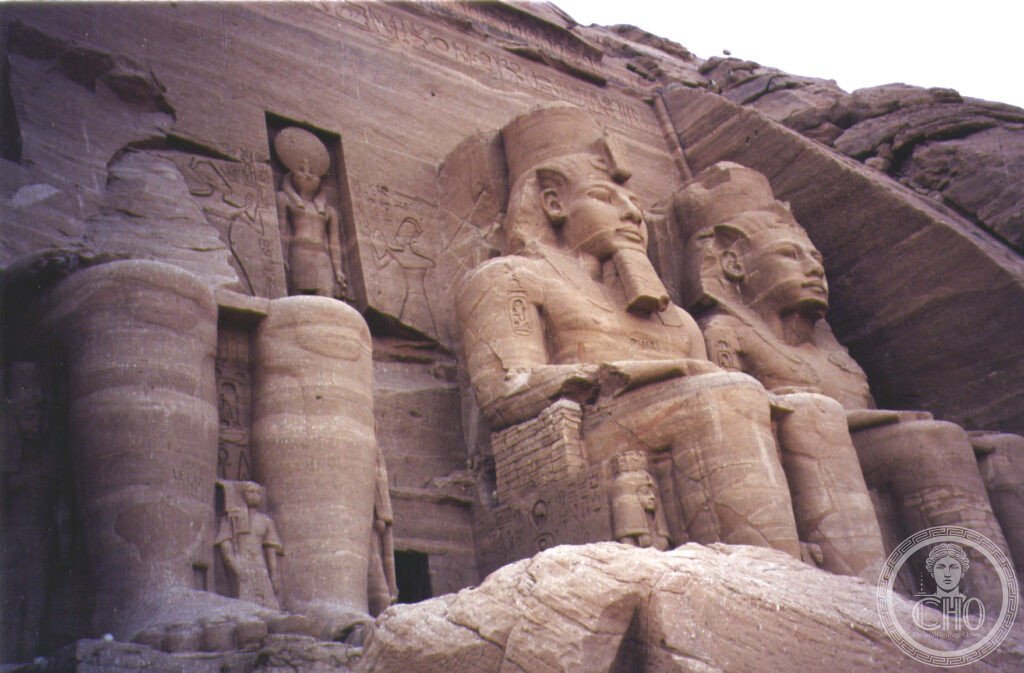
Ramesses II cut two temples into the living rock of Nubia to assert Egyptian dominion over the south — the Great Temple’s four 20-metre seated colossi of the pharaoh staring across the Nile have watched the morning sun illuminate the sanctuary for 3,270 years, except for two days a year (22 February and 22 October) when the light reaches the innermost chamber and illuminates the four seated gods.
At a glance
Abu Simbel is a complex of two rock-cut temples in the Nubia region of southern Egypt, on the west bank of the Nile (now Lake Nasser), 280 km south of Aswan near the Sudan border. The temples were built by the pharaoh Ramesses II (r. c. 1279–1213 BC) during the New Kingdom, with construction estimated between c. 1264–1244 BC. The larger (the Great Temple of Ramesses II) has a facade of four 20-metre colossal seated statues of the pharaoh; the smaller (the Temple of Hathor and Nefertari) has six 10-metre standing statues of the pharaoh and his queen Nefertari. In 1960–1968, rising waters behind the newly built Aswan High Dam threatened to submerge both temples; an international UNESCO campaign organized the extraordinary engineering feat of cutting the temples from the cliff in 1,036 blocks weighing up to 30 tonnes each, and reassembling them 64 metres higher and 200 metres back from the Nile. Abu Simbel is part of the UNESCO World Heritage Site “Nubian Monuments from Abu Simbel to Philae,” inscribed 1979.
Key facts
- Great Temple: 30 metres high, 35 metres wide facade; four seated colossi of Ramesses II each 20 metres tall; the interior 56 metres deep, cut entirely from the living sandstone cliff; eight 10-metre Osiride pillars support the first hall; painted reliefs throughout cover the walls with accounts of the Battle of Kadesh
- Solar alignment: the temple is oriented so that twice a year (22 February and 22 October — believed to coincide with Ramesses’s birthday and coronation day), the rising sun illuminates the innermost sanctuary and its four seated statues; the temple was designed so that the figure of Ptah (god of the underworld) on the far left remains in permanent shadow; after the relocation, the dates shifted by one day
- Temple of Hathor: the smaller temple dedicated to the goddess Hathor and Queen Nefertari; the six 10-metre statues alternate three Ramesses with three Nefertari; uniquely, the queen’s statues are the same height as the king’s — an unprecedented honour in Egyptian royal iconography
- Relocation 1964–1968: one of the great engineering achievements of the 20th century; 54 countries contributed; the temples were cut into 1,036 blocks (18–30 tonnes each) using precision saws to preserve the painted surfaces; the blocks were transported and reassembled inside an artificial mountain 200 metres from the original site; an artificial dome conceals the assembled ceiling
- Discovery: the temples were buried to the neck in sand when discovered by the Swiss explorer Johann Ludwig Burckhardt in 1813; Giovanni Belzoni cleared the entrance and first entered the interior in 1817
- Heritage: UNESCO World Heritage Site, Nubian Monuments from Abu Simbel to Philae, inscribed 1979
- GPS: 22.3372° N, 31.6258° E
History
Ramesses II was the greatest self-promoter in Egyptian history: his 67-year reign (the longest of any pharaoh) was characterised by an extraordinary program of temple building, monument erection, and image multiplication across Egypt and Nubia. Abu Simbel represents the southern boundary of this program — the last major temple before the Nubian desert — and its message was political as well as religious: the four colossi of Ramesses on the facade, visible from the Nile for kilometres, announced Egyptian sovereignty to the Nubian peoples of the south. The temples were simultaneously a royal cult site (Ramesses was worshipped as a god in his own lifetime in his Nubian temples) and a military deterrent.
The Battle of Kadesh (c. 1274 BC) — depicted in the reliefs of the first hall of the Great Temple — was the largest chariot battle in ancient history, fought between the Egyptian and Hittite empires in present-day Syria; Ramesses presented it as a personal triumph despite the inconclusive outcome. The reliefs show the pharaoh at superhuman scale dispatching the Hittites with his bow; the textual accounts on the walls describe his single-handed routing of the Hittite army. In fact, the battle ended in a diplomatic stalemate and the world’s first known peace treaty; but Egyptian propagandists recast it as victory, and Abu Simbel’s reliefs are the most complete surviving version of this narrative.
The temples were buried in sand sometime after the end of the New Kingdom and remained unknown to the outside world until 1813. Burckhardt’s discovery and Belzoni’s 1817 clearance and entry made the temples famous in Europe; drawings and early photographs circulated widely. The construction of the Aswan High Dam (completed 1970) would have submerged the temples permanently beneath Lake Nasser; the UNESCO campaign (1959–1968) raised USD 80 million from 54 countries, an unprecedented international response to a heritage threat that established the model for subsequent UNESCO World Heritage campaigns.
What you see
The facade of the Great Temple arrives suddenly from the desert: the four colossi (three intact; the upper body of the second fell in antiquity, probably from an earthquake) flanking the entrance portal, the entablature above carved with baboons in adoration of the rising sun (a solar hymn in stone), and the small figures at the base of the colossi representing the royal family and captured enemies. The colossi are carved directly from the cliff face; the scale of the faces — the distance from ear to ear is 4 metres — is legible only from close range, where the level of detail (the individual plaits of the royal nemes headdress, the royal features in serene idealization) becomes visible.
The interior: the first hypostyle hall has eight Osiride pillars (Ramesses as Osiris, 10 metres tall) and painted reliefs of the Battle of Kadesh on the north wall; the inner vestibule has painted reliefs of offerings to the gods; the innermost sanctuary has four seated figures cut from the rock — Ptah, Amun-Ra, Ramesses, and Ra-Horakhty. On the two solar alignment days, the light enters the entrance, travels the full 56 metres to the sanctuary, and illuminates Amun-Ra, Ramesses, and Ra-Horakhty while leaving Ptah (god of darkness) in shadow. The adjacent museum building explains the relocation engineering with models and photographs.
Practical information
- Location: 280 km south of Aswan; on the west bank of Lake Nasser near the Sudan border
- Hours: daily 5 am–6 pm
- Admission: EGP 540 (approximately USD 11); optional sound-and-light show at night
- Getting there: flight from Aswan (35 minutes, daily; most convenient); organized day trip from Aswan by road (3.5 hours each way, departing 3–4 am to arrive at sunrise); some tour operators run overnight cruises from Aswan to Abu Simbel on Lake Nasser
- Solar alignment days: 21–22 February and 21–22 October; the temple fills with visitors for the sunrise alignment; special entry times; book well in advance
Getting there
Abu Simbel Airport (ABS) has daily flights from Aswan (35 minutes) and Cairo (1.5 hours). From Aswan by road: 280 km (3.5 hours) along the Lake Nasser shoreline; most visitors take an organized tour leaving Aswan at 3–4 am to arrive at sunrise. GPS: 22.3372, 31.6258.
Nearby
- Aswan — the southernmost city of Egypt; the Philae Temple complex (Isis temple, relocated to Agilkia Island from its original flooded site, UNESCO WHS); the Nubian Museum; the Unfinished Obelisk (a 42-metre obelisk abandoned in the quarry when a crack appeared, still attached to the bedrock, the largest known ancient obelisk); 280 km north
- Wadi el-Seboua — two additional Ramesses II temples on the Lake Nasser shore, relocated like Abu Simbel; quieter and less visited; accessible from Abu Simbel by boat
- Amada Temple — the oldest surviving temple in Nubia (Thutmose III, c. 1450 BC); relocated and less visited; its painted reliefs are in the best condition of any temple in Nubia
Sources
- Wikipedia, Abu Simbel temples, accessed June 2026
- UNESCO, Nubian Monuments from Abu Simbel to Philae, WHS reference 88, inscribed 1979
- William MacQuitty, Abu Simbel, Putnam, 1965 — the photographic record of the temples before and during relocation
Find it on the map
See this place and what’s around it →Events here — now on & upcoming
- Abu Simbel Sun Festival — October 202622 Oct 2026See the event →
- Death of Johann Ludwig Burckhardt (1817) — Abu Simbel15 Oct 2026See the event →
- Born 24/11/1784 — Johann Ludwig Burckhardt (242th anniversary)24 Nov 2026See the event →
Historical events at this place (2)
📷 Become a Cultural Heritage Online photographer
Share your photos of places: they stay published under your name as the author. The more they're seen, the more you get noticed — and soon a contest will reward the most appreciated photos.
Log in or sign up free to add a photoIs this page about you?
This page is read by travellers and heritage enthusiasts who find it on Google. Tell us how you are connected to this place and we will take it from there.