
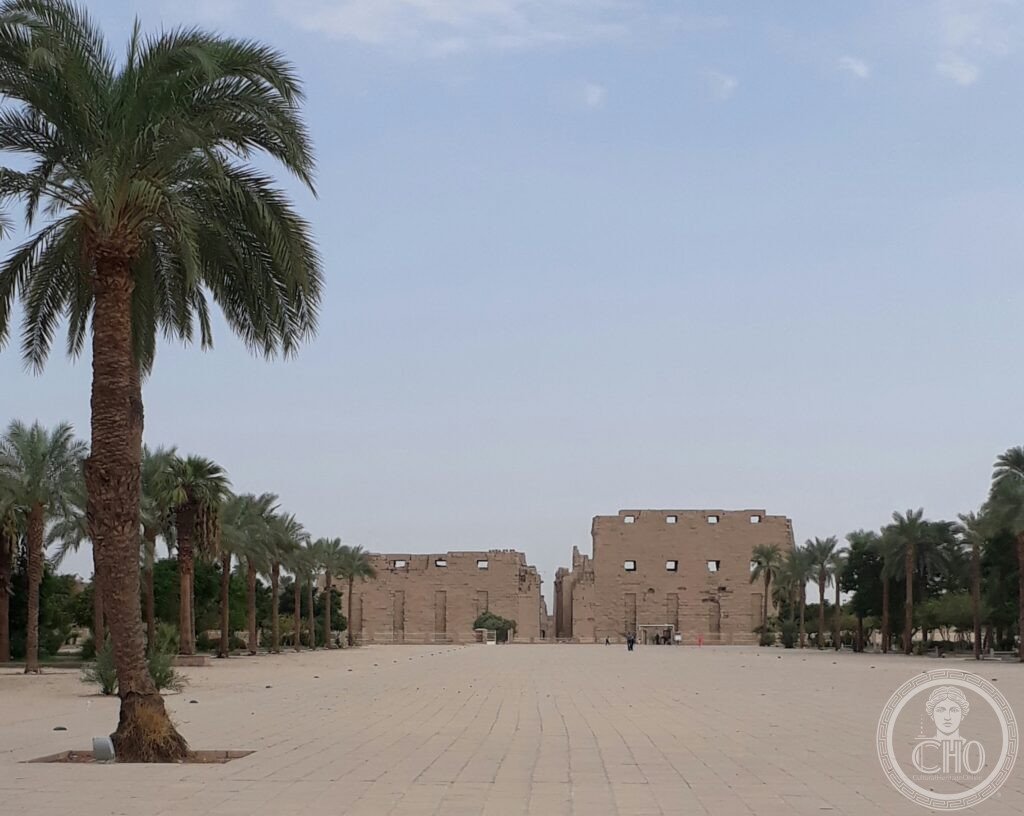
Karnak Temple — Luxor
The largest religious complex ever built — 2,000 years of successive pharaohs each adding their own temples, obelisks, and hypostyle halls to the precinct of Amun at Thebes, until the Great Hypostyle Hall alone covered 5,000 square metres with 134 columns, the tallest reaching 24 metres, every surface carved with the religious and military boasts of the pharaohs who built them.
At a glance
The Karnak Temple Complex (Arabic: الكرنك, al-Karnak) is the largest ancient religious site in the world, located on the east bank of the Nile at Luxor (ancient Thebes), the capital of Egypt during the New Kingdom (c. 1550–1070 BC). The complex was the principal temple of the state god Amun-Ra and was added to, rebuilt, and expanded by nearly every pharaoh of the New Kingdom and the Late Period, over a span of approximately 2,000 years. The core of the complex — the Precinct of Amun-Ra — covers 250 hectares and includes the Great Hypostyle Hall (the largest columned hall in the world), ten pylons (monumental gateway towers), the sacred lake, and dozens of subsidiary temples and chapels. The complex is part of the UNESCO World Heritage Site “Ancient Thebes with its Necropolis” (inscribed 1979).
Key facts
- Scale: the Precinct of Amun-Ra covers 250 hectares (the main accessible area is approximately 100 hectares); the temple complex as a whole (including the Precincts of Mut and Montu) covers 2 km²; the Great Hypostyle Hall alone is 5,406 square metres
- Great Hypostyle Hall: built primarily by Ramesses I and completed by Ramesses II (c. 1294–1213 BC); 134 columns in 16 rows; the central 2 rows (12 columns) are 24 metres tall with open papyrus-flower capitals (6.4 metres in diameter); the surrounding 122 columns are 15 metres tall with closed bud capitals; every surface is carved in relief
- Obelisks: originally the complex had 12 obelisks; 3 survive in situ (including the tallest surviving Egyptian obelisk, that of Thutmose I, 21.8 metres); Hatshepsut’s obelisk (21.7 metres) was partially concealed by Thutmose III who built a wall around it — the obelisk’s lower section and the wall survive; other Karnak obelisks are now in Paris, Rome, Istanbul, and New York (the “Cleopatra’s Needle” obelisks)
- Avenue of Sphinxes: a 3-km processional avenue lined with 1,350 human-headed sphinxes connecting Karnak to Luxor Temple; the sphinxes have ram heads (sacred to Amun) along the Karnak section; the avenue was excavated and partially restored 2011–2021
- Sacred Lake: a rectangular artificial lake (the largest of its type in Egypt, 120 × 77 metres), used for ritual purification and the daily solar barque ceremony; geese (sacred to Amun) were kept here
- Heritage: part of UNESCO World Heritage Site, Ancient Thebes with its Necropolis, inscribed 1979
- GPS: 25.7188° N, 32.6573° E
History
The earliest structure at Karnak dates from the Middle Kingdom pharaoh Senusret I (c. 1971–1926 BC); a small alabaster chapel he built survives, reassembled in the Open Air Museum at Karnak. The great expansion of the complex began in the New Kingdom under Thutmose I (c. 1504–1492 BC) and Thutmose III (c. 1479–1425 BC), who built the earliest surviving pylons and a festival hall that is the finest example of the Thutmoside architectural style. Hatshepsut, the female pharaoh (r. c. 1473–1458 BC), added two obelisks and a Red Chapel (her barque sanctuary, now partially reconstructed in the Open Air Museum).
The most prolific builder at Karnak was Ramesses II (r. c. 1279–1213 BC), who added the Great Hypostyle Hall to the work begun by his father Seti I and covered every available surface with reliefs celebrating his military campaigns (including the Battle of Kadesh against the Hittites, which Ramesses presented as a personal victory although the battle was essentially a draw). The theological and political importance of Karnak is inseparable from the role of Amun and his priesthood in Egyptian state religion: the high priest of Amun at Karnak was, by the end of the New Kingdom, one of the most powerful figures in Egypt, able to challenge royal authority — a tension that the Amarna heresy of Akhenaten (who closed the Karnak temples and removed all references to Amun from Egyptian monuments) was in part a response to.
The complex continued to be used and added to through the Late Period, the Persian occupation, and the Ptolemaic period; the last known dated inscription from an Egyptian hieroglyphic temple is from 394 AD, from the Khnum Temple at Philae (which is part of the same Nile religious landscape). The temple fell out of use after the Edict of Thessalonica (380 AD), which made Christianity the state religion of the Roman Empire; the Hypostyle Hall was used briefly as a Coptic church. Systematic excavation and study began with the Institut Français d’Archéologie Orientale (IFAO) in the early 20th century; work continues today.
What you see
The main processional axis runs east-west, beginning at the First Pylon (the largest, though unfinished) and passing through a sequence of pylons and courts toward the sanctuary at the heart of the complex. The First Pylon gives access to the Great Court, flanked by subsidiary chapels; beyond it, the Second Pylon leads to the Great Hypostyle Hall. The Hall is the most overwhelming architectural space in Egypt: the scale of the columns (the tallest at 24 metres with a capital large enough to hold 100 standing people), the density of the forest of stone, and the completeness of the carved reliefs covering every surface create an experience of extraordinary intensity. In the early morning, before the tour groups arrive, the quality of light and the silence of the space are among the finest in the ancient world.
Beyond the Hypostyle Hall: the remains of Hatshepsut’s obelisk (still 21.7 metres, the lower section surrounded by the wall Thutmose III built to conceal it), the Festival Hall of Thutmose III (a unique Thutmoside architectural form with tent-pole columns), and the Sacred Lake. The Open Air Museum (a separate ticket, north of the First Pylon) contains the most important dismantled structures: Hatshepsut’s Red Chapel, Senusret I’s White Chapel, and the Alabaster Chapel of Amenhotep I.
Practical information
- Address: Karnak, Luxor, Egypt; on the east bank of the Nile, 3 km north of Luxor Temple
- Hours: daily 6 am–5 pm (October–April); 6 am–7 pm (May–September)
- Admission: EGP 540 (approximately USD 11); Open Air Museum EGP 125 additional
- Sound and Light Show: nightly; approximately 1 hour; walks visitors through the complex with narration and coloured lighting; available in multiple languages; atmospheric but optional
- Best time: arrive at opening (6 am) before the tour groups; the early morning light in the Hypostyle Hall is extraordinary and the space relatively quiet for 1–1.5 hours
Getting there
Luxor International Airport (LXR) has direct flights from Cairo (1 hour) and European charter flights. Luxor is 670 km south of Cairo; overnight sleeper trains are comfortable and reasonably priced. From central Luxor to Karnak: 3 km north on the east bank; taxi (10 minutes, EGP 20) or calèche (horse-drawn carriage); the Avenue of Sphinxes walkway connects Luxor Temple to Karnak (3 km) and is usable during opening hours. GPS: 25.7188, 32.6573.
Nearby
- Luxor Temple — the second great New Kingdom temple complex on the east bank, 3 km south of Karnak; built primarily by Amenhotep III and Ramesses II; the Abu Haggag Mosque built on top of the buried temple is still active; Alexander the Great added a sanctuary at the inner core; connected to Karnak by the Avenue of Sphinxes
- Valley of the Kings — the west bank royal necropolis where 64 tombs of New Kingdom pharaohs have been found; Tutankhamun’s tomb (KV62) is the most famous, its treasure now in the Grand Egyptian Museum in Cairo; accessible by ferry across the Nile
- Hatshepsut’s Mortuary Temple (Deir el-Bahari) — three terraced colonnades built into the cliffs of the west bank; the female pharaoh’s architectural masterpiece; the painted reliefs of the Punt expedition are the finest surviving from the New Kingdom
- Colossi of Memnon — two 18-metre seated statues of Amenhotep III that once guarded his (now largely destroyed) mortuary temple; on the west bank plain; they famously “sang” at dawn (a crack caused by an earthquake emitted sound as the temperature rose)
Sources
- Wikipedia, Karnak, accessed June 2026
- UNESCO, Ancient Thebes with its Necropolis, WHS reference 87, inscribed 1979
- Richard H. Wilkinson, The Complete Temples of Ancient Egypt, Thames & Hudson, 2000 — the standard reference on Egyptian temple architecture
- Centre Franco-Égyptien d’Étude des Temples de Karnak: cfeetk.cnrs.fr — ongoing excavation and research
Find it on the map
See this place and what’s around it →📷 Diventa un fotografo di Cultural Heritage Online
Condividi le tue foto dei luoghi: restano pubblicate con la tua firma come autore. Più vengono viste, più ti fai conoscere — e presto un concorso premierà le foto più apprezzate.
Accedi o registrati gratis per aggiungere una foto