
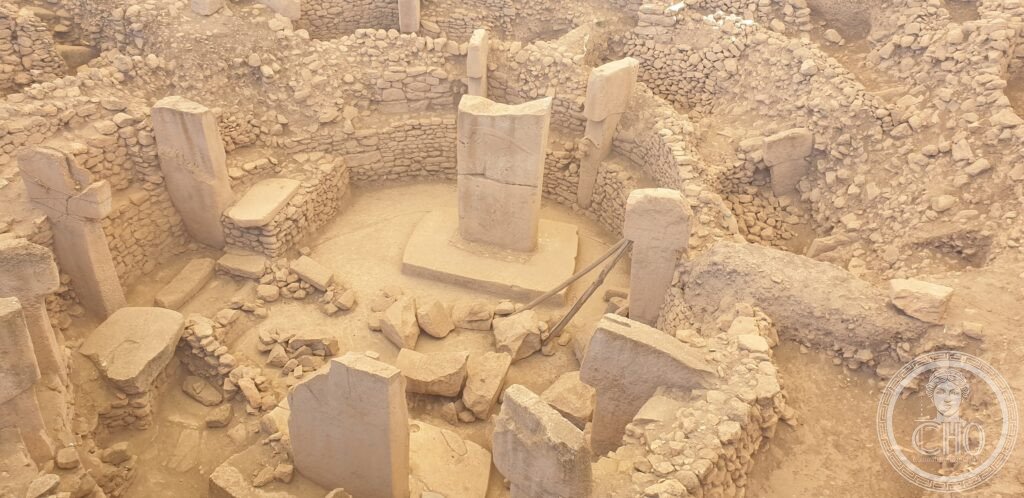
Göbekli Tepe
The site that rewrote the history of civilisation — circular enclosures of T-shaped limestone pillars 5 metres tall, carved with animals in high relief, built on a hilltop in south-eastern Turkey 11,600 years ago by hunter-gatherers who, by every conventional model of prehistory, should not yet have had either the social organisation or the motivation to build anything at all.
At a glance
Göbekli Tepe (Turkish: “Potbelly Hill”) is a Neolithic archaeological site in the Şanlıurfa Province of south-eastern Turkey, 15 km north-east of Şanlıurfa. Its excavation since 1994 by the German archaeologist Klaus Schmidt (1953–2014) has fundamentally altered the scholarly understanding of the origins of civilisation and religion. The site contains at least 20 circular or oval enclosures, each with multiple T-shaped limestone pillars (the tallest 5.5 metres and 16 tonnes) arranged in pairs and rings; the pillars are carved with reliefs of animals (foxes, boar, birds, snakes, aurochs, gazelle) in styles suggesting sophisticated symbolic programmes. The enclosures were built and used during the Pre-Pottery Neolithic A period (c. 9600–8200 BC) — before agriculture, before permanent settlements, before any conventional criterion of “civilisation” — and then deliberately buried, possibly when new enclosures were constructed. Göbekli Tepe was inscribed as a UNESCO World Heritage Site in 2018.
Key facts
- Age: the oldest enclosures (Layer III) date to c. 9600–8800 BC — approximately 11,600 years old; 7,000 years older than Stonehenge; 6,500 years older than the Egyptian pyramids; the site predates the earliest evidence of agriculture in the region by approximately 500 years
- Scale: at least 20 enclosures have been identified by geophysical survey; only 4 (Enclosures A, B, C, D — the oldest) have been fully excavated; these contain T-shaped pillars up to 5.5 metres tall weighing up to 16 tonnes; the remaining 16 enclosures are unexcavated
- T-pillars: the characteristic form — a rectangular shaft topped by a T-shaped crosspiece — is believed to represent stylised human figures; some pillars have carved hands, arms, and a belt with a loincloth, suggesting that the T-shape represents a head and body; the animal reliefs on the shafts may represent clan symbols or mythological narratives
- No evidence of habitation: there are no hearths, no storage facilities, no evidence of permanent occupation at the site; this strongly suggests it was a gathering place for religious or ceremonial purposes, not a residential settlement — the people who built it lived elsewhere and came to Göbekli Tepe for specific events
- Deliberate burial: when each enclosure was no longer in use, it was deliberately filled with stone, animal bones, and soil; this intentional burial preserved the enclosures but also raises questions about what events or beliefs prompted the burial
- Heritage: UNESCO World Heritage Site, inscribed 2018
- GPS: 37.2231° N, 38.9225° E
History
Göbekli Tepe was known to archaeologists as a hilltop with flint tools from at least the 1960s; a 1963 survey noted it but classified it as a medieval cemetery (the T-shaped stones were thought to be gravestones). Klaus Schmidt, reviewing the survey records, recognized that the scale of the stones was inconsistent with gravestones and organized excavations beginning in 1994. Within the first season, Schmidt had found the T-shaped pillars and recognised that the site dated from the Pre-Pottery Neolithic. Schmidt excavated the site continuously until his death in 2014; excavations are now directed by the German Archaeological Institute and the Turkish General Directorate of Cultural Heritage and Museums.
The implications of Göbekli Tepe for our understanding of human prehistory are still being debated. The conventional model of the development of civilisation — hunter-gatherers → agriculture → permanent settlements → social complexity → monumental architecture and religion — cannot accommodate a site where hunter-gatherers built monumental religious architecture before any of the other steps. The “cathedral hypothesis” proposed by Schmidt suggests that the construction of sites like Göbekli Tepe was itself the driver of the Neolithic transition: building a monument requires sustained collaborative effort, which requires a surplus of food and labour, which may have been the motivation for beginning to manage plant and animal resources (i.e., to develop agriculture). This reversal of the conventional causation — religion before agriculture rather than after — is one of the most significant hypotheses in contemporary archaeology.
The site continues to yield new enclosures as geophysical survey expands. In 2017, a new enclosure (the “Grand Enclosure”) was identified that appears to be larger than any previously known; its excavation is in the early stages. The scale of the unexcavated portions — approximately 90% of the site — means that Göbekli Tepe will be the subject of active excavation for generations.
What you see
The excavated enclosures (A, B, C, D) are now covered by a large protective roof structure. The approach from the visitor centre along the ridge gives the first view of the hilltop and the scale of the excavation trenches. Within the enclosures, the T-shaped pillars stand at their original height; the two central pillars of Enclosure D (the most elaborate, sometimes called “the guardian” pillars) are 5.5 metres and have carved on them: arms and hands reaching around the lower shaft, a belt and loincloth at the waist, a fox skin hanging from the belt, and a series of pictograms whose meaning is debated. The animal reliefs on the surrounding pillars — foxes, boar, birds in flight, a headless human figure — create a visual environment unlike anything in later human art: the product of a mind radically different from any subsequent art tradition, yet clearly engaged in the same impulse to represent the world in carved stone.
The adjacent Şanlıurfa Archaeological Museum has the most complete display of objects from Göbekli Tepe, including the life-size limestone statue of a man (the “Urfa Man,” c. 10,000 BC) found nearby — arguably the oldest known life-size human sculpture. The “Urfa Man” has obsidian eyes and hands clasped over his genitals; his facial expression and posture are impossible to read across 12,000 years of cultural distance but suggest an intense engagement with the fact of individual human presence.
Practical information
- Location: 15 km north-east of Şanlıurfa (also spelled Urfa); the site is well-signposted from the city
- Hours: daily 8 am–7 pm (summer); 8 am–5 pm (winter)
- Admission: TRY 400 (approximately EUR 12)
- Getting there: from Şanlıurfa city centre, 20 minutes by taxi (TRY 100); some tour operators run half-day trips; the site is not served by public bus
- Museum: the Şanlıurfa Archaeological Museum (15 minutes in the city) is essential context; the Urfa Man and many Göbekli Tepe finds are displayed there; allow 2 hours
Getting there
Şanlıurfa GAP Airport (GNY) has direct flights from Istanbul and Ankara (1.5 hours). From the airport to the city centre: 35 km (30 minutes by taxi). From Şanlıurfa to Göbekli Tepe: 15 km, 20 minutes by taxi. GPS: 37.2231, 38.9225.
Nearby
- Şanlıurfa Old City — the birthplace of Abraham (Ur of the Chaldees, in local tradition); the sacred Pool of Abraham (Balıklıgöl, Carp Lake) filled with fish that are sacred by tradition; the Great Mosque; the Bazaar quarter with 19th-century hans (caravanserais) still in use as workshops
- Harran — the ancient city 44 km south of Şanlıurfa, mentioned in the Bible as Abraham’s stopping point before Canaan; the distinctive beehive-shaped mud-brick houses still inhabited; the ruins of one of the oldest universities in the Islamic world; 45 minutes south
- Nemrut Dağı — the summit of King Antiochus I Commagene (69 BC), with colossal stone heads of gods (Greek, Persian, and local) arranged around the burial mound; UNESCO WHS; 2.5 hours north-west of Şanlıurfa
- Çatalhöyük — the Neolithic town (c. 7500–5700 BC) in central Turkey where the earliest evidence of permanent urban settlement in the world has been found; slightly later than Göbekli Tepe but showing the next stage of the Neolithic transition; UNESCO WHS
Sources
- Wikipedia, Göbekli Tepe, accessed June 2026
- UNESCO, Göbekli Tepe, WHS reference 1572, inscribed 2018
- Klaus Schmidt, Sie bauten die ersten Tempel: Das rätselhafte Heiligtum der Steinzeitjäger (They Built the First Temples: The Mysterious Sanctuary of the Stone Age Hunters), C.H. Beck, 2006
- Oliver Dietrich et al., “The role of cult and feasting in the emergence of Neolithic communities,” Antiquity, 2012
Find it on the map
See this place and what’s around it →📷 Diventa un fotografo di Cultural Heritage Online
Condividi le tue foto dei luoghi: restano pubblicate con la tua firma come autore. Più vengono viste, più ti fai conoscere — e presto un concorso premierà le foto più apprezzate.
Accedi o registrati gratis per aggiungere una foto