
Bagan — Myanmar
The largest and densest concentration of Buddhist temples in the world — 3,500 temples, pagodas, and monasteries built over four centuries on a flat plain in central Myanmar, the remains of an empire whose kings competed with each other in piety and in construction until the city contained more religious buildings than any other in the Buddhist world.
At a glance
Bagan (also written Pagan) is an ancient city in the Mandalay Region of central Myanmar, on the east bank of the Irrawaddy River. It was the capital of the Pagan Kingdom (849–1297 AD), which unified most of present-day Myanmar under a single Theravada Buddhist state. Between the 9th and 13th centuries, the kings of Pagan and their subjects built an extraordinary concentration of religious structures on the Bagan plain: approximately 3,500 temples, pagodas, monasteries, and ordination halls survive (from an estimated original total of 10,000), covering an area of approximately 67 km². The Pagan Kingdom ended in 1287 when Mongol forces under Kublai Khan sacked the capital; the population dispersed and the temples were never substantially reoccupied. Bagan was inscribed as a UNESCO World Heritage Site in 2019.
Key facts
- Scale: approximately 3,500 surviving structures across 67 km²; from an estimated 10,000 original structures (documented in a 1225 Pagan inscription); the current survivors are those built in brick or stone; wooden structures have disappeared
- Key temples: Ananda Pahto (c. 1105, the finest Mon-style temple, with four standing gilded Buddhas 9.5 metres tall, one for each of the four Buddhas of the current world cycle); Dhammayangyi Pahto (the largest temple, begun c. 1167 by Narathu — who murdered his father and brother to take the throne and built the temple as an act of expiation; the inner passages were bricked up before completion, possibly when Narathu was assassinated); Shwezigon Pagoda (1059–1090, the model for all subsequent Burmese pagodas, its gold-gilded bell-shaped stupa the form that defines Burmese Buddhist architecture)
- Sunrise balloon flights: Bagan is one of the premier hot-air ballooning destinations in Asia; the view of 3,500 temples emerging from the morning mist over the Irrawaddy plain is considered one of the great travel experiences in South-East Asia; flights run October–March only (dry season)
- Lacquerware: Bagan is the centre of Burmese lacquerware production; the traditional craftsmen on the east side of the Dhammayangyi Temple demonstrate the 7–10 layer process; the Bagan Lacquerware Museum documents the tradition
- 1975 earthquake and 2016 earthquake: both events damaged many temples; the 1975 restoration (UNESCO-assisted) was controversial for its concrete-heavy approach; the 2016 earthquake (6.8 magnitude) damaged 389 structures; restoration ongoing
- Heritage: UNESCO World Heritage Site, Bagan, inscribed 2019
- GPS: 21.1717° N, 94.8586° E
History
The Pagan Kingdom was established by King Anawrahta (r. 1044–1077), who unified the fragmented polities of Burma under a single state and converted to Theravada Buddhism in 1056 after meeting the Mon monk Shin Arahan; the king subsequently invaded the Mon kingdom of Thaton and brought back 30 elephants loaded with Pali scriptures and the Mon monks who could read them. This moment — the import of Theravada orthodoxy from the Mon kingdom — was the founding event of the Bagan religious tradition; the subsequent 250 years of temple construction were driven by the desire of kings and nobles to accumulate merit through religious building on a scale unprecedented in mainland South-East Asia.
The building program was not merely religious but economic: the temples accumulated land, slaves, and agricultural production in their endowments; by the late Pagan period, approximately one-third of the arable land and population of the kingdom was under temple control, and the king could no longer tax it. This “merit economy” — where the transfer of resources to religious institutions generated supernatural merit for the donor but removed wealth from the state — has been proposed by the historian Michael Aung-Thwin as a contributing factor to the Pagan Kingdom’s inability to resist the Mongol threat. The Mongols sacked Bagan in 1287; subsequent Burmese kingdoms used the site for building materials but preserved the larger temples.
Bagan became part of British Burma in 1886 and was declared an archaeological zone; systematic excavation began under the Archaeological Survey of Burma in the early 20th century. The military government’s controversial 1990s restoration programme — which rebuilt deteriorated structures with cement, capped towers with new gilded umbrellas (htis), and built access roads through the archaeological zone — was widely criticised by archaeologists and contributed to UNESCO’s long delay in inscribing the site. The 2016 earthquake, which damaged nearly 400 structures, forced more careful restoration approaches; the 2019 UNESCO inscription followed.
What you see
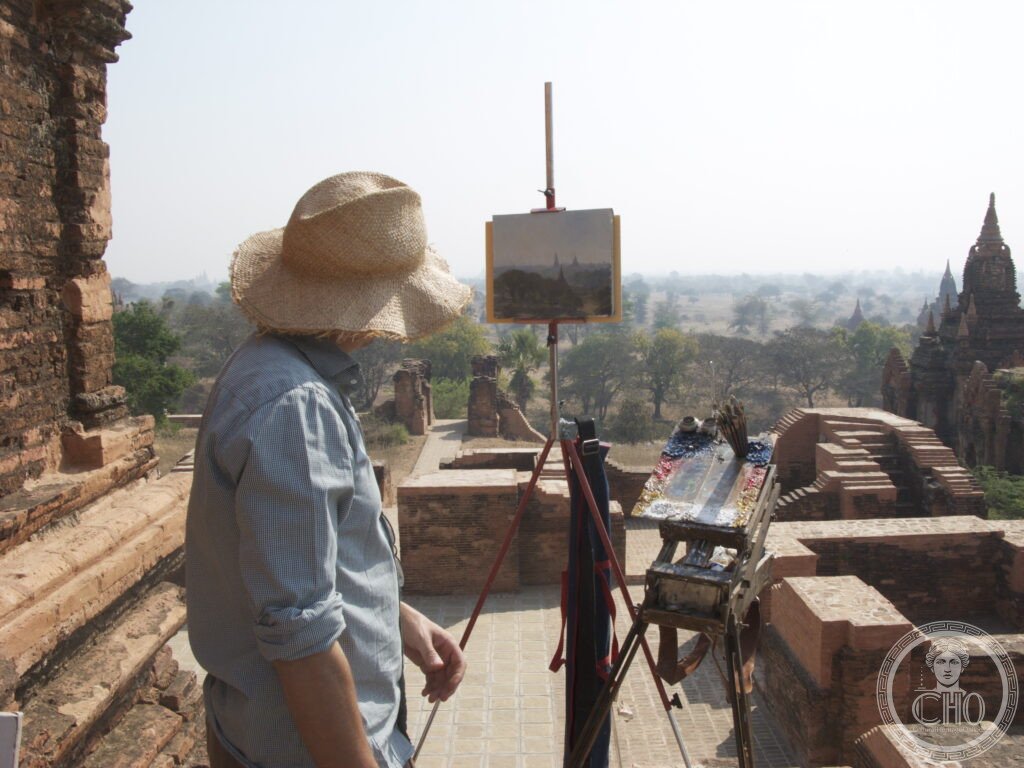
Bagan is best understood as a landscape of religious architecture rather than a single monument: the experience is of moving through an environment where temples appear in every direction, some restored and gilded, many in various states of picturesque ruin, the red-brick forms and white-painted stupas creating an irregular skyline across the flat plain. The Shwesandaw Pagoda, the Pyathada Pagoda, and the Buledi Pagoda are the preferred sunset viewpoints; the view from the upper terraces of these temples, looking out over the plain with temples in every direction and the Irrawaddy glittering in the distance, is among the most extraordinary in South-East Asia.
The Ananda Pahto is the most complete temple interior in Bagan: a double ambulatory around a solid core, each of the four cardinal directions opening to a 9.5-metre standing gilded Buddha in a different posture, the wall niches behind filled with terracotta tile reliefs of the Jataka tales (the previous lives of the Buddha), in a continuous narrative programme of approximately 1,500 scenes. The Dhammayangyi, the largest, is the most atmospherically unusual: the inner passages are bricked shut (no one has ever explained convincingly why), the exterior bulk is unreleased by windows or decoration, and the air inside has the density and weight of a sealed space that has not been fully opened for 850 years.
Practical information
- Permits: archaeological zone entry USD 25 (3-day pass, sold at arrival points)
- Transport: e-bikes (electric bicycles) are the ideal way to cover the zone; USD 5–10/day from any Nyaung-U guesthouse; the distances between temples are significant and walking in the heat is impractical; horse carts and taxis also available
- Balloon flights: Balloons Over Bagan and Oriental Ballooning are the main operators; USD 300–350 per person; book months in advance for December–February; run only in the dry season (October–March)
- Best time: November–February (cool and dry; optimum light for photography); avoid April–May (extreme heat, up to 42°C)
- Political context: Myanmar has been under military rule since the 2021 coup; international travel advisories vary; check current government guidance before booking