
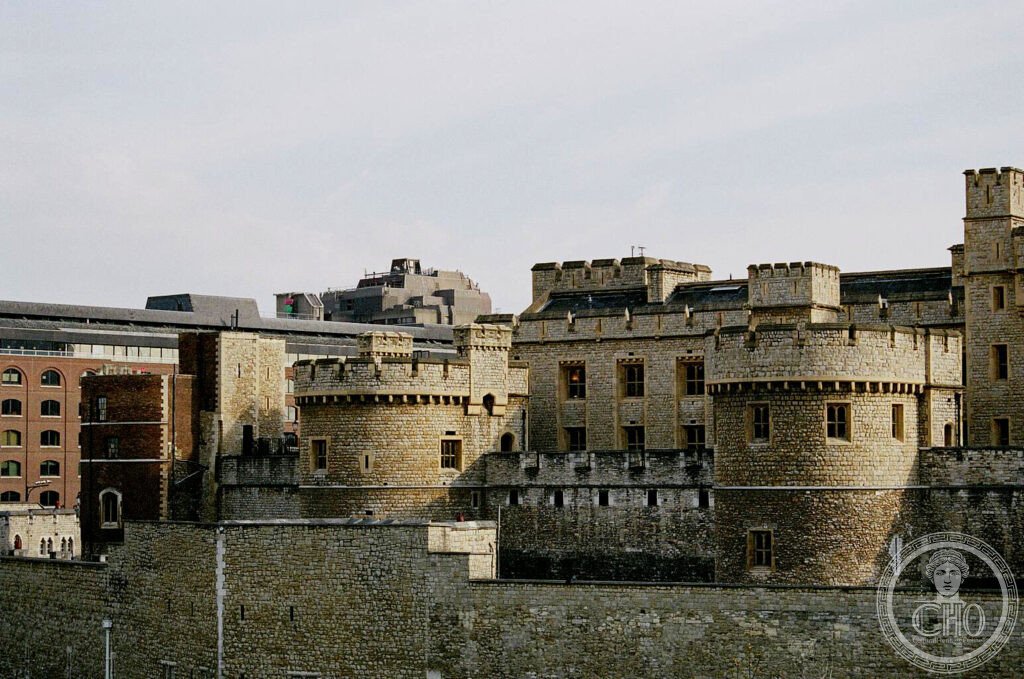
Tower of London
William the Conqueror began building the White Tower in 1078 as a statement of Norman power over the English capital — the first of 11 English monarchs who would use the complex as palace, prison, arsenal, mint, and menagerie, and whose prisoners carved their names into the walls of the Beauchamp Tower, where Anne Boleyn spent her last days before execution on Tower Green in 1536.
At a glance
The Tower of London (Her Majesty’s Royal Palace and Fortress of the Tower of London) is a historic castle on the north bank of the Thames in the London Borough of Tower Hamlets. Its core — the White Tower, begun by William the Conqueror in 1078 — was the first major Norman stone fortification in England; subsequent additions by Richard I, Henry III, and Edward I created the concentric ring of walls and towers that defines the complex today. Over its 950-year history, the Tower has served as royal palace (William I–Henry VIII), state prison (Roger Mortimer to Rudolf Hess), place of execution (seven persons on Tower Green, including two of Henry VIII’s wives), royal mint (from Henry II to 1810), royal armoury (the Royal Armouries collection is now partly at Leeds), royal menagerie (Royal Menagerie 1204–1835, including lions, a polar bear, and an African elephant), and home of the Crown Jewels (from 1669). It is a UNESCO World Heritage Site (1988) and one of the most visited paid attractions in the United Kingdom (approximately 3 million visitors annually).
Key facts
- White Tower: the original Norman keep, begun 1078 under William the Conqueror; 36 metres tall; walls 4–5 metres thick; contains the Chapel of St John the Evangelist (c. 1080, the finest surviving Norman ecclesiastical interior in England) and the Royal Armouries’ Line of Kings display (17th-century royal mounted equestrian figures)
- Crown Jewels: displayed in the Waterloo Barracks; include St Edward’s Crown (the coronation crown, 1661, made for Charles II after the original was melted down by Cromwell), the Imperial State Crown (worn at the State Opening of Parliament), and the Sovereign’s Sceptre with Cross (set with the Cullinan I diamond, 530.2 carats, the largest clear-cut diamond in the world)
- Famous prisoners: Thomas More (1534–35), Anne Boleyn (1536), Catherine Howard (1541–42), Princess Elizabeth (later Elizabeth I, 1554), Walter Raleigh (1603–1616), Guy Fawkes (1605), Rudolf Hess (1941, the last prisoner in the Tower)
- Yeoman Warders (Beefeaters): the ceremonial guardians of the Tower, numbering 37; they conduct public tours; they must be retired senior NCOs or warrant officers from the British armed forces; six ravens are also kept at the Tower, whose continued presence is required by legend to preserve the Crown and the Tower
- Traitors’ Gate: the water gate on the Thames through which prisoners were brought into the Tower; now dry
- Heritage: UNESCO World Heritage Site, Tower of London, inscribed 1988
- GPS: 51.5081° N, 0.0759° W
History
William the Conqueror began the White Tower immediately after his coronation in December 1066, using Caen limestone imported from Normandy and Kentish ragstone; the building was designed by the Norman monk Gundulf of Rochester. Its purpose was dual: to demonstrate Norman dominance over the conquered English population and to provide a defensible residence for the new royal court. The tower was the most impressive stone building in England when completed; its effect on the population of London, who had no equivalent construction in their experience, was calculated and deliberate.
The medieval history of the Tower is the political history of England: it was here that Henry VI was murdered in 1471 during the Wars of the Roses; here that the young Edward V and his brother Richard, Duke of York (“the Princes in the Tower”) disappeared in 1483 (almost certainly murdered by Richard III or on his order); here that Henry VIII sent his first wife’s advisor Cardinal Wolsey, and subsequently Thomas More, for refusing to accept his authority over the Church. The Tower’s role as a state prison ended effectively in the 17th century, though it was used for high-profile prisoners in both World Wars (Roger Casement was held there in 1916; eleven German spies were executed there in the Second World War; Rudolf Hess was held briefly in 1941 after his bizarre solo flight to Scotland).
The Constable of the Tower (the Tower’s governor) is an appointment held since the Norman period; today it is a largely ceremonial post held by a distinguished military officer. The Ceremony of the Keys — the locking of the outer gates by the Chief Yeoman Warder every night at exactly 9:53 pm — has been performed every night for at least 700 years without interruption (including during the Blitz; one night in 1940, a bomb blast threw the ceremony party to the ground, delaying the ceremony; the Chief Warder wrote to the King to apologise for the unavoidable late locking, and received a handwritten reply).
What you see
The Tower complex covers 4.8 hectares and is best understood as three concentric rings: the outer ward (a broad moat, now dry, with a grass-covered ditch visible from the perimeter); the outer ward (the curtain wall with towers and gates, including the Bloody Tower and Traitors’ Gate); and the inner ward (the White Tower in the centre, surrounded by the Beauchamp Tower, the Wakefield Tower, and the residential towers). The entrance is through the Middle Tower on the south-west, across the dry moat, through the Byward Tower, past the Traitors’ Gate (the water entrance, now dry), and into the inner ward.
The Chapel of St John the Evangelist in the White Tower is the most architecturally significant space: a two-storey Norman Romanesque chapel of extraordinary austerity, its drum columns and round arches in Caen limestone unchanged since 1080, the space used by William the Conqueror as his personal chapel. The Crown Jewels display (Waterloo Barracks) moves visitors past the jewels on a conveyor belt at busy times; arrive early to walk at your own pace. The Beauchamp Tower’s interior walls carry carved inscriptions from its Tudor prisoners — some are extraordinarily skilled, particularly the carved heraldic device of the Dudley family, made by one of the brothers of Lady Jane Grey.
Practical information
- Address: Tower Hill, London EC3N 4AB
- Hours: Tuesday–Saturday 9 am–5:30 pm; Sunday–Monday 10 am–5:30 pm (last entry 5 pm); extended hours in summer
- Admission: GBP 34.80 adults (2024); GBP 17.40 children; book online (hrp.org.uk) to avoid queues; members of Historic Royal Palaces have free entry
- Yeoman Warder tours: free with admission; depart from the Byward Tower; 1 hour; entertaining and informative; the Yeoman Warders are among the best guides in London
- Ceremony of the Keys: the nightly locking ceremony is free to attend but requires advance ticket application (minimum 2 months); 25 guests per evening; check hrp.org.uk/tower-of-london/ceremony-of-the-keys
Getting there
Tower Hill Underground station (District and Circle lines) is 200 metres from the entrance. Fenchurch Street railway station is 5 minutes on foot. River boats from Westminster and Greenwich stop at Tower Millennium Pier (adjacent). GPS: 51.5081, -0.0759.
Nearby
- Tower Bridge — the Victorian bascule and suspension bridge (1894) immediately east of the Tower; the Tower Bridge Exhibition allows visitors inside the towers and onto the glass floor of the high-level walkway; the best elevated view of the Tower
- St Paul’s Cathedral — Christopher Wren’s 1708 masterpiece; 1 km west; the dome and the Whispering Gallery; the Geometric Staircase in the north transept; the crypt (Nelson, Wellington, Wren himself)
- Borough Market — the covered food market in Southwark, one of the largest and oldest in London; 500 metres across Tower Bridge; the best place to eat lunch near the Tower
- Museum of London Docklands — the history of London’s trade, the river, and the docks in a converted sugar warehouse; West India Quay; 1 km east
Sources
- Wikipedia, Tower of London, accessed June 2026
- Historic Royal Palaces: hrp.org.uk/tower-of-london
- UNESCO, Tower of London, WHS reference 488, inscribed 1988
- Anna Keay, The Elizabethan Tower of London: The Haiward and Gascoyne Plan of 1597, London Topographical Society, 2001
Find it on the map
See this place and what’s around it →📷 Diventa un fotografo di Cultural Heritage Online
Condividi le tue foto dei luoghi: restano pubblicate con la tua firma come autore. Più vengono viste, più ti fai conoscere — e presto un concorso premierà le foto più apprezzate.
Accedi o registrati gratis per aggiungere una foto