
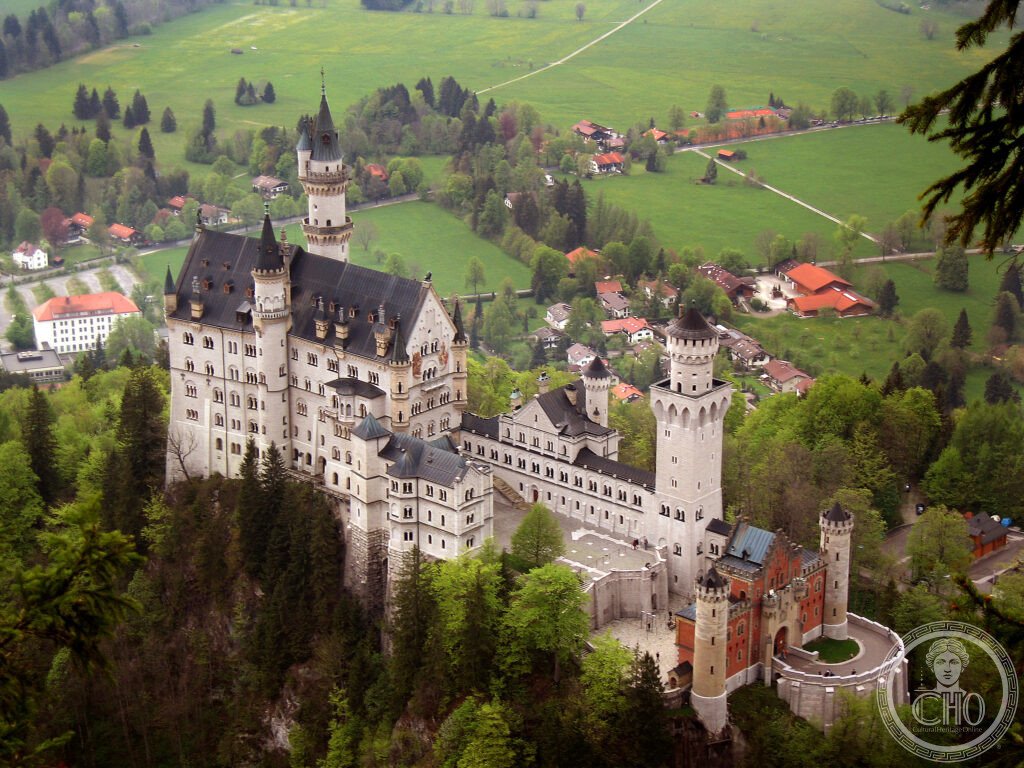
Neuschwanstein Castle — Bavaria
The “fairy-tale castle” that King Ludwig II of Bavaria built as a personal monument to Richard Wagner and medieval German legend — never intended to be a seat of government or a military fortification, but a theatrical stage set for a king who preferred fantasy to politics, left unfinished at his death, and opened to the public immediately afterward to pay his debts.
At a glance
Neuschwanstein Castle (German: Schloss Neuschwanstein, “New Swan Stone Castle”) is a Romanesque Revival palace in the south-west Bavarian Alps, built on a rocky outcrop above the village of Hohenschwangau near Füssen. It was commissioned by Ludwig II of Bavaria (r. 1864–1886) as a private retreat and built between 1869 and 1892, though it was never completed; Ludwig lived in it for only 172 nights before his mysterious death by drowning in 1886. The castle is the most visited castle in Germany (approximately 1.4 million visitors annually) and one of the most visited heritage sites in Europe; it was the primary visual inspiration for the Sleeping Beauty castle at Disneyland (designed by Herb Ryman, 1955). Though not a UNESCO World Heritage Site, it is the flagship of Bavarian heritage tourism and one of the most recognised buildings in the world.
Key facts
- Builder: Ludwig II of Bavaria (r. 1864–1886), the “Swan King” or “Mad King Ludwig”; design by theatrical set designer Christian Jank, executed in architecture by Eduard Riedel and later Georg von Dollmann; construction 1869–1892
- Style: Romanesque Revival with strong Byzantine and Gothic elements; the interior decoration (completed for the throne room and the singer’s hall) references medieval German Romanesque and the legends of Parsifal, Tannhäuser, and Lohengrin — all subjects of Richard Wagner’s operas, which Ludwig obsessively attended
- Interiors: only 14 of the planned 65 rooms were completed before Ludwig’s death; the Throne Room (a Byzantine basilica in blue and gold with a mosaic floor, but no throne — it was never installed); the Singer’s Hall (the largest room, modelled on the Wartburg, with Parsifal cycle paintings); Ludwig’s bedroom (carved oak Gothic Revival, the only room where he lived)
- Ludwig II: heavily indebted from his castle-building program (Neuschwanstein, Linderhof, and Herrenchiemsee were all under construction simultaneously); declared mentally ill and deposed by his own government ministers on 10 June 1886; died by drowning in the Starnberger See three days later under circumstances never fully explained
- Disney connection: the Sleeping Beauty Castle (Disneyland, 1955), Cinderella Castle (Walt Disney World, 1971), and the Enchanted Storybook Castle (Shanghai Disneyland, 2016) are all directly inspired by Neuschwanstein’s silhouette
- GPS: 47.5576° N, 10.7498° E
History
Ludwig II acceded to the Bavarian throne at 18, six weeks before the beginning of the Austro-Prussian War (1866), which ended with Bavaria’s humiliating defeat and the beginning of its incorporation into the Prussian-dominated North German Confederation. Ludwig, who had no interest in the day-to-day work of government, retreated progressively into the artistic and architectural world he preferred: his patronage of Richard Wagner (who received a generous stipend and the freedom to build the Bayreuth Festspielhaus) was the most productive single act of royal arts patronage in the 19th century. The three palaces Ludwig commissioned were not merely residences but architectural manifestations of operatic worlds: Neuschwanstein embodied the world of Lohengrin (the Swan Knight) and Parsifal; Herrenchiemsee was a replica of Versailles as an homage to Louis XIV; Linderhof was a rococo jewel-box for intimate solitude.
The construction of Neuschwanstein began in 1869 on the site of two ruined medieval fortifications; the theatrical designer Christian Jank provided the visual design (drawings that look like stage set designs, not architectural plans), which was then translated into buildable form by Eduard Riedel. The castle rose on a spectacular rocky peak above the Pöllat gorge and the Alpsee lake, connected to the existing Hohenschwangau Castle where Ludwig had spent his childhood. The construction progress was slow — the building site was only accessible by a difficult mountain path until a road was built — and the cost enormous: the completed and unfinished construction consumed approximately 6.2 million marks (several hundred million euros in modern terms), contributing to the debts that gave Ludwig’s government the pretext to depose him.
Ludwig was found dead in the Starnberger See on 13 June 1886, 12 hours after his deposition; his doctor, who was also found dead, was ruled a suicide; Ludwig’s death was ruled a drowning, but the water was shallow and Ludwig was known to be a strong swimmer; no autopsy was performed. The castle was opened to the paying public seven weeks after his death, with the explicit purpose of paying his debts. It has been one of Bavaria’s principal tourist attractions ever since.
What you see
The standard visitor approach is from the Hohenschwangau village square: either a 40-minute uphill walk, a horse-drawn carriage, or a shuttle bus to the castle approach. The most famous view of the castle is from the Marienbrücke (Mary’s Bridge), a footbridge spanning the Pöllat gorge above the castle, from which the south facade — the towers, the white limestone walls, the crenellated parapets against the Alpine background — is the quintessential composition. This view is the one that Disney’s designers used as their reference.
The guided interior tour (mandatory; approximately 35 minutes) covers the completed rooms: the second-floor kitchen (fitted with 19th-century technology — central heating, hot running water, and mechanical spits); Ludwig’s bedroom (carved in neo-Gothic oak with a pointed arch canopy over the bed that took 14 craftsmen 4.5 years to complete); the Throne Room (a breathtaking Byzantine basilica whose gold mosaics and blue ceiling panels were installed but whose throne was never placed — Ludwig died before it was installed); and the Singer’s Hall (the largest room, its walls painted with scenes from Parsifal in rich Pre-Raphaelite colours). The unfinished state of the upper floors — bare concrete, scaffolding, Ludwig’s death at work — is more poignant than any completed decoration.
Practical information
- Address: Neuschwansteinstraße 20, 87645 Schwangau, Bavaria
- Hours: daily 9 am–6 pm (April–October); 10 am–4 pm (November–March)
- Admission: EUR 15 adults; EUR 14 seniors; free for under 18; guided tour included
- Booking: advance booking essential (hohenschwangau.de); tickets sell out weeks in advance in summer; timed entry slots are strictly enforced; walk-in visitors are almost impossible to accommodate in high season
- Marienbrücke: the bridge for the canonical view is 10 minutes on foot uphill from the castle; occasionally closed in winter/spring (ice, high water); the view is worth the walk regardless of season
Getting there
From Munich: 2 hours by train to Füssen (Bavarian Regional Express, hourly) then 5 km by bus (route 78) or taxi to Hohenschwangau village. By car: 120 km south-west from Munich on the B17 (2 hours). Füssen is the base town; the village of Hohenschwangau is directly below the castle. GPS: 47.5576, 10.7498.
Nearby
- Hohenschwangau Castle — the yellow neo-Gothic castle immediately below Neuschwanstein, built by Ludwig’s father Maximilian II in the 1830s; this was Ludwig’s childhood home; the interior shows the medieval German Romantic world that inspired his later building; same ticketing system as Neuschwanstein
- Linderhof Palace — Ludwig II’s intimate rococo palace, the only one he lived in extensively; the extraordinary blue grotto (a copy of the Capri grotto with electric lighting for Ludwig’s nocturnal boat rides); 55 km east in the Graswang valley
- Füssen Old Town — the Allgäu market town at the foot of the Alps; the Benedictine monastery of St Mang (8th century, with remarkable painted rooms); the starting/ending point of the Romantic Road
- Zugspitze — Germany’s highest mountain (2,962 metres); accessible by cog railway from Garmisch-Partenkirchen; 70 km east of Neuschwanstein
Sources
- Wikipedia, Neuschwanstein Castle, accessed June 2026
- Official castle site: hohenschwangau.de
- Michael Petzet, King Ludwig II and the Arts, Bayerische Verwaltung der staatlichen Schlösser, 1995
Find it on the map
See this place and what’s around it →📷 Diventa un fotografo di Cultural Heritage Online
Condividi le tue foto dei luoghi: restano pubblicate con la tua firma come autore. Più vengono viste, più ti fai conoscere — e presto un concorso premierà le foto più apprezzate.
Accedi o registrati gratis per aggiungere una foto