
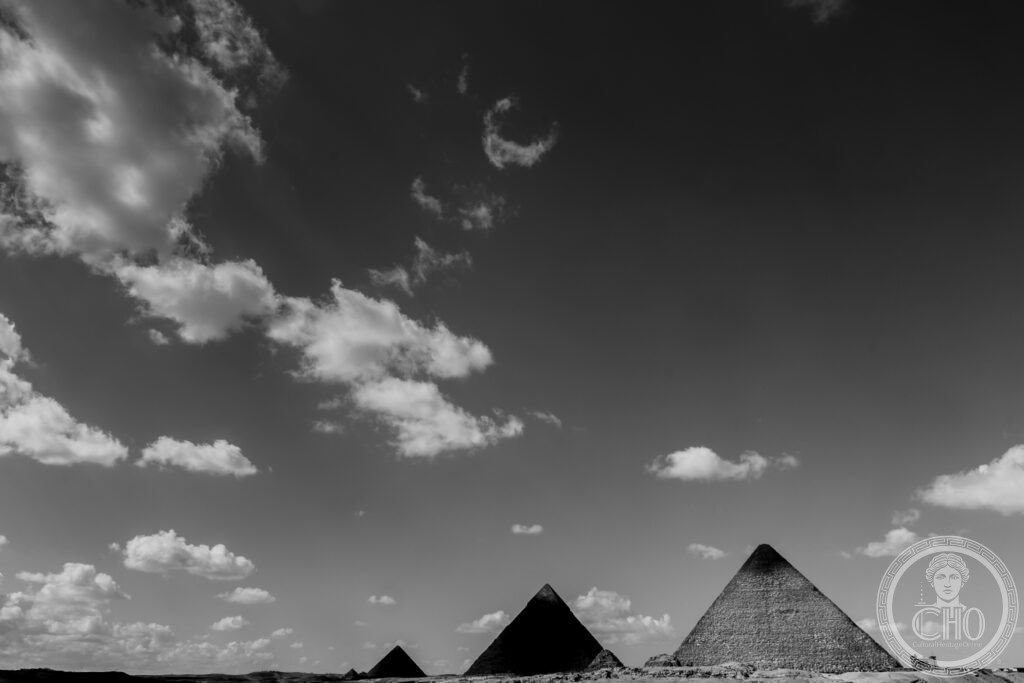
Pyramids of Giza
The Great Pyramid of Khufu — the only surviving wonder of the ancient world, built to a precision that modern engineers cannot fully explain, its 2.3 million stone blocks aligned to the cardinal directions with an accuracy of 0.05 degrees, the internal chambers still holding the atmosphere of a sealed tomb after 4,500 years.
At a glance
The Giza pyramid complex stands on the limestone plateau immediately west of Cairo, its three great pyramids and the Sphinx visible from the city skyline. The complex was built during the 4th Dynasty of the Old Kingdom (c. 2613–2494 BC): the Great Pyramid of Khufu (the largest, c. 2560 BC); the Pyramid of Khafre (slightly smaller but appearing taller because of its elevated position and its surviving polished limestone casing at the apex); and the Pyramid of Menkaure (the smallest of the three). The Great Sphinx — a 73-metre-long sculpture of a recumbent lion with a human head, attributed to Khafre — guards the eastern approach to the complex. The entire plateau is a UNESCO World Heritage Site, inscribed in 1979, and one of the most visited sites in Africa and the Middle East.
Key facts
- Great Pyramid of Khufu: built c. 2560 BC under Pharaoh Khufu (Cheops); original height 146.5 metres (now 138.8 m, the top eroded); base 230 × 230 metres; 2.3 million limestone and granite blocks averaging 2.5 tonnes each (some granite blocks in the King’s Chamber weigh 80 tonnes); the world’s tallest man-made structure for 3,800 years (until Lincoln Cathedral, 1311 AD)
- Orientation: the pyramid’s four sides align to the cardinal directions with an error of less than 0.05 degrees; the northern face deviates from true north by 3’ 6″ (3.6 minutes of arc); the mechanism for achieving this precision is debated — solar, stellar, or using the circumpolar stars
- Internal chambers: three: the subterranean chamber (unfinished); the Queen’s Chamber (incorrectly named — it may have held a cult statue); the King’s Chamber (the actual burial chamber, red granite, the sarcophagus still in place)
- Sphinx: 73 metres long, 20 metres tall; carved from the natural limestone bedrock of the plateau; thought to represent Khafre; built c. 2500 BC; originally painted; its nose was damaged before the Napoleonic expedition (historical record confirms damage predates 1798)
- Workers: evidence from the Valley of the Kings and the workers’ village discovered south of the plateau shows that the builders were not slaves but skilled workers who were fed, housed, and given medical care by the Egyptian state
- Heritage: UNESCO World Heritage Site, Memphis and its Necropolis, inscribed 1979
- GPS: 29.9792° N, 31.1342° E
History
The three pyramids were built over approximately 85 years during the reigns of three successive pharaohs: Khufu (r. c. 2589–2566 BC), his son Djedefre (who built his pyramid at Abu Rawash, 8 km north), and his grandson Khafre (r. c. 2558–2532 BC), followed by Menkaure (r. c. 2532–2503 BC). The construction of the Great Pyramid was apparently completed in approximately 20 years; calculations based on the known number of blocks and the workforce size estimated from the workers’ village suggest 20,000–30,000 workers at peak, not the 100,000 claimed by Herodotus.
The ancient Egyptians called the Great Pyramid “Akhet Khufu” (the Horizon of Khufu) — a name that refers to the sun rising and setting between the pyramids when viewed from the Sphinx. The pyramid complex is not merely a tomb but a complete funerary landscape: the valley temple at the base, the causeway running up the plateau, the mortuary temple on the east face, and the queen’s pyramids to the east are all part of an integrated theological programme designed to secure the pharaoh’s eternal life and deification as Osiris.
The pyramid was originally cased in white Tura limestone, polished to a mirror finish; this casing was stripped for building material during the medieval period, particularly after the 1303 earthquake, which loosened much of it. Khafre’s pyramid retains some of the casing at its apex. The Sphinx was buried to its neck in desert sand for most of recorded history; its significance was largely forgotten during the Middle Kingdom and it was excavated by Thutmose IV (c. 1400 BC) after he dreamed that the Sphinx promised him the kingship if he cleared the sand — the Dream Stele between the paws records this story. Modern excavations began with Giovanni Caviglia in 1817; the systematic archaeological work of the Giza Plateau Mapping Project has continued since 1988.
What you see
Photographs of the Giza pyramids always lie about scale. Standing at the base of the Great Pyramid, looking up at the stone blocks (each at roughly waist height, stacked 200+ courses) to the vanishing point at the apex, the sense of scale is overwhelming in a way that photographs with people for reference rarely convey. The stones at the base are not rough — they are precisely fitted; the joints in the original casing (visible in the sections that survive) are so fine that a knife blade cannot be inserted.
The interior of the Great Pyramid is accessible to a limited number of visitors: the ascending passage, which you must crouch to navigate, leads through the Grand Gallery (47 metres long, 8.6 metres high — a corbelled limestone vault of extraordinary precision) to the King’s Chamber. The chamber is completely plain red Aswan granite; the sarcophagus (the only object remaining) is slightly larger than the entrance, which means it was placed in the chamber during construction, not lowered in afterward. The effect of the space — sealed, silent, perfectly proportioned — is unlike anything else in the ancient world. At night, the pyramids are illuminated from below; a sound-and-light show runs from the base of the Sphinx.
Practical information
- Address: Al Haram, Giza, Egypt; the entrance is on the east side of the plateau off Al Haram Street
- Hours: daily 8 am–5 pm (summer to 7 pm)
- Admission: plateau entry EGP 540 (c. USD 11); Great Pyramid interior EGP 600 extra; Khafre pyramid interior EGP 300 extra; Solar Boat Museum EGP 100 extra
- Interior visits: limited daily tickets for the Great Pyramid interior (sold at the kiosk from 8 am, gone by 9 am in high season); book through an authorised tour operator for advance allocation
- Sunrise: the plateau opens at 8 am; the Sphinx is dramatically lit by the rising sun from the east at dawn; arrive at opening and go directly to the Sphinx for the best photographs with no crowds
- Camel and horse rides: offered by operators at the plateau edge; agree on the price in advance and confirm it includes the return journey
Getting there
Cairo International Airport (CAI) to the plateau: 40 minutes by taxi (EGP 150–250 from central Cairo). The Metro does not reach the pyramids; take a taxi or the no. 997 bus from Tahrir Square. The plateau is 12 km south-west of central Cairo. GPS: 29.9792, 31.1342.
Nearby
- Egyptian Museum, Cairo — Tutankhamun’s treasure, mummy rooms, and the Royal Mummy Gallery; the New Grand Egyptian Museum at Giza opened 2023 and holds much of the Tutankhamun collection adjacent to the plateau
- Saqqara — the necropolis of Memphis, 30 km south; the Step Pyramid of Djoser (c. 2670 BC, the world’s oldest large-scale stone structure); multiple mastabas with outstanding painted reliefs; the Serapeum; far less crowded than Giza
- Dahshur — two pyramids of Sneferu (Khufu’s father): the Bent Pyramid (c. 2600 BC, its casing largely intact, giving the best sense of what polished pyramid casing looked like) and the Red Pyramid (the first true smooth-sided pyramid); almost no tourists
- Memphis — the ancient capital at Mit Rahina; the Open Air Museum with the colossal recumbent Ramesses II statue
Sources
- Wikipedia, Giza pyramid complex, accessed June 2026
- UNESCO, Memphis and its Necropolis, WHS reference 86, inscribed 1979
- Mark Lehner, The Complete Pyramids, Thames & Hudson, 1997 — the standard reference
- Giza Plateau Mapping Project (Oriental Institute, University of Chicago): oi.uchicago.edu/research/projects/giza
Find it on the map
See this place and what’s around it →📷 Diventa un fotografo di Cultural Heritage Online
Condividi le tue foto dei luoghi: restano pubblicate con la tua firma come autore. Più vengono viste, più ti fai conoscere — e presto un concorso premierà le foto più apprezzate.
Accedi o registrati gratis per aggiungere una foto