
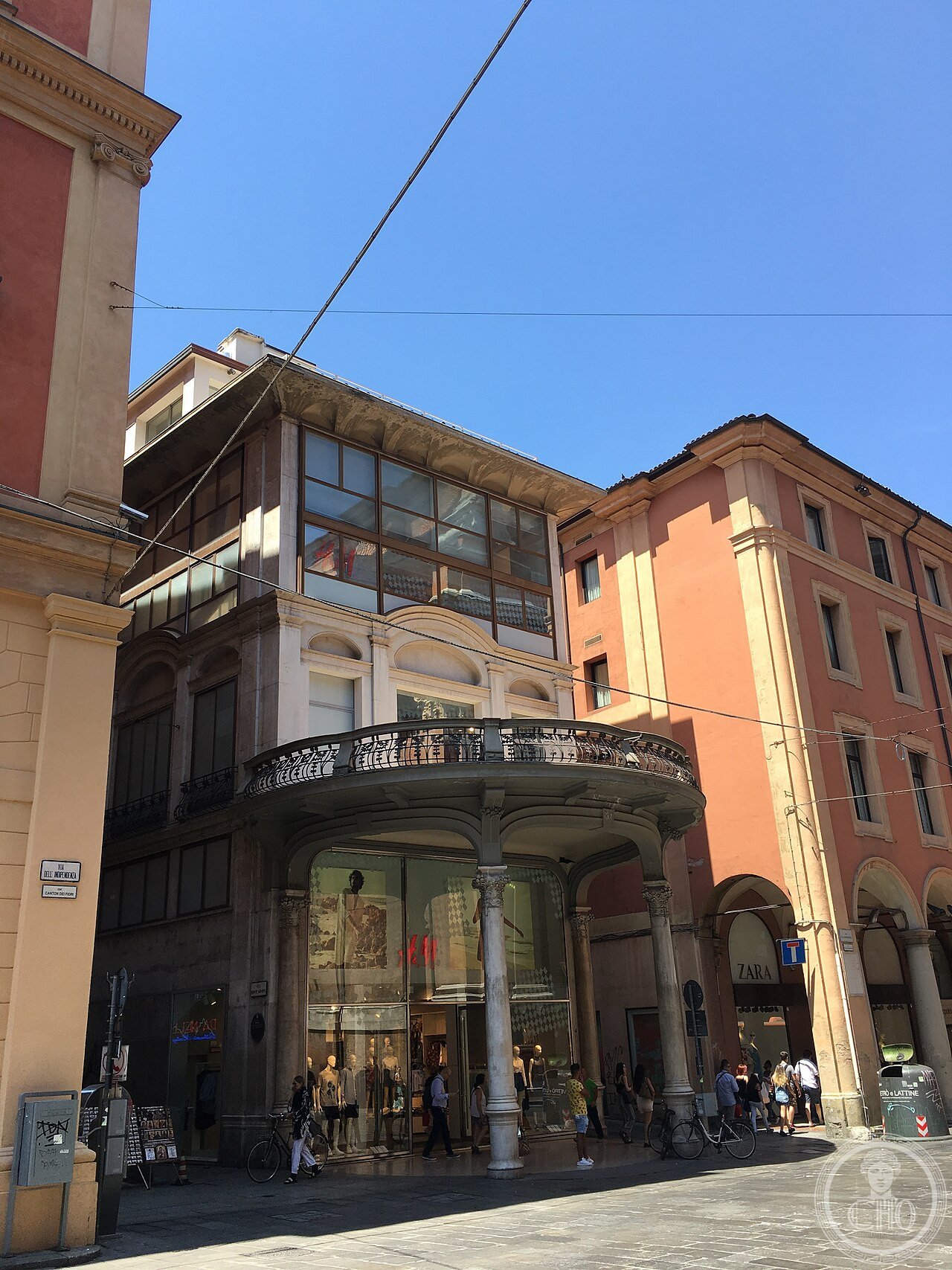

Bologna’s most provocative Liberty building, built for the city’s oldest chocolate company and immediately nicknamed “the Viennese chair” — a sarcastic tribute to its radical break with the medieval porticoes and Baroque cathedral surrounding it.
At a glance
Palazzina Majani stands at Via Indipendenza 4, one of Bologna’s busiest commercial streets, directly across from the Baroque facade of San Pietro Cathedral. Designed by Augusto Sezanne and built between 1904 and 1908 for the Majani chocolate company — founded in Bologna in 1796 — the building provoked immediate controversy for its Liberty ornament among the city’s medieval porticoes. A 1937 Rationalist renovation by Melchiorre Bega altered the upper floors; what survives today is a layering of two different modernisms, Liberty and Rationalist, on a single commercial facade.
Key facts
- Original architect: Augusto Sezanne (1856–1935)
- 1937 renovation: Melchiorre Bega (Rationalist)
- Client: Giuseppe Majani, Majani confectionery (founded 1796)
- Built: 1904–1908 (renovated 1937)
- Address: Via Indipendenza 4, 40121 Bologna
- Style: Liberty (1908); Rationalist overlay (1937)
- Nickname: “La sedia viennese” (the Viennese chair)
- Current use: Commercial retail
- GPS: 44.4955, 11.3427
History
The Majani company, founded in 1796 by Teresa Majani as a confectionery business, had grown by the early twentieth century into one of Bologna’s most prominent commercial establishments. The commission for Via Indipendenza 4 was an act of branding: the client wanted a building as distinctive as the chocolate it sold. Augusto Sezanne, a Bolognese architect trained in the academic tradition but drawn to the formal vocabulary of the Vienna Secession and the French Art Nouveau, delivered exactly that.
The building drew sharp public criticism from the start. Bologna’s streetscape is medieval and Baroque; the Liberty facade stood directly opposite the seventeenth-century San Pietro Cathedral. Critics mocked it as “la sedia viennese” — the Viennese chair — targeting both its foreign stylistic reference and its angular dissonance with the surrounding arcades. The nickname has persisted to the present day.
In 1937, during the Fascist architectural rationalisation that swept many Italian city centres, the architect Melchiorre Bega remodelled the upper floors in the Rationalist style then mandated for commercial modernisation. In 1953 the building passed to a bank; in 2004 H&M converted it to retail use.
What you see
The building as it stands today is a palimpsest of two modernisms. Sezanne’s original Liberty language survives most clearly at the ground-floor level: the curvilinear ironwork, the sinuous linework around the main opening, and the ornamental language of a fin-de-siècle commercial front designed to attract and to display. The upper floors carry the marks of Bega’s 1937 intervention: cleaner planes, horizontal emphasis, the compressed ornamental register of Italian Rationalism.
The original programme included a bar, a tea room, a pastry shop on the lower levels, and a ballroom with a rooftop terrace above — the commercial Liberty building as total social environment, one of the conventions of the genre from Paris to Vienna. That programme is legible in the proportions even after the retail conversions that followed.
Practical information
- Access: Ground floor is commercial retail (H&M), open during shop hours
- Exterior: Fully visible from Via Indipendenza at any time
- Context: Bologna’s porticoes (UNESCO World Heritage Site 2021) begin directly outside
- Time needed: 10 minutes for exterior; plan 30 minutes if exploring the surrounding porticoes
Getting there
From Bologna Centrale station, Via Indipendenza is a 10-minute walk south-west along the main shopping boulevard. Palazzina Majani is at n. 4, near the start of Via Indipendenza where it meets Piazza del Nettuno and the Piazza Maggiore complex. The building is easy to include in any walk through Bologna’s historic centre.
Nearby
- Piazza Maggiore and Piazza del Nettuno — 200 m south, Bologna’s main civic squares
- Cattedrale di San Pietro — directly opposite, seventeenth-century Baroque facade
- Bologna porticoes (UNESCO 2021) — begin at the doorstep and extend 38 km across the city
- Due Torri — 600 m east, Bologna’s medieval landmark towers
Sources
- Wikipedia (Italian): Palazzina Majani
- Wikimedia Commons: File:Palazzina majani bologna.jpg, CC BY-SA 4.0
- Nominatim / OpenStreetMap: GPS 44.4955, 11.3427
Find it on the map
See this place and what’s around it →📷 Become a Cultural Heritage Online photographer
Share your photos of places: they stay published under your name as the author. The more they're seen, the more you get noticed — and soon a contest will reward the most appreciated photos.
Log in or sign up free to add a photoDo you manage this place?
This page is read by travellers and heritage enthusiasts who find it on Google. Keep it accurate — and make it work for you. Free for non-profit heritage institutions.