
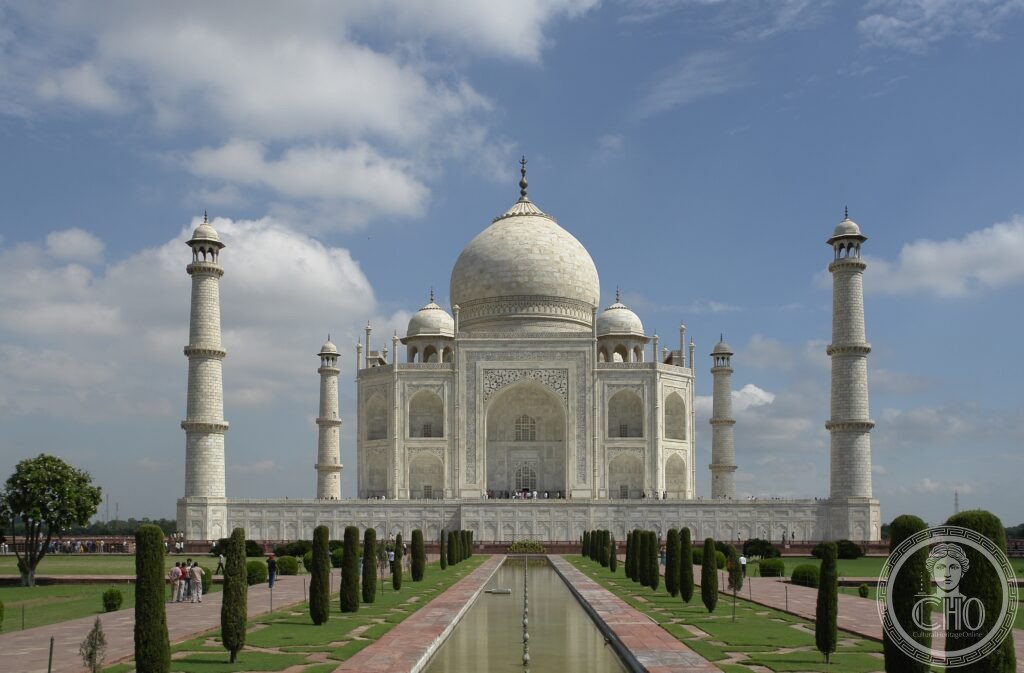
Taj Mahal — Agra
Shah Jahan built the Taj Mahal between 1632 and 1653 as a mausoleum for his wife Mumtaz Mahal — the white Makrana marble changes colour through the day, from pale grey at dawn to warm gold at sunset, and the reflection in the long pool doubles every dimension of the building.
At a glance
The Taj Mahal stands on the south bank of the Yamuna river in Agra, Uttar Pradesh, its white marble dome and four minarets reflected in a 300-metre long water channel. The complex was commissioned by the Mughal emperor Shah Jahan (r. 1628–1658) as a mausoleum for his wife Arjumand Banu Begum, known as Mumtaz Mahal (the Chosen One of the Palace), who died in childbirth in 1631. Construction lasted from 1632 to 1653; the principal architect was Ustad Ahmad Lahauri, assisted by a team of architects from the Mughal court. The main mausoleum is faced in white Makrana marble inlaid with semi-precious stones (pietra dura) in geometric and floral patterns; the calligraphic inscriptions around the portals are the work of the calligrapher Amanat Khan. Approximately 20,000 artisans worked on the project. The Taj Mahal was inscribed as a UNESCO World Heritage Site in 1983 and receives approximately 7–8 million visitors annually.
Key facts
- Architect: Ustad Ahmad Lahauri (principal); calligraphy by Amanat Khan; construction 1632–1653
- Material: white Makrana marble from Rajasthan; pietra dura (inlaid semi-precious stones: carnelian, lapis lazuli, onyx, amethyst); red sandstone for subsidiary buildings and gateway
- Dome: 73 metres to the finial; the inner dome is 24.5 metres high; the outer shell is a double-shell design unique in Mughal architecture
- Minarets: four at the platform corners, each 40 metres tall; deliberately angled slightly outward so that in an earthquake they would fall away from the main tomb
- Gardens: the charbagh (four-quadrant garden divided by water channels) representing Paradise as described in the Quran; the tomb stands at the far end rather than the centre, oriented toward the Yamuna
- Heritage: UNESCO World Heritage Site, inscribed 1983; one of the New Seven Wonders of the World (2007)
- GPS: 27.1751° N, 78.0421° E
History
Shah Jahan’s relationship with Mumtaz Mahal is one of the most celebrated in the history of royal courts. She was his third but most beloved wife, the daughter of his chief minister; they married in 1612, and he is reported to have been in a state of prolonged grief following her death in 1631 during the birth of their fourteenth child. The scale and quality of the mausoleum he built is without parallel in Mughal architecture. Materials were brought from across the empire: marble from Rajasthan, carnelian from Baghdad, lapis lazuli from Afghanistan, crystal from China, jade from Turkestan. The labour force included specialists from Persia, Ottoman Turkey, and Europe as well as local craftsmen.
Shah Jahan was deposed in 1658 by his son Aurangzeb and spent the last years of his life under house arrest in the Red Fort at Agra, said to have been able to see the Taj Mahal through a window. He died in 1666 and was buried beside his wife in the Taj Mahal’s lower chamber. The building suffered damage and neglect during the decline of the Mughal Empire and the British colonial period; Lord Curzon, Viceroy of India from 1899 to 1905, undertook a major restoration. Current threats include air pollution from the city of Agra (the marble surface yellowing) and the gradual drying of the Yamuna river, which is affecting the wooden foundation of the minarets.
What you see
The approach from the southern entrance gate — the Darwaza-i-Rauza (Gateway of the Mausoleum), in red sandstone with white marble inlay — frames the Taj Mahal precisely: the gate’s arch contains the entire composition of dome, minaret, and garden axis. The water channel running from the gate to the tomb reflects the building from the moment of entry. At the far end, the marble platform (plinth) rises 7 metres above the garden level; the tomb stands on a further platform 6 metres above the plinth.
The marble changes colour through the day — a pale grey-blue before sunrise, white and gold in morning light, orange and rose at sunset, white under moonlight. The pietra dura inlay on the exterior is most detailed at the portal niches; the calligraphic panels framing each portal are composed in a perspectival illusion designed to appear the same size at ground level whether read from near or far. Inside, the cenotaphs of Mumtaz Mahal and Shah Jahan occupy the octagonal chamber beneath the dome; the actual burials are in the lower chamber. The acoustic of the dome — a single note holds for thirty seconds — was an intentional design decision.
Practical information
- Address: Dharmapuri, Forest Colony, Tajganj, Agra 282001, India
- Hours: sunrise to sunset, Saturday to Thursday; closed Friday except for namaz (prayers); open on full moon nights in advance-purchased slots
- Admission: INR 1,100 for foreign visitors (approximately USD 13); includes Agra Fort same-day discount; online booking recommended to avoid queues
- Photography: no photography inside the main mausoleum; permitted throughout the gardens and exterior
- Best light: sunrise is the classic visit — the gates open before dawn and the marble turns gold as the sun rises over the Yamuna. Sunset is the second-best option. Midday heat and crowds are punishing
Getting there
Agra is 230 km south of Delhi; Gatimaan Express from Hazrat Nizamuddin station (Delhi) to Agra Cantonment in 1.5 hours (the fastest train on Indian Railways). Yamuna Expressway by car: 3–4 hours from Delhi. The South Gate entrance (recommended for first visits) is 10 minutes from Agra Cantonment station by auto-rickshaw. Agra’s Kheria Airport has limited flights; most visitors arrive by rail from Delhi. GPS: 27.1751, 78.0421.
Nearby
- Agra Fort — the Mughal fortress 2 km north-west; Shah Jahan was imprisoned here for the last 7 years of his life; red sandstone and marble; UNESCO WHS
- Fatehpur Sikri — Akbar’s ghost capital 37 km west; complete Mughal walled city abandoned due to water shortage; UNESCO WHS
- Tomb of Itmad-ud-Daula — Mughal mausoleum 2 km north; entirely clad in pietra dura inlay and considered the prototype for the Taj Mahal’s decorative programme
- Mehtab Bagh — the garden directly across the Yamuna from the Taj Mahal; the north-facing view of the building at sunset is preferred by photographers
Sources
- Wikipedia, Taj Mahal, accessed June 2026
- Archaeological Survey of India: asi.nic.in
- UNESCO, Taj Mahal, WHS reference 252, inscribed 1983
- Ebba Koch, The Complete Taj Mahal and the Riverfront Gardens of Agra, Thames & Hudson, 2006
Find it on the map
See this place and what’s around it →📷 Diventa un fotografo di Cultural Heritage Online
Condividi le tue foto dei luoghi: restano pubblicate con la tua firma come autore. Più vengono viste, più ti fai conoscere — e presto un concorso premierà le foto più apprezzate.
Accedi o registrati gratis per aggiungere una foto